
Dependent Visa for Children in Japan: Requirements and Process

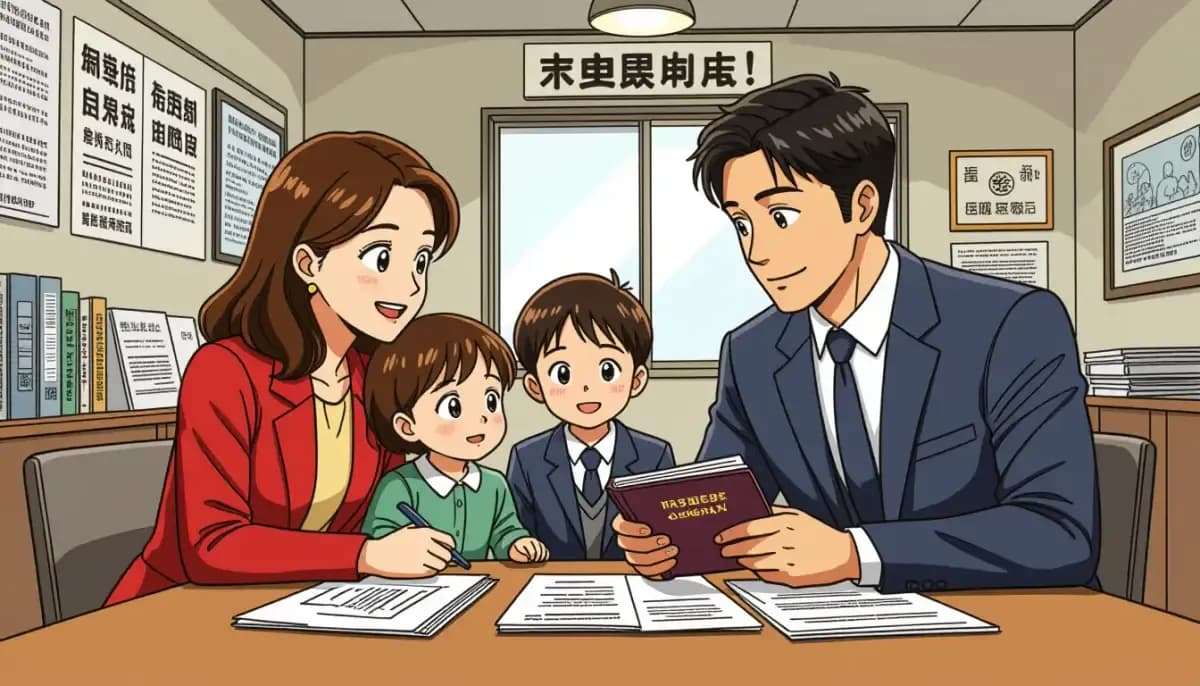
Complete guide to getting a dependent visa for your child in Japan. Learn about eligibility requirements, required documents, the COE process, income thresholds, and step-by-step application timeline.
Dependent Visa for Children in Japan: Requirements and Process
Bringing your child to live with you in Japan as a foreign resident is entirely possible, but navigating Japan's immigration system requires careful preparation. The dependent visa (officially called the "Family Stay" status of residence) allows your child to reside in Japan alongside you while you hold a qualifying work, study, or skilled professional visa. This guide covers everything you need to know about the requirements, documents, and step-by-step process for obtaining a dependent visa for your child in Japan.
Who Qualifies for a Dependent Visa in Japan?
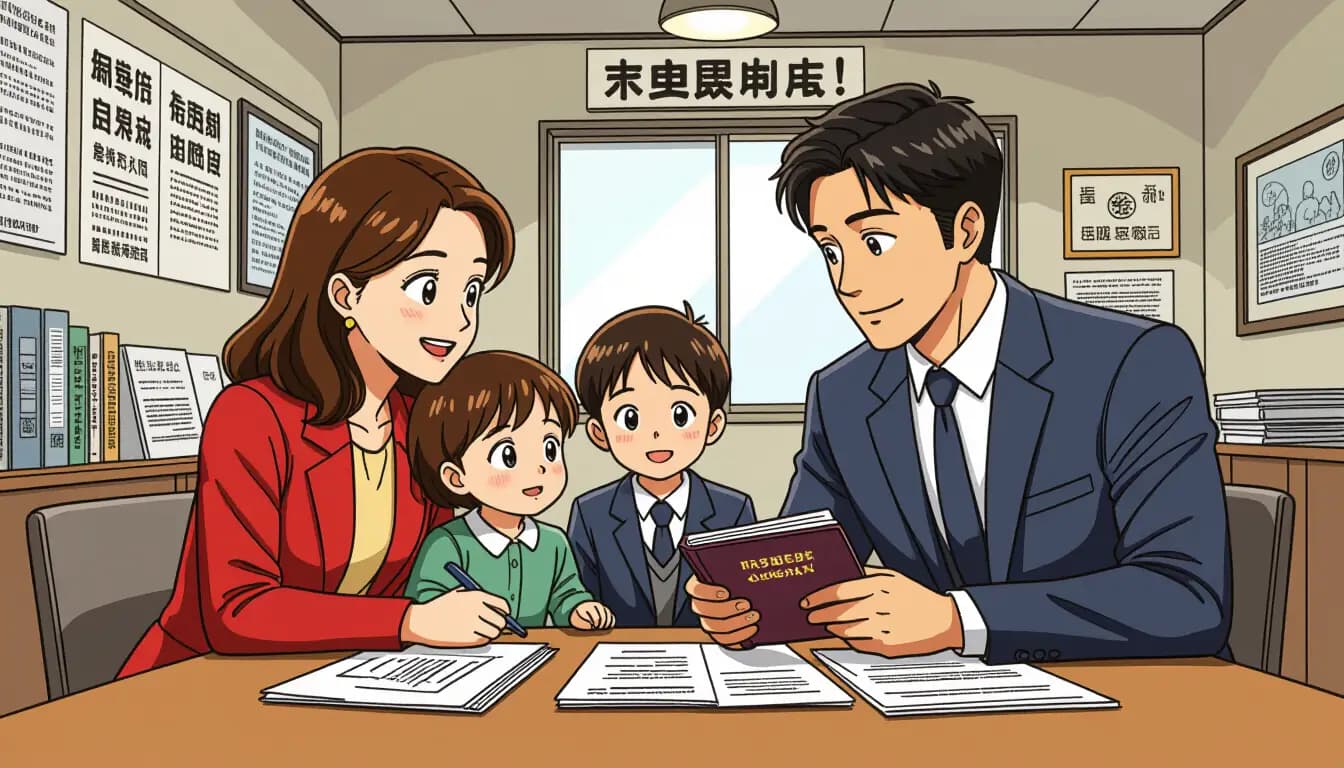
Japan's immigration rules are specific about who counts as a "dependent." Not every family member automatically qualifies.
Eligible Dependents
Under Japan's Immigration Control and Refugee Recognition Act, only the following family members qualify for the Family Stay (dependent) status of residence:
- Legally married spouse
- Minor, unmarried children (biological or legally adopted)
This means that parents, siblings, grandparents, and step-children who have not been formally adopted through Japanese legal procedures are not eligible for the dependent visa. If you have a step-child you wish to bring to Japan, you must first complete a legal adoption process before the child can qualify.
Age Requirements for Children
Children are generally expected to be minors (under 18 years old). However, children over 18 who remain fully financially dependent — for example, full-time university students — may still qualify in some cases. Immigration officers have discretion in evaluating adult dependents, so strong documentation of financial dependency is essential.
For the special Settler/Permanent Resident pathway (where the parent holds permanent residency), minor children must typically enter Japan before their 18th birthday to qualify under that specific route.
Qualifying Sponsor Visa Types
Not every visa type allows you to sponsor a dependent. The principal applicant (parent) must hold one of the following qualifying residence statuses:
| Qualifying Visa Categories | Notes |
|---|---|
| Engineer/Specialist in Humanities/International Services | Common work visa |
| Highly Skilled Professional (HSP) | Points-based system |
| Researcher | Academic/research institutions |
| Professor | University-level teaching |
| Business Manager | Company directors |
| Legal/Accounting Services | Lawyers, accountants |
| Medical Services | Doctors, nurses |
| Instructor | Language schools, public education |
| Student (University/Graduate/Junior College) | Higher education only |
| Intra-company Transferee | Corporate transfers |
| Permanent Resident | Can sponsor children |
| Long-Term Resident | Case-by-case basis |
Important: Parents attending Japanese language schools (語学学校) cannot sponsor dependents. Only higher education institution students (universities, graduate schools, junior colleges) qualify. This catches many families off guard — if you are on a language school student visa and wish to bring your child, you must first upgrade to a higher education enrollment.
For more guidance on navigating visa and legal issues for foreign families with children in Japan, our comprehensive overview covers the broader legal landscape.
Required Documents for the Dependent Visa Application
Preparing a thorough document package is the most critical step. Missing or improperly certified documents are the most common reason applications are delayed or rejected.
Core Required Documents
- Application for Certificate of Eligibility (COE) — Official immigration form (available at Immigration Services Bureau or online)
- Child's birth certificate — Proving the biological or legal relationship between the child and the sponsor
- Sponsor's Residence Card (在留カード) copy — Both front and back
- Sponsor's passport copy
- Proof of income and employment:
- Certificate of employment (在職証明書) from employer - Tax withholding certificate (源泉徴収票) from the previous year - Pay slips from the past 3–6 months - Bank statements showing financial stability
- Proof of stable housing — Rental contract or property ownership documents
- ID photos — Standard 4cm × 3cm or 3cm × 4cm photographs (passport-style)
- Self-addressed return envelope with sufficient postage (for COE mailing)
Document Certification Requirements
All documents issued in a foreign language must be accompanied by a certified Japanese translation. Depending on the issuing country, documents such as birth certificates may also require:
- Apostille certification (for Hague Convention member countries)
- Notarial authentication at the Japanese embassy in the child's home country
- Consular certification for countries not in the Hague Convention
Check with your country's Japanese embassy or consulate for the exact requirements — these vary significantly by nationality.
The Step-by-Step Application Process
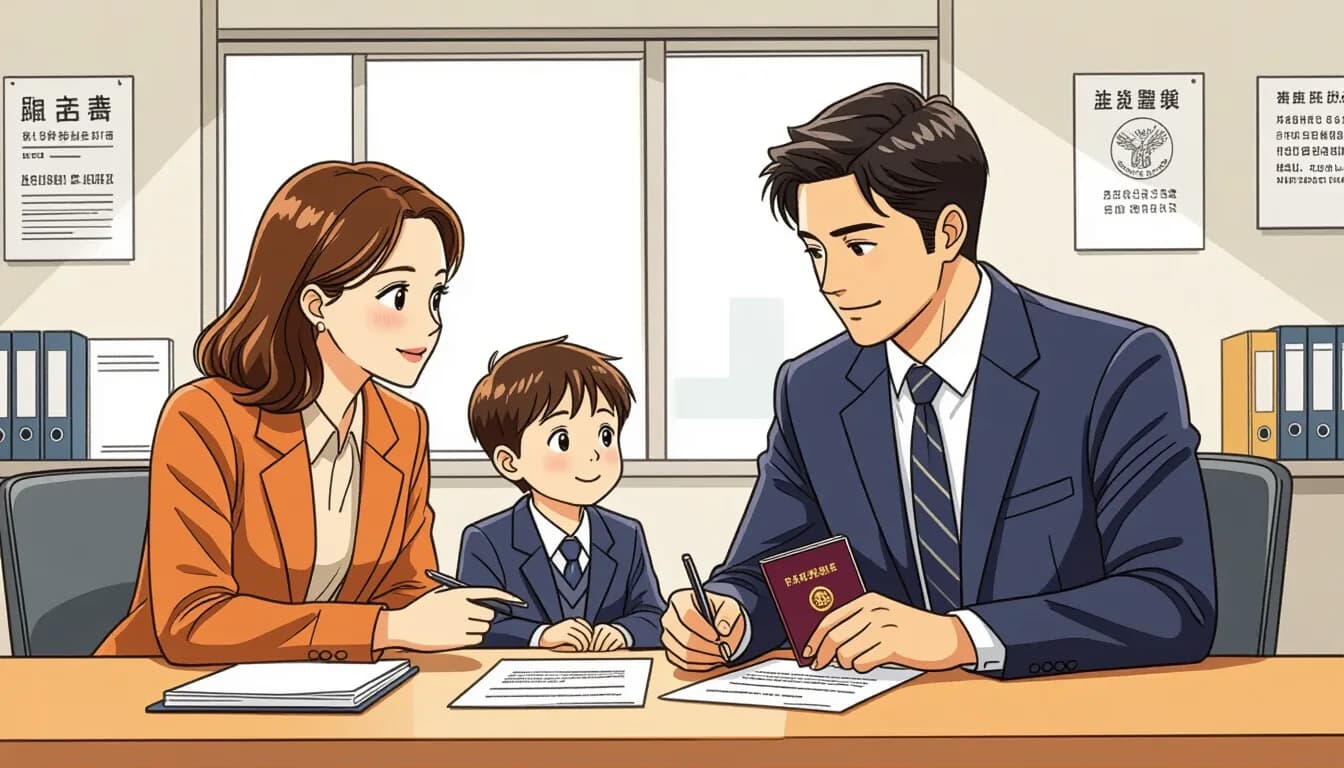
The dependent visa process involves multiple stages across different institutions in Japan and abroad. Here is the complete timeline:
Step 1: Gather All Documents (2–4 weeks)
Begin collecting documents as early as possible. Obtaining certified translations and apostilles from overseas can take several weeks. Contact your home country's relevant authorities well in advance.
Step 2: Apply for a Certificate of Eligibility (COE) in Japan (1–3 months)
The sponsoring parent in Japan submits the COE application to the local Immigration Services Bureau (出入国在留管理局). There is no filing fee for this application.
- Processing time: typically 1–3 months
- The bureau will review the sponsor's income, housing stability, employment status, and the legitimacy of the family relationship
- If approved, the COE (証明書) is mailed to the sponsor's registered address in Japan
Step 3: Send the COE to Your Child Abroad
Once received, mail or courier the COE to your child (or the accompanying parent) abroad. The child must use this document to apply for the dependent visa at a Japanese embassy or consulate in their home country.
Important: The child must enter Japan within 3 months of the COE's issue date. This window does not pause once the COE is issued, so plan travel timing carefully.
Step 4: Apply for the Visa at a Japanese Embassy/Consulate (1–3 weeks)
With the COE in hand, the child applies for the "Family Stay" visa stamp at the nearest Japanese embassy or consulate in their home country. Processing typically takes 1–3 weeks. Required documents at this stage include:
- The original COE
- Valid passport
- Completed visa application form
- Visa fee (amount varies by nationality)
Step 5: Enter Japan and Complete Post-Arrival Registration
After arriving in Japan:
- Register your address at the local city or ward office within 14 days of moving in
- Enroll in National Health Insurance (国民健康保険)
- If the child is school-age, contact the local Board of Education for school enrollment
Immigration officers view evidence of prepared school enrollment and community integration positively, which can benefit future visa renewals.
For more on raising children in Japan's school system, see our guide on elementary school in Japan for foreign parents.
Income Requirements and Financial Proof
Japan's immigration authorities do not publish a single fixed salary threshold for dependent visa approval. Instead, they assess "financial stability" holistically. Here are the practical benchmarks:
| Household Size | Approximate Minimum Annual Income |
|---|---|
| Sponsor + 1 child | ¥3,000,000–¥3,500,000 |
| Sponsor + 2 children | ¥3,500,000–¥4,000,000 |
| Sponsor + spouse + 1 child | ¥4,000,000–¥5,000,000 |
| Sponsor + spouse + 2+ children | ¥5,000,000+ |
These figures are general benchmarks cited by immigration specialists — actual decisions depend on your specific circumstances, region, and the immigration officer's assessment. Steady employment, a stable housing situation, and consistent financial history carry significant weight.
A useful rule of thumb from immigration practitioners: budget approximately ¥800,000–¥1,000,000 per year per additional dependent beyond your own living costs.
For broader financial planning considerations, see financial planning for expat families raising children in Japan.
Dependent Visa Duration and Renewal
The dependent visa is issued for a period that typically mirrors the sponsor's own residence period:
- 6 months, 1 year, 3 years, or 5 years depending on the sponsor's visa duration
- Renewal follows the same COE/application process as the initial grant — submit renewal applications at least 3 months before expiration
- Each renewal requires updated proof of income, employment, and continued family relationship
If the sponsor's visa status changes — for example, if they upgrade to Highly Skilled Professional status or obtain Permanent Residency — the dependent's visa can also be extended accordingly.
Work Restrictions for Dependent Visa Holders
Children on a dependent visa cannot work in Japan by default. However, for older teenagers or young adult children who wish to work part-time while studying, there is a pathway:
Permission to Engage in Other Activity (資格外活動許可)
Dependent visa holders can apply for Permission to Engage in Activity Other Than That Permitted under the Status of Residence at the Immigration Services Bureau. If approved:
- Part-time work is permitted up to 28 hours per week (40 hours/week during school holidays for students)
- This permission is commonly granted for students enrolled in Japanese schools or universities
For full-time employment, the child must apply to change their status of residence to an appropriate work visa category (e.g., Specified Skilled Worker, Engineer/Specialist in Humanities, etc.).
Common Reasons for Rejection and How to Avoid Them
Understanding why applications fail is just as important as knowing the requirements.
| Common Rejection Reason | How to Avoid |
|---|---|
| Insufficient income documentation | Submit 3+ months of pay slips, tax certificate, and bank statements together |
| Sponsor on language school student visa | Upgrade to university/graduate school enrollment first |
| Missing or incorrectly certified foreign documents | Obtain apostille/notarial certification before submitting |
| No proof of stable housing | Provide full rental contract with your name clearly listed |
| Step-child without legal adoption | Complete formal adoption proceedings before applying |
| COE expired before child's arrival | Allow buffer time; plan travel immediately after COE receipt |
| Weak proof of parent-child relationship | Include multiple forms of documentation (birth certificate + family register) |
Resources for Further Research
Getting accurate, up-to-date information is essential for any immigration application. These resources provide detailed guidance:
- How to Apply for a Dependent Visa in Japan: 2025 Guide — Comprehensive step-by-step overview from Coto Academy
- Dependent Visa Japan: Full Process Explained — Detailed breakdown from TranSenz including financial thresholds
- Bringing Family to Japan on a Work Visa — Practical guide for work visa holders
- Living in Nihon — Japan Expat Resources — General expat life in Japan
- For Work in Japan — Employment and Visa Guides — Work visa and employment resources for foreigners
- Chuukou Benkyou — Life in Japan Resources — Resources for foreign families navigating life in Japan
Conclusion
Obtaining a dependent visa for your child in Japan is a manageable process when you understand the requirements and prepare your documents thoroughly. The key steps are: confirming your own visa qualifies for sponsorship, gathering certified documents, applying for the COE at your local Immigration Bureau, and ensuring your child enters Japan within the 3-month validity window.
Start the process early — 3–4 months before your intended arrival date is ideal. Once in Japan, complete all post-arrival registrations promptly, and your child will be settled and ready to begin their life in Japan.
For related information, explore healthcare and medical care for children in Japan and our guide to raising bilingual children in Japan to help your child thrive after arrival.

Originally from Vietnam, living in Japan for 16+ years. Graduated from Nagoya University, with 11 years of professional experience at Japanese and international companies. Sharing practical information for foreign parents raising children in Japan.
View Profile →Related Articles
Name Registration Rules for Mixed-Nationality Children
Complete guide to name registration rules for mixed-nationality children in Japan: birth notification deadline, koseki, dual nationality, residence status, and how to avoid statelessness.
Read more →
Consular Registration for Children Born in Japan
Complete guide for foreign parents on consular registration for children born in Japan. Learn deadlines, required documents, embassy procedures, and how to avoid statelessness.
Read more →
When to Hire an Immigration Lawyer for Family Matters
Learn when foreign families in Japan need an immigration lawyer for spousal visas, family status changes, custody disputes, and more. Includes 2025 fee breakdown and free consultation options.
Read more →
Common Family Visa Complications and Solutions
Struggling with Japan's dependent visa? Learn the most common family visa complications — income issues, document errors, rejection reasons — and practical solutions to resolve them.
Read more →
Residence Card (Zairyu Card) Guide for Children
Everything foreign parents need to know about the Zairyu Card (residence card) for children in Japan: how to get it, validity rules for under-16s, the age-16 renewal, carrying requirements, and what to do when a child is born in Japan.
Read more →
Changing Visa Status When You Have Children
Complete guide to changing visa status for children in Japan: Family Stay visa eligibility, COE process, children born in Japan, 2025 fee updates, and common mistakes to avoid.
Read more →