
Art Education in Japanese Schools: What Children Learn

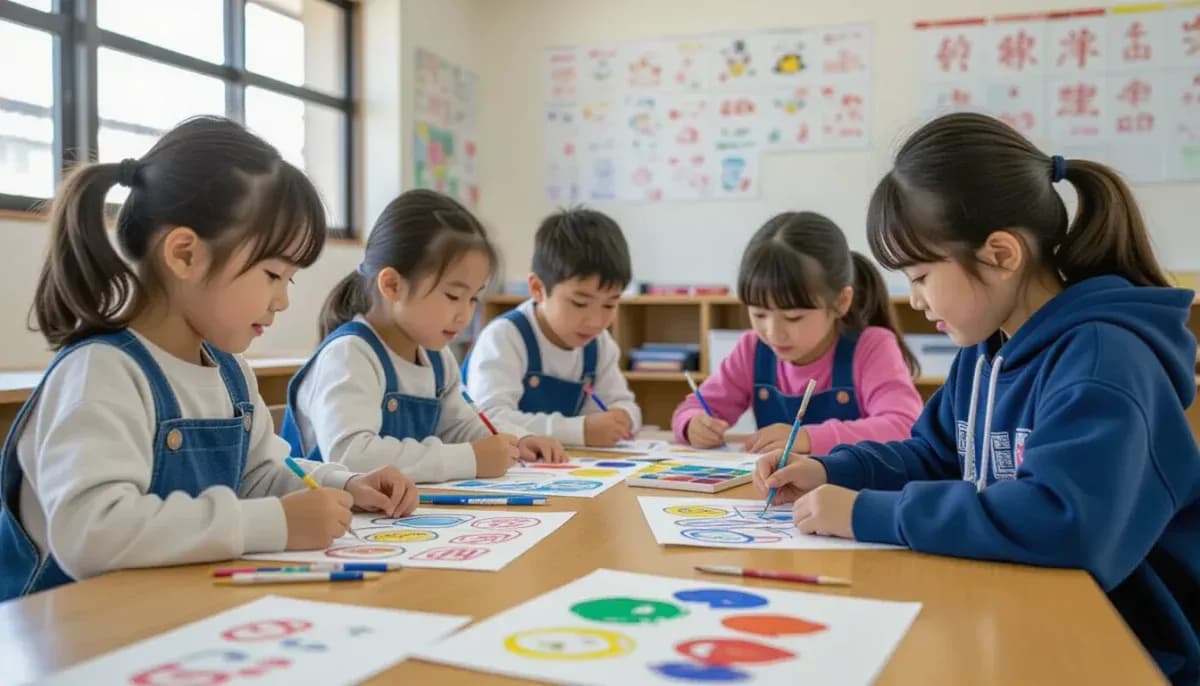
Discover how art education works in Japanese schools, from Drawing and Handicrafts in elementary to Fine Arts in junior high. A guide for foreign parents in Japan.
Art Education in Japanese Schools: What Children Learn
Art education holds a unique and cherished place in Japan's school system. From the first day of elementary school to the final year of junior high, every child in Japan takes art as a compulsory subject. For foreign families raising children in Japan, understanding what art class looks like — what skills are taught, what aesthetic values are emphasized, and how it differs from art education in other countries — can help you support your child's creative development and appreciate one of the most distinctive elements of Japanese schooling.
This guide breaks down the art curriculum at each school level, the Japanese aesthetic principles behind it, and practical tips for foreign parents navigating this creative corner of the Japanese education system.
Why Art Education Matters in Japanese Schools
Japan's commitment to art education is deeply rooted in its postwar educational reforms. The 1947 Fundamental Law of Education established fine arts as a required subject across all nine years of compulsory schooling — a policy that has remained largely intact for nearly eight decades. This is not an accident. Japanese educational policy explicitly states that art education aims to "encourage the development of students' rich sensitivity to have a spiritually wonderful life in the future, which other subjects cannot do."
This philosophy sets Japanese art education apart from purely skills-based or STEM-focused approaches. Art class in Japan is considered a form of emotional and spiritual education, not merely a technical exercise. Children learn to observe, feel, and express — and these experiences are considered as essential to their development as mathematics or reading.
The national curriculum is centrally standardized by Japan's Ministry of Education, Culture, Sports, Science and Technology (MEXT). All textbooks must be evaluated and approved by the government, a system in place since 1886. This means your child's art classes will follow the same curriculum whether you live in Tokyo, Osaka, or a rural town in Hokkaido.
For a broader overview of how Japan's school system works, see our Complete Guide to the Japanese Education System for Foreign Families.
Art at Elementary School (Grades 1–6): Drawing and Handicrafts
At elementary school, art is taught as a subject called Zu-ko (図工), short for Zuga Kōsaku — Drawing and Handicrafts. It is one of nine compulsory subjects and receives notable emphasis alongside music and physical education.
The curriculum is organized into three grade bands:
| Grade Band | Grades | Focus Areas |
|---|---|---|
| Lower | 1–2 | Free expression, exploring materials, basic shapes and colors |
| Middle | 3–4 | 2D and 3D expression, purposeful making, appreciation of art |
| Upper | 5–6 | More refined techniques, design thinking, cultural appreciation |
Within each grade band, students work across three modes:
- Creative activity based on materials — using clay, paper, fabric, and natural objects to make things
- Expressive activity in 2D and 3D — drawing, painting, printmaking, and sculpting
- Productive and purposeful making — creating objects that serve a function, such as handmade boxes, cards, or decorations
Young children typically spend time on free drawing with crayons or watercolors, making animals out of clay, and creating collages. By grades 5 and 6, activities become more complex — students might design and print their own woodblock prints, create self-portraits in multiple media, or build simple structures from cardboard and wire.
Art class also introduces children to art appreciation early. Students look at famous Japanese and international artworks and discuss what they see, feel, and think. This habit of visual observation and reflection is cultivated throughout the elementary years.
If your child is starting elementary school in Japan, our Elementary School in Japan: A Complete Guide for Foreign Parents will walk you through what to expect.
Art at Junior High School (Grades 7–9): Fine Arts
In junior high school, art becomes its own dedicated subject — Bijutsu (美術), or Fine Arts. Students typically have one or two art periods per week, and the curriculum deepens in both technical skill and cultural awareness.
Junior high art covers:
- Drawing and painting — pencil sketching, oil pastel, and watercolor techniques
- Sculpture and 3D design — working with wire, clay, and mixed media
- Design — graphic design principles, poster creation, lettering
- Printmaking — woodblock printing (mokuhanga), a traditional Japanese art form
- Art history and appreciation — studying both Japanese and Western art movements
One notable feature of junior high art is the emphasis on design and applied arts. Students don't just create "fine art" for its own sake — they design posters, logos, book covers, and everyday objects. This reflects Japan's broader cultural integration of design and aesthetics into daily life.
For families with children entering junior high school, see our Junior High School in Japan: Guide for Foreign Families.
Japanese Aesthetic Principles Woven Into Art Education
Perhaps the most distinctive aspect of Japanese art education is the way it embeds traditional aesthetic concepts into children's learning from an early age. Three key principles run through the curriculum:
Wabi (侘) — An appreciation of simple, rustic beauty. Children learn to find beauty in imperfection, in natural materials, in the unfinished or understated. A rough-edged clay bowl can be more beautiful than a perfectly smooth one.
Sabi (寂) — An appreciation of age, weathering, and the passage of time. Children learn to value things that show their history — a worn wooden surface, a faded color, a patina that develops with use.
Suki (数寄) — A subtle elegance found in unconventional or unexpected forms. This concept encourages children to look for beauty in surprising places and to trust their own aesthetic instincts.
These principles are not taught as formal vocabulary in early grades, but they shape how teachers talk about art, how projects are evaluated, and what kinds of work are celebrated. A child who creates a messy, expressive self-portrait might receive just as much praise as one who produces a technically perfect drawing — because expression and feeling are valued alongside skill.
Children also engage directly with traditional Japanese art forms (learn more about teaching children through Japanese art at Stanford FSI): calligraphy (shodo), printmaking (hanga), paper arts (origami and chigiri-e), kimono pattern design, and collage using Japanese washi paper.
How Foreign Children Experience Art Class
For foreign children in Japanese public schools, art class is often one of the more accessible and enjoyable subjects — especially in the early stages when Japanese language skills are still developing. The hands-on, visual nature of art means that language barriers matter less than in subjects like Japanese, social studies, or science.
That said, there are a few things foreign parents should know:
Materials fees: Art materials are typically not free. At the beginning of each school year, families pay a small fee for art supplies — paints, sketchbooks, clay, and so on. These are usually included in the general kyoikuhi (educational expenses) collected by the school.
Art festivals and displays: Schools regularly display students' artwork in the hallways and classrooms. Twice a year at many schools, there are art exhibitions (sakuhinten) where the whole school's work is displayed for parents to view. These are wonderful opportunities to see your child's progress and understand what the curriculum looks like in practice.
Art homework: Children sometimes bring art projects home to finish, especially in upper elementary grades. Unlike in some Western schools, art homework is taken seriously — students are expected to put genuine effort into finishing pieces at home.
Grading: Art is graded in Japanese schools, typically using a three-point scale in elementary school and a five-point scale in junior high. Grades are based on effort, expression, and engagement as much as technical skill.
For more on how Japanese school life works for foreign families, Living in Nihon offers practical guides for expats navigating daily life in Japan.
After-School Art Activities and Juku
Outside of regular school hours, many Japanese families enroll their children in art classes (kaiga kyoshitsu) at community centers, private art schools, or dedicated juku (cram schools focused on creative arts). According to a 2019 survey by an educational research institute, approximately 80% of Japanese elementary school children participate in some form of out-of-school activity, and painting and drawing classes are among the most popular.
These extracurricular art classes typically offer:
- More time for individual projects than school allows
- Instruction in specific techniques (watercolor, oil painting, sketching)
- Preparation for entrance exams at art-focused high schools
- A social environment for children who love creating
For families interested in exploring extracurricular options, For Work in Japan has resources for expat families on activities and enrichment programs.
If your child shows a strong interest in art, Japan also has a well-developed network of art-focused junior high and high schools (bijutsu-ka), where students spend more time on art than at general schools. Getting into these schools typically requires a portfolio review and sometimes a written exam.
Art Education and High School
Art remains a core subject in Japanese high schools, though it becomes somewhat more elective in structure. Students typically choose one arts elective from among fine arts (bijutsu), music (ongaku), and craft (kogei). Many students who discovered a love for art in elementary or junior high school continue to develop their skills through high school and beyond.
Japan's higher education system includes a strong tradition of fine arts universities and art programs. The country has 25+ university-level art programs, and the first private art university Master's Degree Program was officially approved in 1964. For students hoping to study art professionally, the path typically involves specialized high school preparation and a competitive portfolio-based entrance process.
For more on navigating high school in Japan as a foreign family, see our High School in Japan: Options and Guidance for Foreign Families.
Supporting Your Child's Artistic Development in Japan
Here are practical tips for foreign parents who want to support their child's art education in Japan:
- Visit the sakuhinten (art exhibition): These school-wide art displays are usually held in autumn. Attending shows your child you value their creative work and helps you understand the curriculum.
- Stock the home with basic supplies: Watercolors, colored pencils, sketchbooks, and origami paper are inexpensive and widely available at Japanese 100-yen stores and stationery shops. Having them at home encourages continued creativity.
- Explore Japanese art with your child: Visit local museums, especially those with collections of Japanese art and crafts. Many cities have municipal art museums that are free or very low-cost for children.
- Don't over-direct: Japanese art education values free expression and individual creativity. Resist the urge to correct your child's technique at home — let them explore and make mistakes.
- Consider an extracurricular art class: If your child shows enthusiasm, a community art class can deepen their skills and connect them with Japanese peers who share their interest.
For guidance on raising bilingual and bicultural children in Japan, see our article on Raising Bilingual Children in Japan: Strategies and Best Practices.
You can also find more resources on school life for foreign families at Chuukou Benkyou, which covers education topics for families in Japan.
Key Takeaways
Art education in Japanese schools is compulsory, nationally standardized, and philosophically rich. Children learn not just techniques but ways of seeing, feeling, and appreciating beauty — rooted in distinctly Japanese aesthetic traditions. For foreign families, art class is often a bridge into Japanese culture, a place where language barriers matter less and creativity speaks for itself.
Whether your child is just starting elementary school or preparing for junior high, understanding the role of art in Japanese education will help you appreciate one of the most human and culturally distinctive aspects of raising a child in Japan.

Originally from Vietnam, living in Japan for 16+ years. Graduated from Nagoya University, with 11 years of professional experience at Japanese and international companies. Sharing practical information for foreign parents raising children in Japan.
View Profile →Related Articles
Cultural Arts Festivals and Children's Participation
Complete guide to cultural arts festivals and children participation in Japan for expat families. Covers bunkasai, Shichi-Go-San, Kodomo no Hi, matsuri traditions, and how foreign children can participate fully.
Read more →
How to Support Your Creative Child in Japan
Discover how to nurture your creative child in Japan through traditional crafts, naraigoto lessons, bilingual expression, and smart use of Japan's generous family support programs. A complete guide for foreign parents.
Read more →
Art Competitions and Exhibitions for Children in Japan
Complete guide to art competitions and exhibitions for children in Japan. Discover Pentel ICAE, JQA Environmental Drawing Contest, top museums, and tips for expat families supporting young artists.
Read more →
Digital Art and Animation Classes for Kids in Japan
A complete guide for expat families: find English-friendly digital art and animation classes for kids in Japan, from iPad studios to bilingual workshops in Tokyo and beyond.
Read more →
Community Art Programs and Workshops for Kids
Discover community art programs and workshops for kids in Japan. Find English-friendly studios, costs, and tips for expat families to enroll children in art classes.
Read more →
Best Museums and Art Galleries for Children in Japan
Discover the best museums and art galleries for children in Japan — from Tokyo's Ghibli Museum and teamLab to Railway Museum and Kids Plaza Osaka. Practical tips, admission prices, and age-by-age recommendations for foreign families.
Read more →