
Eye Care and Vision Screening for Children in Japan

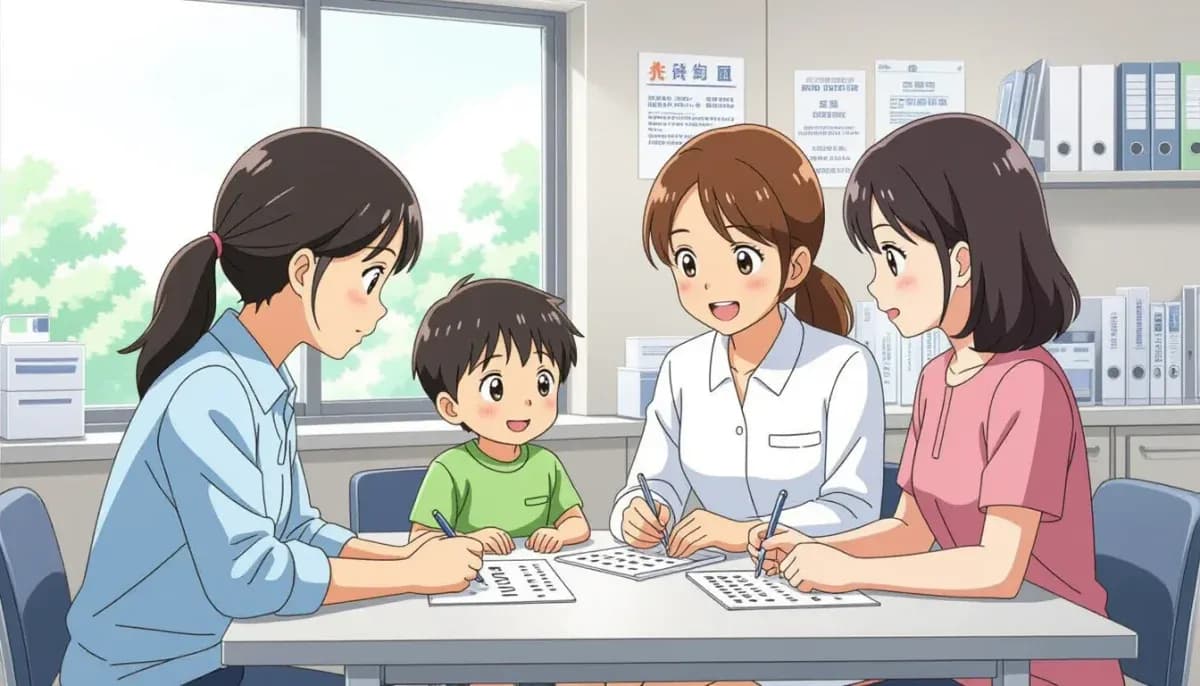
Complete guide to children's eye care in Japan: mandatory school vision screenings, ganka clinics, myopia statistics, insurance coverage, and tips for expat families navigating Japan's eye health system.
Eye Care and Vision Screening for Children in Japan
If you're raising a child in Japan, understanding the country's eye care system is essential — especially given that Japan has one of the highest rates of childhood myopia in the world. From mandatory school vision screenings to finding an English-speaking ophthalmologist, this guide covers everything foreign parents need to know about children's eye care in Japan.
Why Eye Health Matters So Much in Japan
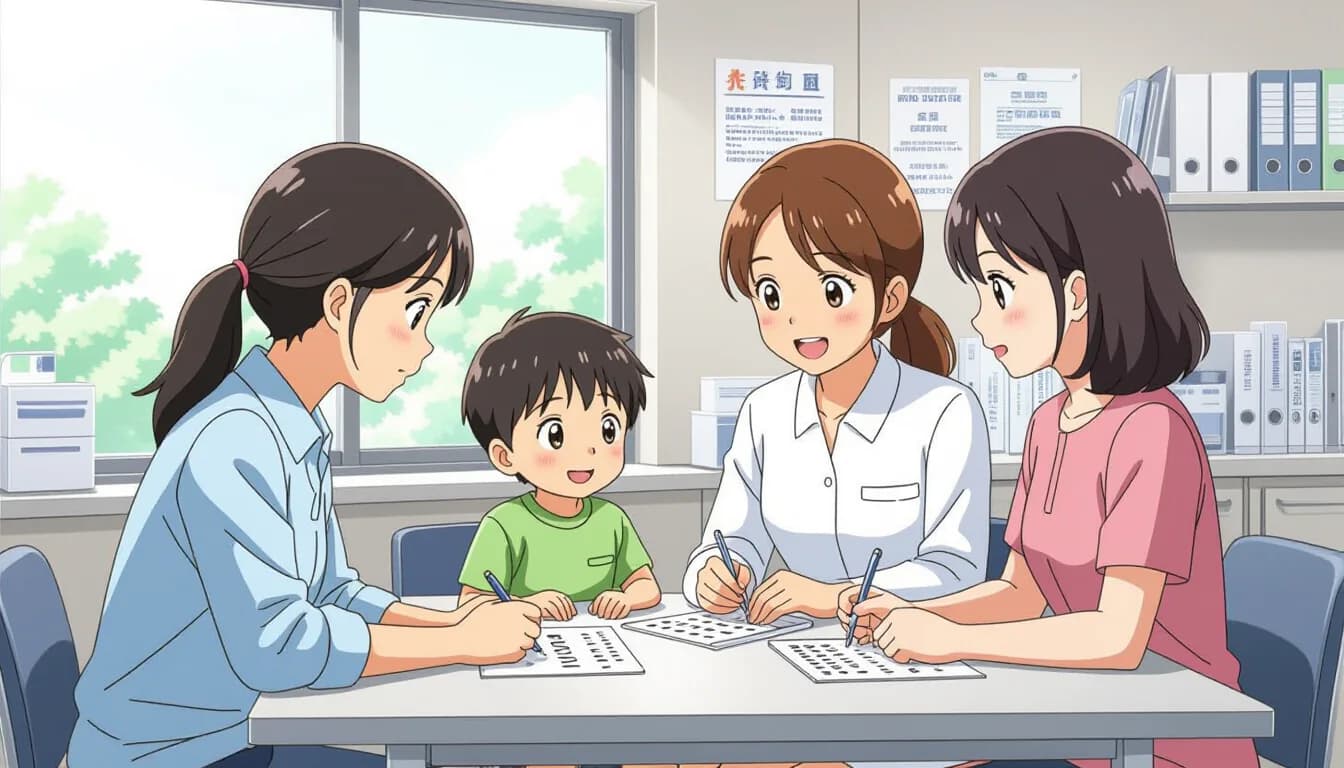
Japan is facing a childhood myopia epidemic. Studies show that myopia prevalence among children has skyrocketed over the past few decades:
- In 1999, about 10% of 6-year-olds were myopic; by 2017, that figure had jumped to 63%
- Among 12-year-olds, prevalence went from 60% in 1999 to over 95% in 2017
- The peak age for myopia onset is around age 8, with the sharpest increase between ages 6–9
- Even preschool children are affected: about 2.9% of Japanese preschoolers are already myopic
This rapid rise is attributed to increased screen time, less outdoor activity, and intense academic pressure. For foreign families in Japan, staying on top of your child's vision health from an early age is more important than ever.
For a broader perspective on healthcare for children in Japan, see our guide to Healthcare and Medical Care for Children in Japan.
Mandatory Vision Screening in Japan
One of the most reassuring aspects of Japan's system is that vision screening is mandatory and built into the public health and education infrastructure. Here's when your child will be screened:
3-Year-Old Health Checkup (Sansai Kenshin)
Under Japan's Maternal and Child Health Act, all children must undergo an ophthalmological health checkup at age 3. This is typically organized by your local municipal office and covers vision, hearing, teeth, and general development. Parents receive a notification by mail. For foreign families, it's worth calling your local ward or city office to confirm the appointment and ask about interpreter availability.
School Vision Screenings (Ages 6–15)
Under the School Health and Safety Act, all elementary and junior high school students (ages 6–14) must have annual vision checks. These are conducted at school — you don't need to schedule anything separately. Results are sent home on a report card-style form.
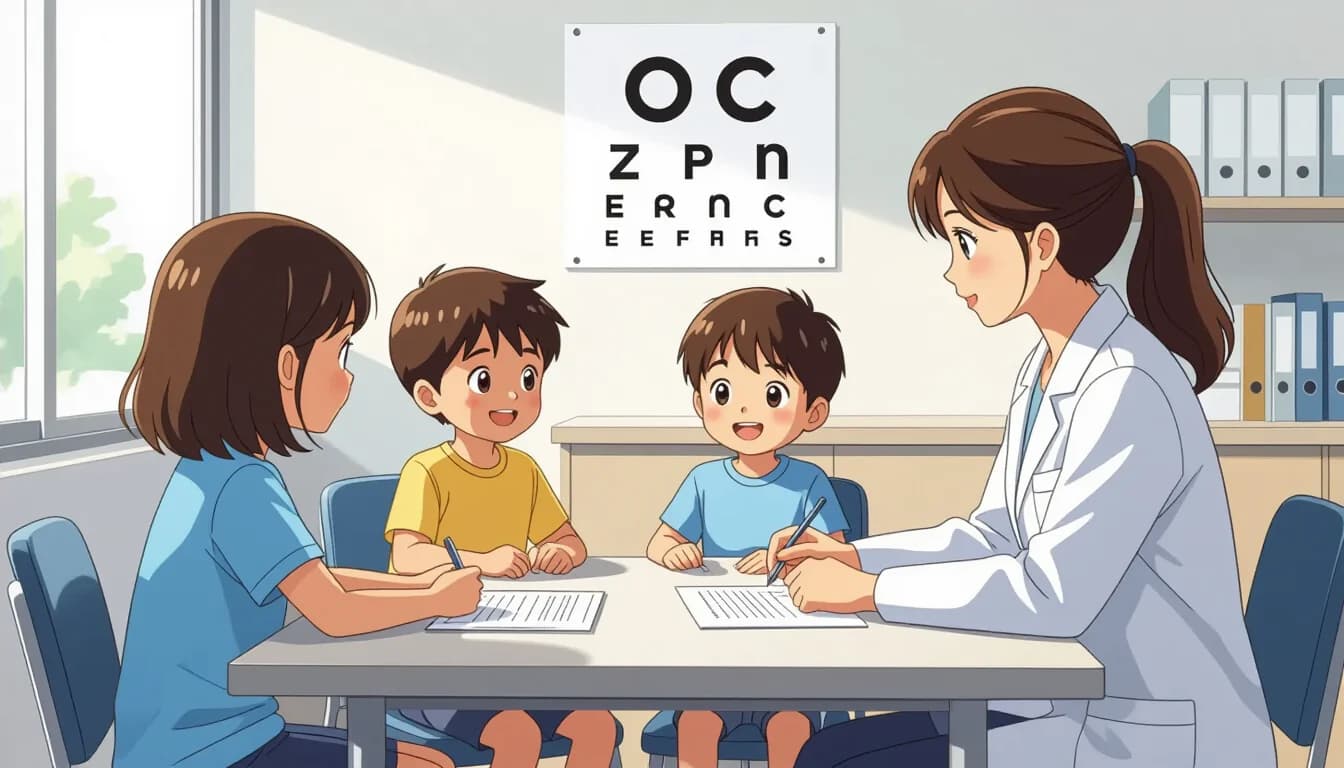
Japan uses the Landolt C chart for vision testing — a circle with a gap that can face in four directions (up, down, left, right). Children are asked to indicate the direction of the opening. This method is excellent for young children and non-native speakers because it doesn't require reading letters. Results are reported on a four-level scale:
| Grade | Visual Acuity | Meaning |
|---|---|---|
| A | 1.0 or better | No concern |
| B | 0.7 – 0.9 | May need monitoring |
| C | 0.3 – 0.6 | Recommended to see a doctor |
| D | Below 0.3 | See a doctor promptly |
If your child receives a B, C, or D grade, the school will send home a recommendation to visit an ophthalmology clinic (眼科, ganka). Don't ignore this — Japan's system is designed to catch problems early.
For more on navigating Japan's school system as a foreign parent, visit our guide on Elementary School in Japan: A Complete Guide for Foreign Parents.
Understanding the Two Types of Eye Care in Japan
Japan has a clear division between routine vision correction and medical eye care:
Optical Shops (眼鏡店, Megane-ten) — For Glasses
For routine glasses or contacts for simple nearsightedness or astigmatism, most families visit an optical shop. Major chains include:
- JINS — Known for affordable pricing and fast service
- Zoff — Similar to JINS, with stylish frames
- OWNDAYS — Transparent all-inclusive pricing
- Megane Ichiba — Wide selection with competitive pricing
These shops provide free vision tests and often offer same-day glasses for single-vision lenses. Prices start from around ¥6,600 for a complete pair. Note that special coatings (anti-glare, blue-light blocking) or high-index lenses may increase cost and wait time.
Ophthalmology Clinics (眼科, Ganka) — For Medical Issues
If your child has any of the following, visit a ganka clinic:
- Eye redness, discharge, or pain
- Suspected amblyopia (lazy eye) or strabismus (crossed eyes)
- Received a C or D grade on school screening
- Needs a prescription for contact lenses
- Shows signs of vision deterioration
Ganka clinics are staffed by ophthalmologists (doctors specializing in eye disease) and optometrists. They can diagnose and treat conditions, prescribe medications, and provide medical referrals.
For comprehensive information on raising children in Japan, check out this resource from Living in Nihon.
Insurance Coverage for Children's Eye Care
Understanding what's covered is crucial for foreign families:
What Public Health Insurance Covers
Japan's National Health Insurance (NHI) and employer health insurance cover medical eye care:
- Clinic consultation fees (copay: typically 20–30% for adults; often less for children)
- Diagnostic tests (visual acuity, eye pressure, retinal scans)
- Prescription medications (eye drops, etc.)
- Treatment for amblyopia, strabismus, and other medical conditions
- Therapeutic eyewear for conditions like amblyopia (with restrictions)
What Is NOT Covered
- Ordinary glasses for simple nearsightedness or astigmatism
- Standard contact lenses for refractive correction
- Routine eye tests at optical shops
Free Healthcare for Children (Jidou Iryohi Josei)
Here's great news for expat families: almost every local government in Japan offers a Medical Subsidy for Children (児童医療費助成, jidou iryohi josei). This program covers the copayment costs that health insurance doesn't pay. In many areas, children up to age 18 receive effectively free medical care, including eye clinic visits.
To enroll, visit your local municipal office after registering your child. You'll receive a subsidy card to use at clinics. For more on accessing these subsidies, see our guide to Government Benefits and Subsidies for Families in Japan.
Common Eye Conditions in Children to Watch For
Myopia (近視, Kinshi)
Nearsightedness is by far the most common issue. Signs include squinting, sitting close to the TV, difficulty seeing the classroom board, or complaining of headaches after reading. Japan has excellent myopia management options, including orthokeratology (overnight contact lenses that reshape the cornea) for older children.
Amblyopia (弱視, Jakushi — Lazy Eye)
If one eye doesn't develop proper vision during early childhood, the brain begins to suppress input from that eye. Amblyopia is most treatable before age 7–8. Japan's 3-year health check is specifically designed to catch this early. Treatment often involves patching the stronger eye to force the weaker one to work.
Strabismus (斜視, Shashi — Crossed or Misaligned Eyes)
If you notice your child's eyes aren't aligned, visit a ganka clinic promptly. Strabismus can lead to amblyopia if untreated. Treatment may include glasses, patching, vision therapy, or surgery.
Digital Eye Strain
With increased screen time from school tablets (Japan's GIGA School Program distributes devices to all students), digital eye strain is increasingly common. Symptoms include headaches, tired eyes, and blurred vision. The 20-20-20 rule (every 20 minutes, look at something 20 feet away for 20 seconds) is recommended.
Finding an English-Speaking Eye Doctor in Japan
Finding a ganka clinic with English support can be challenging outside major cities. Here are some strategies:
- Search international clinic directories — Sites like Japan Dev's guide to English-speaking eye doctors in Tokyo maintain updated listings
- Ask at your hospital's international clinic — Many major hospitals have international patient departments that can refer you
- Use Google Maps — Search "眼科 英語対応" (ophthalmology English support) in your area
- Contact your employer's HR — International companies often have lists of English-friendly clinics
- National Center for Child Health and Development — The NCCHD in Tokyo has a Division of Ophthalmology staffed by pediatric ophthalmology specialists
For work-life balance advice and family resources in Japan, For Work in Japan is a useful resource for expat families navigating daily life.
Tips for Expat Parents: Practical Advice
At the 3-Year Health Check:
- Bring your mother-child health booklet (boshi techo)
- Call ahead to request an interpreter or ask a Japanese-speaking friend to accompany you
- Practice with your child at home: use a printed Landolt C chart and practice saying "up," "down," "left," "right"
When Receiving School Screening Results:
- "A" = pass; "B/C/D" = follow-up needed
- Even a "B" result warrants a ganka visit if your child is complaining of vision issues
- Ask the school nurse (yogo kyoshi) for a referral letter (uketsuke-hyo) to bring to the clinic
Buying Glasses for Your Child:
- Children's frames at JINS and Zoff start around ¥8,000–¥12,000 for a complete pair
- Look for frames labeled 子供用 (kodomo-yo, children's use) — these are more durable
- Anti-scratch and anti-UV coatings are worth adding for active kids
- If your child is being treated for amblyopia, their therapeutic glasses may be partially covered by insurance
Managing Myopia Progression:
- Encourage at least 90 minutes of outdoor time per day — research shows outdoor activity reduces myopia onset
- Limit near-work sessions and enforce regular breaks
- Ask your ganka doctor about myopia control options (atropine eye drops, orthokeratology)
For additional support on raising children in Japan's school environment, see our guide on Junior High School in Japan: Guide for Foreign Families.
Summary: Eye Care Checklist for Foreign Families in Japan
| Action | When | Where |
|---|---|---|
| 3-year-old eye check | Age 3 | Local municipal health center |
| Annual school screening | Ages 6–14 | At school (no scheduling needed) |
| Follow-up clinic visit | If B/C/D grade received | Ganka (ophthalmology clinic) |
| Routine glasses | Any age | Optical shop (JINS, Zoff, OWNDAYS) |
| Amblyopia/strabismus treatment | As early as possible | Ganka clinic |
| Register for children's medical subsidy | After birth registration | Municipal office |
Japan's eye care system for children is thorough and largely free for foreign families who register for local subsidies. The mandatory screenings at ages 3 and throughout school years mean that most problems are caught early. As a parent, your job is to follow up on screening results, register for the children's medical subsidy, and watch for signs of vision changes between check-ups.
For more on navigating Japan's healthcare system as a foreign parent, read our comprehensive guides on Healthcare and Medical Care for Children in Japan and Baby and Infant Care in Japan.
For more resources on vision care in Japan, the Japan Handbook's guide to vision care and Life Abroad's eye care guide provide detailed practical information. The site Chuukou Benkyou also covers educational health topics relevant to children growing up in Japan.

Originally from Vietnam, living in Japan for 16+ years. Graduated from Nagoya University, with 11 years of professional experience at Japanese and international companies. Sharing practical information for foreign parents raising children in Japan.
View Profile →Related Articles
Children's Health Checkup Timeline in Japan
Complete guide to Japan's children's health checkup timeline for foreign parents. Learn about free municipal checkups, vaccination schedules, costs, and tips for expats navigating the Japanese healthcare system.
Read more →
When Your Child Is Hospitalized in Japan
Navigate your child's hospitalization in Japan with confidence. Learn about admission procedures, costs, insurance coverage, what to bring, communicating with staff, and discharge in Japan's pediatric system.
Read more →
Understanding Medical Forms and Documents at Japanese Schools
A complete guide to understanding medical forms and health documents at Japanese schools for foreign families, including school health checkups, vaccination records, allergy forms, and enrollment documents.
Read more →
Traditional Japanese Remedies and Home Treatments for Kids
Discover traditional Japanese home remedies for children: okayu, hachimitsu daikon, shoga-yu, umeboshi, and Kampo medicine. Practical guide for foreign parents in Japan.
Read more →
Mental Health Services for Children in Japan
Navigate mental health services for children in Japan as a foreign parent. Find English-speaking therapists, understand insurance coverage, and access crisis resources for your child.
Read more →
Managing Food Allergies in Children in Japan
Complete guide to managing food allergies in children in Japan. Learn about Japan's allergen labeling system, allergy-safe restaurants, school lunch accommodations, medical care, and emergency phrases for foreign parents.
Read more →