
Understanding Japanese Report Cards and Academic Evaluation

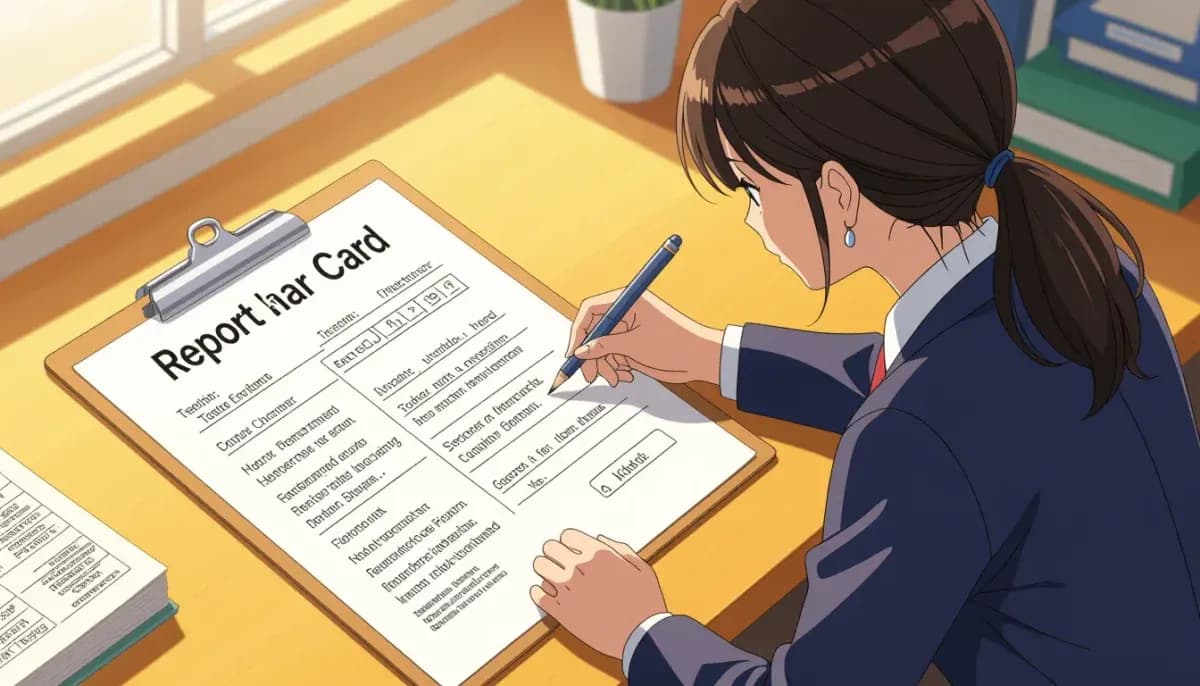
Understand Japanese report cards (tsushinbo), grading scales, evaluation criteria, and naishoten scores. A complete guide for foreign parents navigating academic assessment in Japanese schools.
Understanding Japanese Report Cards and Academic Evaluation
If your child attends a Japanese school, one of the most confusing documents you will encounter is the tsushinbo (通知表) — the Japanese report card. Unlike the letter-grade systems common in Western countries, Japanese report cards evaluate students on a combination of academic performance, behavior, effort, and attitude. This guide breaks down exactly how the Japanese academic evaluation system works at every school level, so you can understand your child's progress and support their learning journey.
What Is a Tsushinbo? The Japanese Report Card Explained
The tsushinbo (通知表), sometimes called tsuchinbo or ayumi (あゆみ) at the elementary level, is the official report card issued by Japanese schools. It is distributed to students at the end of each academic term — typically three times per year in April–July, September–December, and January–March.
Unlike many Western report cards that focus almost exclusively on academic grades, the tsushinbo provides a holistic picture of a student's school life. It includes sections on academic subjects, behavior, attendance, extracurricular activities, and teacher comments. For foreign parents, the biggest surprise is often how much weight is placed on effort and attitude rather than raw test scores.
Report cards are physically handed to students to bring home. Parents are expected to review them, stamp or sign them with their hanko (seal), and return them to the school. This process reflects the collaborative relationship between parents and teachers in the Japanese education system. For more about how the broader school system works, see our complete guide to Japanese education.
How Grading Works at Each School Level
The Japanese grading system changes significantly as students advance through school. Here is a breakdown of how evaluation works at each level.
Elementary School (Grades 1–6)
Elementary schools in Japan do not use numerical grades in the traditional sense, especially in the lower grades (1st and 2nd year). Instead, teachers use descriptive evaluations:
| Japanese Term | Reading | English Meaning | Equivalent |
|---|---|---|---|
| たいへんよい | Taihen yoi | Very good | Excellent |
| よい | Yoi | Good | Satisfactory |
| もうすこし | Mō sukoshi | A little more effort needed | Needs improvement |
From 3rd grade onward, some schools begin using a three-tier system (◎, ○, △) or transition to more detailed subject-by-subject evaluations. The emphasis remains on effort, participation, and attitude rather than ranking students against each other.
For a detailed look at what to expect at the elementary level, check our elementary school guide for foreign parents.
Junior High School (Grades 7–9)
Junior high school introduces the 5-point grading scale that becomes critically important for high school entrance exams:
| Grade | Japanese | Meaning |
|---|---|---|
| 5 | 5 (最高) | Outstanding achievement |
| 4 | 4 (良好) | Good achievement |
| 3 | 3 (普通) | Average/Standard |
| 2 | 2 (努力を要する) | Below average, needs effort |
| 1 | 1 (一層努力を要する) | Significantly below standard |
These grades are recorded for each subject and directly contribute to the naishoten (内申点) — the internal assessment score used in high school entrance exams. This makes junior high report cards extremely consequential, as detailed by Chuukou Benkyou, a resource dedicated to junior high and high school exam preparation.
High School (Grades 10–12)
High schools continue using the 5-point scale, but evaluation becomes more exam-oriented. Midterm and final exams typically account for 40–60% of the overall grade, supplemented by daily performance, homework submission, and class participation. Unlike compulsory education, students in high school can actually fail courses and may need to repeat a year.
The Three Pillars of Evaluation: What Teachers Actually Assess
Since Japan's 2020 curriculum reform (led by MEXT, the Ministry of Education), all schools use a standardized framework of three evaluation criteria for each subject:
1. Knowledge and Skills (知識・技能)
This measures whether students have acquired the fundamental knowledge and skills outlined in the curriculum. It is assessed through tests, quizzes, and practical exercises.
2. Thinking, Judgment, and Expression (思考・判断・表現)
This evaluates whether students can apply their knowledge to solve problems, think critically, and express their ideas effectively. Teachers assess this through essays, presentations, group discussions, and project work.
3. Attitude Toward Learning (主体的に学習に取り組む態度)
This is often the most surprising category for foreign parents. It measures a student's proactiveness, effort, and engagement in learning. Teachers observe whether students:
- Actively participate in class discussions
- Complete homework consistently
- Show curiosity and ask questions
- Help classmates and contribute to group work
- Take responsibility for their learning materials
This criterion means that a student who scores perfectly on tests but shows poor effort or attitude may receive a lower overall grade than a student with moderate test scores but excellent participation. Understanding this mindset is crucial for foreign families navigating the system — Living in Nihon's education guide offers additional context on cultural expectations in Japanese schools.
Understanding Naishoten: Why Report Card Grades Matter for Entrance Exams
The naishoten (内申点), also called naishinsho (内申書), is an internal assessment score compiled from report card grades during junior high school. It plays a major role in high school admissions across Japan.
| Component | Weight (Typical) | Details |
|---|---|---|
| Naishoten (report card grades) | 30–50% | Varies by prefecture and school |
| Entrance exam score | 50–70% | Written tests in core subjects |
| Interview/essays | 0–10% | Some schools require these |
The calculation method varies by prefecture. In Tokyo, for example, the naishoten is calculated using grades from 3rd year of junior high only, while some prefectures include grades from 2nd and 3rd year. Some prefectures also weight certain subjects (like music, art, PE, and technical studies) more heavily in the naishoten calculation.
This system means that consistent daily effort throughout junior high school is just as important as performing well on the entrance exam day. For families planning ahead, our junior high school guide covers strategies for maximizing naishoten.
What Foreign Parents Need to Know About Japanese Report Cards
Language Barrier
Report cards are written entirely in Japanese. If you cannot read Japanese, ask your child's teacher for an explanation during the sansha mendan (三者面談) — the parent-teacher-student conference held each term. Some schools with significant foreign student populations may provide translated versions or have multilingual support staff.
No Grade Retention in Compulsory Education
One major difference from many Western systems is that Japanese students in elementary and junior high school automatically advance to the next grade regardless of their academic performance. Even if a child receives the lowest marks, they will not be held back. This policy exists because Japan's compulsory education system prioritizes social development alongside academic growth.
Grade Placement for Newcomers
Foreign children enrolling in Japanese public schools may request to be placed in a lower grade if they face language difficulties, as noted by Plaza Homes' education guide. Children born between April 2nd and April 1st of the following year are placed in the same grade cohort.
Behavior Counts — A Lot
Japanese report cards evaluate behavior and social skills in ways that may seem unusual to foreign parents. Students may be assessed on how they greet teachers and classmates, whether they bring all required supplies to school, how they care for classroom plants and animals, and how they clean their classroom during souji (cleaning time). These behavioral evaluations reflect Japan's educational philosophy that school is about developing the whole person, not just academic knowledge.
For families exploring different schooling options, our international schools guide compares Japanese and international evaluation approaches.
How to Read and Respond to Your Child's Report Card
Here are practical steps for making the most of your child's tsushinbo:
Step 1: Review Each Subject Section Look at both the grade/evaluation mark and the specific criteria (knowledge, thinking, attitude). A low mark in "attitude" might mean your child needs to participate more actively, not that they lack ability.
Step 2: Read Teacher Comments The shoken (所見) section contains the teacher's written observations about your child. These comments highlight strengths and areas for growth. If you cannot read Japanese, use a translation app or ask a bilingual friend to help.
Step 3: Check Attendance Records The report card includes attendance data showing days present, absent, and tardy. Consistent attendance is valued in Japanese schools and affects the overall evaluation.
Step 4: Sign/Stamp and Return Use your hanko or signature to acknowledge you have reviewed the report card, then have your child return it to school promptly.
Step 5: Discuss with Your Child Use the report card as a conversation starter. Focus on effort and growth rather than comparing grades, which aligns with the Japanese educational philosophy.
For comprehensive support on navigating family life in Japan as a foreigner, For Work in Japan's family guide covers education alongside other essential topics. You can also explore resources on Japan's education statistics and assessment systems for deeper context.
National Assessments: The Bigger Picture
Beyond individual school report cards, Japan conducts the National Assessment of Academic Ability (全国学力・学習状況調査) annually. This nationwide test is administered to all students in 6th grade (elementary) and 3rd year of junior high (9th grade) in subjects including Japanese, mathematics, science, and English.
These assessments serve as a benchmark for educational quality across prefectures rather than affecting individual student grades. Results are shared with schools and local education boards to identify areas needing improvement. In recent years, average scores have ranged from approximately 53% to 68% across subjects, reflecting the challenging nature of these standardized tests.
The data from these national assessments helps parents understand how their child's school and prefecture compare to national standards, though individual scores are not publicly shared. For families raising bilingual children, understanding both the Japanese and home-country evaluation systems is important — our guide on raising bilingual children in Japan addresses these dual-system challenges.
Key Differences: Japanese vs. Western Report Cards
| Feature | Japan | US/UK/Australia |
|---|---|---|
| Grading scale | 3-tier (elementary) / 5-point (secondary) | Letter grades (A-F) or percentages |
| Behavior assessment | Major component of grade | Usually separate from academics |
| Grade retention | No retention in compulsory education | Common if standards not met |
| Report frequency | 3 times per year (per term) | 2–4 times per year |
| Teacher comments | Detailed written observations | Varies by school |
| Impact on admissions | Directly affects high school entry | Varies by country |
| Focus | Effort and growth | Achievement and mastery |
| Parent response | Must sign/stamp and return | Usually keep at home |
Understanding these differences helps foreign parents set appropriate expectations and support their children effectively within the Japanese system. For additional guidance on adapting to school life, see Global From Asia's guide on school options for international families in Japan.

Originally from Vietnam, living in Japan for 16+ years. Graduated from Nagoya University, with 11 years of professional experience at Japanese and international companies. Sharing practical information for foreign parents raising children in Japan.
View Profile →Related Articles
Recent Japanese Education Reforms That Affect Foreign Children
Comprehensive guide to recent Japanese education reforms that affect foreign children, including free high school tuition, GIGA School program, JSL support expansion, and special exam pathways for expat families.
Read more →
How to Transfer Schools in Japan as a Foreign Family
Complete guide to transferring schools in Japan for foreign families. Learn the required documents, step-by-step process, best timing, and tips for a smooth school transition in Japan.
Read more →
School Fees and Education Costs in Japan Breakdown
Complete breakdown of education costs in Japan for foreign families. Compare public, private, and international school fees from kindergarten through high school with real cost data.
Read more →
Homework and Study Habits in Japan: What to Expect
A complete guide to homework and study habits in Japanese schools for foreign families. Learn about daily homework amounts, summer assignments, juku cram schools, and tips for supporting your child.
Read more →
Japanese Classroom Culture and Etiquette Your Child Should Know
A complete guide to Japanese classroom culture and etiquette for foreign families. Learn about bowing rituals, school cleaning duties, lunch customs, dress codes, and how to prepare your child for school in Japan.
Read more →
Essential School Supplies for Japanese Schools: Complete Checklist
Complete checklist of school supplies needed for Japanese schools, from randoseru backpacks to uwabaki shoes. Costs, where to buy, and tips for foreign parents in Japan.
Read more →