
Managing Toddler Tantrums in Japanese Public Spaces

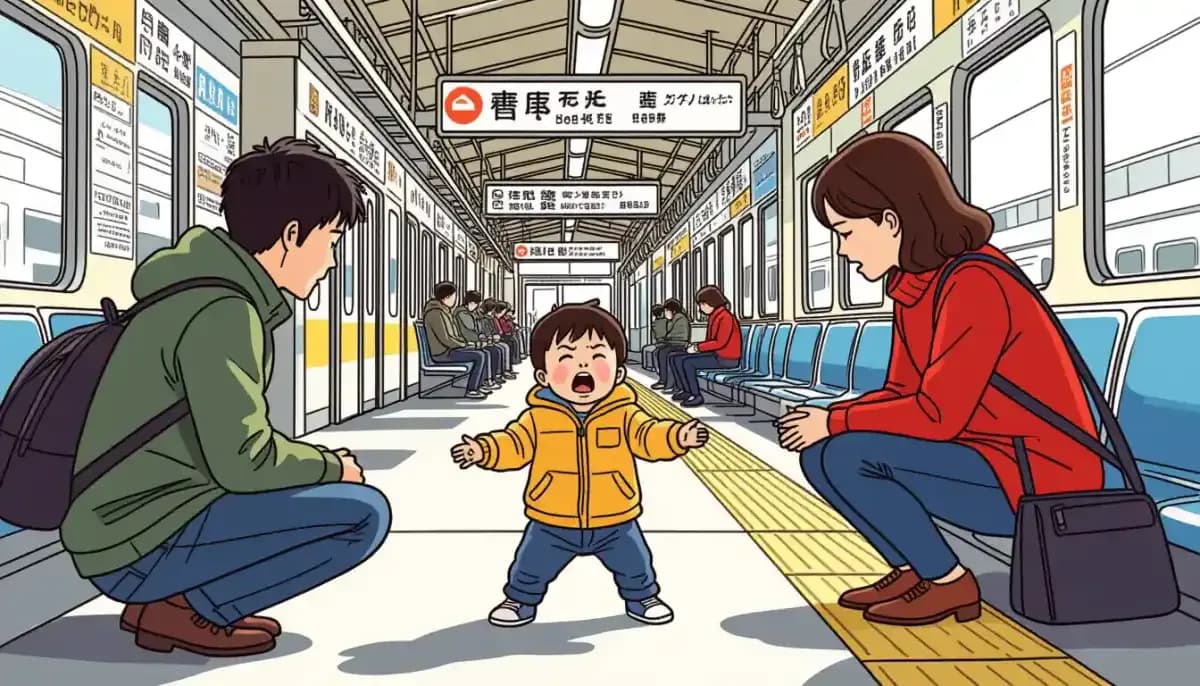
A practical guide for foreign parents on managing toddler tantrums in Japanese trains, restaurants, and public spaces. Learn cultural norms, prevention strategies, and key Japanese phrases to handle meltdowns with confidence.
Managing Toddler Tantrums in Japanese Public Spaces: A Practical Guide for Foreign Parents
Your toddler is melting down in the middle of a Tokyo train station. The floor is immaculate, the crowd is orderly, and every head within earshot has turned your way. As a foreign parent raising children in Japan, moments like this can feel mortifying — but they don't have to be. Understanding Japanese cultural norms around child behavior and equipping yourself with practical strategies can turn these stressful moments into manageable ones.
Japan is one of the most family-friendly countries in the world, yet it also has high expectations around public behavior and harmony. Navigating this balance as a foreign parent takes some cultural knowledge, preparation, and a generous dose of self-compassion. This guide walks you through everything you need to know about managing toddler tantrums in Japanese public spaces — from cultural context to practical on-the-ground tactics.
Understanding Japanese Cultural Attitudes Toward Toddler Tantrums
Before diving into strategies, it helps to understand how Japanese society views childhood behavior. Japan's approach to parenting is rooted in shitsuke (しつけ) — a concept that translates roughly as discipline or upbringing, but is better understood as modeling appropriate behavior over time. Rather than punishing misbehavior on the spot, Japanese parents focus on consistent routine, social modeling, and quiet correction away from public view.
Interestingly, Japanese parents have a name for the toddler tantrum phase: ma no nisai (魔の2歳児), literally "the devilish two-year-old." Yes, even in Japan, terrible twos are a recognized developmental reality. Japanese parents are not oblivious to meltdowns — they simply handle them with a culturally specific approach.
When a child throws a tantrum on a train, a Japanese parent might calmly step off at the next station, have a quiet word with the child on the platform, and reboard. The misbehavior is addressed privately, protecting both the child's dignity and the parent's composure. This "remove and address" method is widely practiced, and you will often see parents crouched beside their children at park edges or behind pillars at stations, having calm, low-voiced conversations after an incident.
As a foreign parent, you are not expected to master this approach overnight. But understanding it helps you recognize that Japan's tolerance for toddler behavior is more nuanced than it might first appear. For more context on raising children in Japan as a foreigner, Living in Nihon has an excellent overview of the Japanese education and parenting landscape.
The Reality: Are Japanese Public Spaces Actually Hostile to Children?
A common misconception among newly arrived expat families is that Japan is unfriendly to children in public. The truth is far more reassuring. Japan is extraordinarily welcoming to families — children are treated with warmth and curiosity by strangers, train station staff, and shop assistants alike.
What Japan does value highly is communal harmony (wa, 和). This means that noise, disruption, or behavior that inconveniences others in a shared space is something people are sensitive to — not because children are unwelcome, but because consideration for others is a deeply held value. The distinction is important: it is not your child who is the problem, it is unmanaged disruption that draws attention.
Japan's collectivist culture means that visible effort matters enormously. The act of being seen to try — to calm your child, to apologize sincerely, to remove your toddler from a difficult situation — communicates that you respect community values. You do not need to succeed perfectly. You just need to show you care.
Most Japanese people are genuinely forgiving and kind toward foreign parents who are clearly making an effort. They understand that children are children. And if someone does react negatively, it is almost certainly the exception, not the rule.
To understand more about the broader context of family life in Japan as an expat, For Work in Japan's family life guide offers useful additional context.
Practical Strategies for Tantrum Prevention in Public
The best tantrum is the one that never happens. Japanese parents are skilled planners, and many of their approaches to public outings are built around preemptive management rather than reactive damage control.
Timing Is Everything
One of the most powerful tools at your disposal is scheduling. Avoid peak times whenever possible:
- Lunch: Aim to eat at 11:00 am, before the crowds arrive
- Dinner: Head out at 5:00 pm, before the post-work rush
- Train travel: Avoid rush hours (7–9 am and 5–8 pm) with toddlers whenever possible
Hungry, tired, or overstimulated toddlers are tantrum waiting to happen. Planning around your child's meal and nap schedule rather than convenience is one of the highest-leverage habits you can develop.
Pack the Right Bag
A well-packed bag is your first line of defense. Experienced expat parents in Japan swear by:
| Item | Why It Helps |
|---|---|
| Stickers and coloring books | Quiet, absorbing activity for restaurants |
| Tablet or phone with headphones | Essential — always use headphones in public |
| Lollipops or soft snacks | Quiet snacking; avoid crunchy foods on trains |
| A small toy or figurine | Familiar comfort object for stressful moments |
| Japanese phrase cards or notes | For apologizing or explaining your child's age |
| Change of clothes | Japan's toddlers spill things too |
The headphones point cannot be overstated. Allowing a device to blare audio in a quiet Japanese train or restaurant is considered quite rude. Always bring headphones designed for toddlers.
Pre-Brief Your Toddler
Even very young children respond to clear expectations set before you enter a public space. Use a consistent metaphor: many parents tell their children that trains are like libraries — a quiet place where everyone uses their inside voices. Repeat this every time before boarding.
Japanese kindergartens use this approach extensively — consistent verbal cues before transitions help children regulate their behavior over time. You can borrow this technique even with toddlers as young as two.
Managing Tantrums When They Happen
Despite your best planning, meltdowns happen. Here is how to handle them with grace in a Japanese public context.
Step 1: Remove and Regulate
Follow the Japanese approach: remove first, address second. If you are on a train, step off at the next station if possible, or move to the space between carriages. If you are in a restaurant, take your child to the entrance area or outside. If you are in a shop, step outdoors.
Do not try to talk your child through a full meltdown in the middle of a public space. Your first job is to reduce the noise impact on others, and your second is to help your toddler regulate. These two goals are much easier to accomplish in a quieter, less stimulating environment.
Step 2: Stay Calm and Low-Energy
This is easier said than done, but your toddler takes enormous cues from your energy. In the context of Japan's quiet public culture, a panicked or loud parental response compounds the problem. Crouch to your child's level, use a low and steady voice, and wait out the storm patiently.
Step 3: Use Simple Japanese Phrases
A few well-timed Japanese words go a long way in Japan. These phrases signal to those around you that you are aware of the situation and taking responsibility:
- Gomennasai (ごめんなさい) — "I'm sorry"
- Mada [age] sai desu (まだ[年齢]歳です) — "They're only [age] years old"
- Kosodate wa taihen desu ne (子育ては大変ですね) — "Raising kids is tough, isn't it?"
The last phrase is particularly powerful. It acknowledges shared human experience and often elicits sympathy and even smiles from nearby Japanese adults — many of whom have been through the exact same thing.
Step 4: Return When Ready
Once your child has calmed, return to the activity calmly and without dwelling on the incident. This mirrors the Japanese approach: address, resolve, move on. Avoid excessive apology loops or making the incident a bigger event than it needs to be.
For more guidance on raising multilingual and bicultural children in Japan's social context, see our guide on raising bilingual children in Japan.
Specific Venues: Train-Specific Tips
Trains are the most common source of anxiety for foreign parents with toddlers in Japan, and for good reason. Japanese train culture has specific norms that differ from many other countries.
Before boarding:
- Remove your toddler's shoes if they are likely to stand on the seat — this is standard Japanese practice and prevents dirt transfer
- Board the women-only carriage if available and applicable — these are sometimes quieter and less crowded
- Avoid rush hour entirely with strollers when possible; many stations have limited elevator access and packed cars pose safety risks
On the train:
- Discourage swinging on handrails — this is considered very disrespectful in Japan
- Keep bag on lap, not on adjacent seat, to free space
- For longer shinkansen (bullet train) journeys, bento boxes are perfectly normal to eat; this is not the case on local city trains
If a tantrum starts:
- Move toward the carriage doors or the space between cars to reduce noise impact
- For short routes, this may simply be a matter of riding it out while doing your best
- For longer journeys, a backup plan (snack, device, song) is essential
Restaurant Strategies: Eating Out Without Incident
Dining out with toddlers in Japan is very achievable with the right approach. Japan has a strong family restaurant culture, and many establishments are explicitly designed to welcome young children.
Choose the right restaurant. Family restaurants (ファミレス, famiresu) like Gusto, Royal Host, Denny's Japan, and Saizeriya are perfect for families with toddlers. They have children's menus, booster seats, and a relaxed atmosphere where small amounts of noise are entirely expected. High-end or small intimate restaurants are best avoided until your children are older.
Arrive early. Arriving right when a restaurant opens for lunch or dinner means faster service (less waiting = less fussing), more space, and usually a warmer welcome from staff who are not yet in the weeds of a busy rush.
Request a private area. Many Japanese restaurants have semi-private rooms (座敷, zashiki) with tatami mats. These rooms are often preferred by families precisely because they offer more privacy and lower stakes for noise. Do not hesitate to ask — it is a completely normal request.
Bring your entertainment kit. Even in a family restaurant, stickers, coloring books, and a quiet tablet activity can bridge the gap between ordering and food arriving — the highest-risk window for toddler restlessness.
For more context on navigating Japanese social environments with children, the resource at Chuukou Benkyou provides useful guides on daily life in Japan.
When to Seek Extra Support
Managing toddler tantrums in any cultural context is exhausting, and doing so as a foreign parent in an unfamiliar cultural environment adds an extra layer of pressure. If you find that public outings are consistently overwhelming, consider:
- Connecting with expat parent communities. Groups like those found on Facebook (e.g., "Foreign Moms in Japan," "Expat Parents Tokyo") provide peer support, venue recommendations, and practical advice from parents in the same situation.
- Consulting your child's hoikuen or yochien. Japanese childcare educators are experienced with toddler behavior and can often offer insights into strategies they use in group settings. Even with a language barrier, showing willingness to collaborate is appreciated.
- Speaking to your pediatrician. Japan's child healthcare system is excellent. If your toddler's tantrums seem severe or unusually frequent, a Japanese pediatrician (小児科, shōnika) can offer guidance tailored to your child's development. See our guide on healthcare for children in Japan for more.
For background on the full toddler parenting experience in Japan as a foreign family, our article on toddler parenting in Japan ages 1 to 3 covers the broader landscape.
Key Cultural Reminders for Foreign Parents
Managing tantrums in Japan is as much about cultural awareness as it is about child behavior strategy. A few final reminders:
| Principle | What It Means in Practice |
|---|---|
| Visible effort matters | Being seen to try earns goodwill, even if you don't succeed |
| Private correction is preferred | Address behavior away from the public gaze when possible |
| Community harmony (wa) is valued | Noise and disruption affect shared spaces — minimize where you can |
| Kindness to children is universal | Japanese people genuinely love children; most will respond with warmth |
| You don't need to be perfect | No parent is; the expectation is effort, not perfection |
The most important thing to remember is that you are not alone. Japan's public spaces are full of parents — Japanese and foreign alike — navigating the same unpredictable realities of toddlerhood. The cultural tools and practical strategies outlined in this guide will help you approach these moments with more confidence, less panic, and hopefully a little more grace.
For a broader understanding of the Japanese parenting philosophy and discipline approach, Savvy Tokyo's article on the Japanese way of disciplining children is an excellent resource. And The Tokyo Chapter's guide to noisy kids and Japan is required reading for any family settling into life here.
Japan rewards patience — in parenting, as in so many things. With preparation, cultural sensitivity, and a reliable snack bag, public outings with your toddler can be not just manageable, but genuinely enjoyable.

Originally from Vietnam, living in Japan for 16+ years. Graduated from Nagoya University, with 11 years of professional experience at Japanese and international companies. Sharing practical information for foreign parents raising children in Japan.
View Profile →Related Articles

Discipline Approaches for Toddlers: Japan vs Western Methods
A practical guide for foreign parents on Japanese vs Western discipline methods for toddlers — including shitsuke, mimamoru, ma no nisai, and how to blend both approaches living in Japan.
Read more →
Seasonal Outdoor Activities for Toddlers in Japan
Discover the best seasonal outdoor activities for toddlers in Japan — from spring cherry blossom picnics to winter snow play. A practical guide for expat families with young children.
Read more →
Toddler Sleep Routines and Challenges in Japan
Navigate toddler sleep in Japan with confidence. Understand co-sleeping norms, late bedtimes, and cultural differences—plus research-backed strategies for better sleep routines for your child.
Read more →
Preparing Toddlers for Daycare or Preschool in Japan
Complete guide for foreign parents on preparing toddlers for Japanese daycare (hoikuen) or preschool (yochien). Covers enrollment, narashihoiku, packing lists, labeling, food introduction, and emotional preparation tips.
Read more →
Toddler Safety in Japanese Homes: Practical Tips
Keep your toddler safe in a Japanese home with our practical guide covering sliding doors, earthquake furniture anchoring, balcony safety, kitchen hazards, and where to buy childproofing products in Japan.
Read more →
Best Toddler Toys and Games Available in Japan
Discover the best toddler toys and games available in Japan for foreign parents. From Anpanman to Tomica cars, wooden educational toys to where to buy them — your complete expat guide.
Read more →