
Obon Festival Explained for Foreign Families


A complete guide to Obon festival for foreign families in Japan: dates, traditions, Bon Odori, Toro Nagashi, and how your family can participate respectfully and joyfully.
Obon Festival Explained for Foreign Families in Japan
If you are raising children in Japan, few events will make as deep an impression on your family as Obon. Every August, Japan undergoes a quiet but profound transformation. Cities empty out as millions of people return to their hometowns. Temples glow with lanterns. Community parks fill with the sound of taiko drums and the sight of dancers circling in colorful yukata. For foreign families, Obon can feel mysterious — even slightly eerie — but it is one of the most meaningful and inclusive celebrations in the Japanese calendar.
This guide explains everything you need to know about Obon: its origins, how it is observed, what your children can experience, and how your family can participate respectfully and joyfully.

What Is Obon? The History and Meaning Behind the Festival
Obon (お盆) is a Buddhist festival honoring the spirits of deceased ancestors. According to tradition, during Obon the spirits of the dead return to the world of the living for a brief visit. Families welcome these spirits home, spend time together — both the living and the remembered — and then bid the spirits farewell at the end of the holiday.
The festival traces its roots to a story about a monk named Mokuren (Moggallana in the original Pali), a disciple of the Buddha. In the story, Mokuren sees a vision of his deceased mother suffering in the realm of hungry ghosts. Following the Buddha's advice, he makes offerings to monks on the 15th day of the seventh lunar month, which frees his mother's spirit. His joy was so great that he danced with happiness — an act that is said to be the origin of the Bon Odori (Obon dance).
Obon has been observed in Japan since at least 606 CE, making it one of the country's oldest continuous traditions. Over fourteen centuries, it has evolved from a purely Buddhist rite into a cultural holiday with deep emotional resonance for virtually every Japanese family, regardless of their level of religious observance.
For foreign families, understanding the ancestral and spiritual significance of Obon helps explain why the holiday feels so different from Western festivals. It is less about celebration for its own sake and more about family continuity — a time to remember where you came from and honor those who came before.
When Is Obon? Dates Vary by Region
One of the first things foreign families discover is that Obon does not happen on the same dates everywhere in Japan.
| Region | Obon Dates | Notes |
|---|---|---|
| Tokyo / Kanto | July 13–15 | Based on the solar calendar |
| Most of Japan | August 13–16 | Most common nationwide dates |
| Okinawa / Some rural areas | Late August – September | Based on the lunar calendar |
| Peak travel congestion | August 8–16 | Trains, highways, airports packed |
The August 13–16 dates are by far the most widely observed. During this period, Japan experiences one of its three major holiday travel surges — alongside New Year (Oshougatsu) and Golden Week. If you plan to travel anywhere in Japan during Obon, book transportation and accommodation several months in advance. Shinkansen seats sell out, highway service areas overflow, and hotel prices rise sharply.
Conversely, if you stay in a major city like Tokyo or Osaka during August Obon, you may find the urban area pleasantly quiet. Restaurants may be less crowded, and commutes become much easier as millions of residents leave for their hometowns.
For more on how Japan's calendar shapes family life, see our guide to Japanese Holidays, Festivals, and Seasonal Events for Families.
The Five Core Traditions of Obon
Understanding the main customs of Obon helps your family appreciate what they are seeing — and participate where appropriate.
1. Mukae-bi (Welcoming Fire) — August 13
On the first evening of Obon, families light small fires at the entrance to their homes or at the family grave to guide ancestral spirits home. In some regions, small bundles of hemp stalks (ogara) are burned on stone steps or in small pots. This "welcoming fire" is the signal that the household is ready to receive its ancestors.
2. The Family Altar (Butsudan) and Offerings
Most Japanese homes contain a butsudan — a Buddhist household altar with photographs of deceased family members, incense, candles, and offerings. During Obon, the altar is specially decorated with flowers, seasonal vegetables, and food that the ancestor was known to enjoy.
Among the most distinctive offerings are shoryouma (spirit horses): a cucumber with four chopstick legs represents a horse (for the spirit to ride quickly to the family), and an eggplant with four chopstick legs represents a cow (for the spirit to ride slowly away, reluctant to leave). These charming vegetable sculptures often fascinate foreign children encountering them for the first time.
If your Japanese neighbors or colleagues invite you to see their butsudan during Obon, this is a gesture of great trust and warmth. Bow respectfully, offer incense if invited to do so, and follow their lead.
3. Ohakamairi (Grave Visiting)
During Obon, families travel to cemeteries to clean the grave markers of their ancestors — removing weeds, scrubbing the stone, placing fresh flowers, and lighting incense. This act of care is central to the Obon spirit. It is why Obon triggers the largest domestic travel surge in Japan: adult children return to their parents' hometowns, often for the only extended family visit of the year.
For foreign families, particularly those raising children in Japan without extended family nearby, watching Japanese families engage in grave-visiting can be both illuminating and poignant. It underscores how differently Japanese culture conceptualizes the relationship between the living and the dead.
4. Bon Odori (Obon Dancing)
The Bon Odori is the most publicly visible — and most accessible — part of Obon for foreign families. These community circle dances are held at temples, shrines, parks, school grounds, and shopping centers throughout Japan during the Obon period.
Dancers circle a raised wooden platform called a yagura, from which musicians play taiko drums and traditional instruments, and lead dancers demonstrate the movements. The dances vary by region, but they typically involve gestures that mime agricultural work, fishing, mining, or other traditional labor — movements passed down through generations.
Foreign families are warmly welcomed to join. There is no expertise required, and most Bon Odori events have volunteer instructors or visible lead dancers to follow. Wearing a yukata (a light cotton kimono suitable for summer festivals) greatly enhances the experience. Yukata can be rented at festival venues for approximately ¥3,000–5,000, or purchased and kept for future festivals.
Look for Bon Odori events at your local temple or community center. The dates usually fall in the week surrounding August 13–16.
5. Okuri-bi and Toro Nagashi (Farewell Fires and Floating Lanterns)
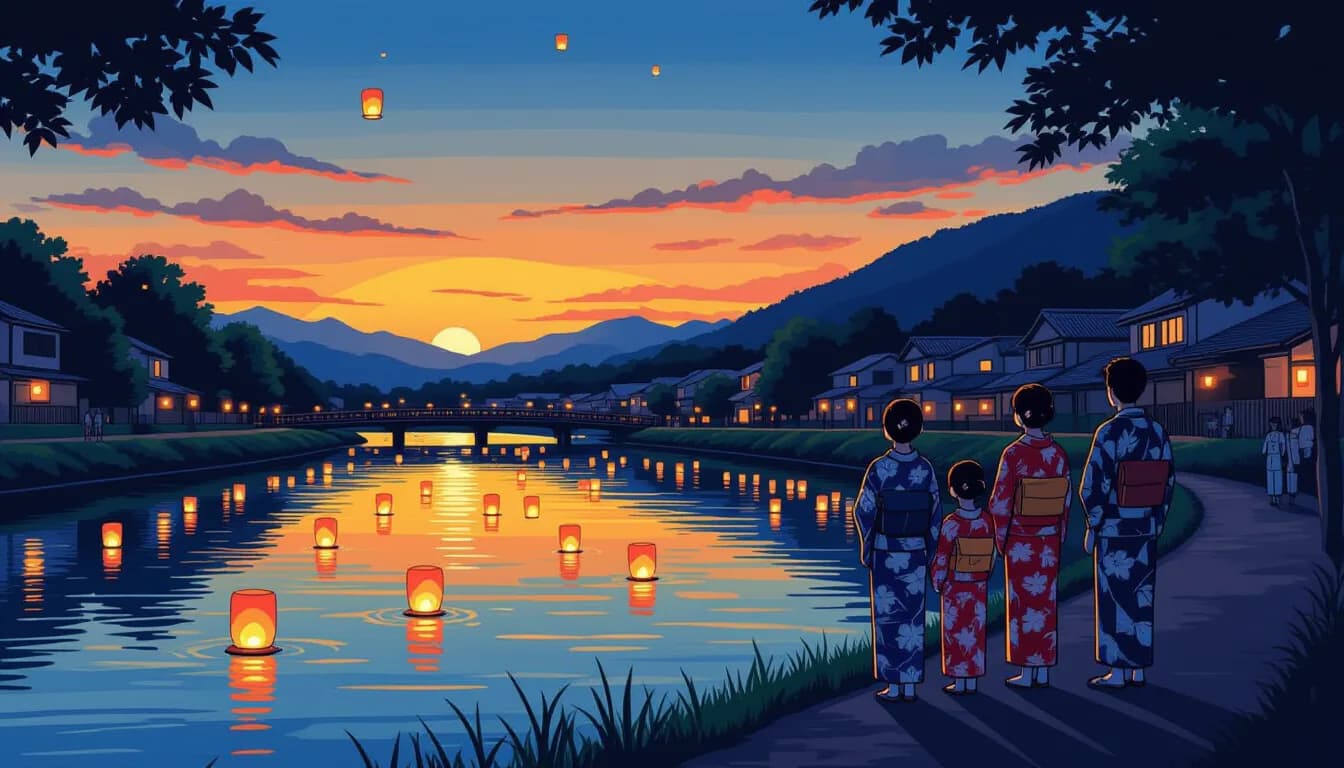
On the final evening of Obon (August 16 in most regions), families bid farewell to the ancestral spirits. This is done through farewell fires (okuri-bi) and, in many communities, through toro nagashi — the floating of paper lanterns on rivers, lakes, or the sea.
Toro Nagashi is one of the most visually stunning traditions in all of Japanese culture. Participants write messages to their ancestors on paper lanterns, light the candles inside, and release the lanterns onto the water. Watching dozens or hundreds of glowing lanterns drift silently downstream in the darkness is an experience that moves even the most unsentimental observer.
Many cities hold public Toro Nagashi events that anyone can attend and participate in. Check your local city's Obon event schedule for details.
Major Obon Festivals Across Japan Worth Visiting
Japan's regional Obon festivals vary enormously in scale and character. If your family has the opportunity to travel during Obon, these are among the most spectacular.
| Festival | Location | Key Feature | Attendance |
|---|---|---|---|
| Awa Odori | Tokushima, Shikoku | Frenetic, fast-paced dance festival | ~1.5 million |
| Gujo Odori | Gujo, Gifu | All-night dancing (8pm–5am) around Obon | ~1.3 million |
| Gozan no Okuribi | Kyoto | Giant kanji burned on mountainsides | Hundreds of thousands |
| Nishimonai Bon Odori | Ugo, Akita | One of Japan's three great Bon Odori | ~80,000 |
| Gion Festival Lantern Events | Kyoto | Lanterns throughout the historic district | Varies |
The Awa Odori in Tokushima is particularly recommended for families with older children. The energy is electric, the dancing is fast-paced and joyful, and there are designated areas where spectators can join experienced dancers. The festival runs for four days in mid-August and transforms the entire city into a stage.
The Gujo Odori in Gifu is one of the most authentic — dances that have been performed continuously for over 400 years. During the Obon nights, dancing runs literally through the night until dawn. Even younger children are welcome at the earlier hours.
For more on navigating Japanese culture as a foreign family, see our guide on Understanding Japanese Parenting Culture as a Foreign Parent and Cross-Cultural Parenting: Managing Multiple Cultures in Your Family.
How Foreign Families Can Participate in Obon
The good news about Obon is that the public-facing elements — especially Bon Odori and Toro Nagashi — are genuinely designed to be communal and inclusive. Here is how your family can engage meaningfully.
Attend local Bon Odori events. Search for "お盆 盆踊り [your city name]" or ask your neighbors, Japanese friends, or your children's school for local event information. Most events are free to attend.
Rent or buy yukata. Dressing in yukata is both respectful and fun. Many shopping centers and department stores near festival venues offer yukata rental. This is an experience children particularly enjoy.
Participate in Toro Nagashi if available. Many public Toro Nagashi events sell lanterns at the venue. Participating requires no special knowledge — staff will guide you through the process.
Explore festival food stalls (yatai). Obon festivals typically have rows of food stalls selling takoyaki, yakisoba, kakigori (shaved ice), corn on the cob, and festival-specific treats. This is one of the most child-friendly aspects of any Japanese festival.
Ask Japanese friends and colleagues about their Obon plans. Many Japanese people are happy to explain their family's customs. This is an excellent opportunity for cross-cultural conversation and connection.
For practical expat living tips in Japan, Living in Nihon provides a wealth of guides on navigating Japanese culture and daily life. For Work in Japan is particularly helpful for foreign workers navigating Ochugen and other professional cultural expectations. Chuukou Benkyou offers resources on Japanese language and cultural education that can help your family deepen their understanding.
Obon and the Workplace: What Foreign Professionals Need to Know
Obon has professional implications that foreign workers in Japan should be aware of.
Obon holiday leave: Most Japanese companies give employees a block of leave during the August Obon period, typically 3–5 days, often combined with adjacent weekends to create a week-long break. Confirm your company's schedule in advance.
Ochugen gift-giving: Obon coincides with Ochugen (お中元), one of Japan's two major gift-giving seasons (the other being Oseibo in December). During Ochugen, it is customary to send gifts to supervisors, clients, mentors, and others who have provided support. Typical gifts are food items, beverages, or high-quality consumables, delivered by department store gift services. Foreign professionals in Japanese companies or those with Japanese clients should observe this custom.
Business closures: Many small businesses, family-run restaurants, and local service providers close entirely during the August Obon week. Do not expect prompt responses to business communications during this period. Plan accordingly.
For further reading on participating in Obon and other Japanese festivals, the Japan Guide's Obon page is a comprehensive English-language resource. JRailPass's Obon Festival Guide offers practical travel advice for navigating Obon transportation. The GoGoNihon Obon explainer provides accessible cultural context.
Talking to Your Children About Obon
One of the most valuable aspects of experiencing Obon as a foreign family in Japan is the opportunity it creates for conversations with your children about death, memory, and cultural difference.
Japanese culture has a deeply practical and accepting relationship with death. Obon treats remembering the dead not as morbid but as a normal, loving, and even joyful act. The festival combines genuine grief and reverence with community, food, music, and dance.
Here are some ways to frame Obon for children of different ages:
For young children (ages 3–7): Focus on the sensory experience — the lanterns, the music, the dancing, the food. You might explain that "Japanese families use this time to remember people they love who have passed away, and they dance and eat together to celebrate those people."
For older children (ages 8–12): Introduce the concept of ancestor veneration and compare it to similar traditions in your own culture (Día de los Muertos, All Souls' Day, etc.). Discuss how different cultures honor the dead.
For teenagers: Engage in deeper conversation about how Japanese Buddhist thought conceptualizes death and the afterlife, and how Obon serves as an annual reconnection point for extended families.
For children being raised between cultures, Obon is also a reminder that Japan's culture is rich, layered, and ancient — and that living here is a rare privilege. See our guide on Cultural Identity for Hafu and Mixed-Race Children in Japan for more on helping children navigate multiple cultural identities.
Quick Reference: Obon at a Glance
| Element | Details |
|---|---|
| What | Buddhist festival honoring ancestral spirits |
| When (main) | August 13–16 (most of Japan) |
| When (Tokyo) | July 13–15 |
| Key public events | Bon Odori dance festivals, Toro Nagashi lantern events |
| What to wear | Yukata (optional but recommended; ~¥3,000–5,000 to rent) |
| Cost to attend | Most events free; food stalls, yukata rental extra |
| Family-friendly? | Highly — especially Bon Odori and Toro Nagashi |
| Professional note | Ochugen gift-giving season; many offices close |
| Travel note | Book early — one of Japan's busiest travel weeks |
Conclusion
Obon is Japan at its most authentic — communal, family-centered, and rooted in a relationship with the past that most modern societies have largely abandoned. For foreign families living in Japan, Obon offers a window into something genuinely profound: a culture that dances in honor of its dead, that travels across the country to clean a grave, that floats lanterns downstream in the darkness as a gesture of love.
Your family does not need Japanese ancestry to participate in Obon. You only need curiosity, respect, and a willingness to step into the circle of dancers. In doing so, you give your children something rare: the experience of belonging, even briefly, to something ancient and alive.

Originally from Vietnam, living in Japan for 16+ years. Graduated from Nagoya University, with 11 years of professional experience at Japanese and international companies. Sharing practical information for foreign parents raising children in Japan.
View Profile →Related Articles
Cherry Blossom Season (Hanami) with Children
Complete guide to enjoying cherry blossom season (hanami) with children in Japan. Best family parks, safety tips, what to bring, cultural etiquette, and activities for kids during sakura season.
Read more →
Japanese Summer Festivals (Matsuri) with Kids
Complete guide to Japanese summer festivals (matsuri) for foreign families with children. Top festivals, kid-friendly activities, yukata tips, heat safety, and how to participate respectfully.
Read more →
Seasonal Crafts and Activities to Do with Your Children
Discover the best seasonal crafts and activities to do with your children in Japan — from spring koinobori and Tanabata wishes to autumn moon viewing and Setsubun bean throwing. A complete guide for expat families.
Read more →
School Events Calendar: What to Expect Throughout the Year
A complete guide to the Japanese school events calendar for foreign parents. Learn about Sports Day, Cultural Festival, graduation ceremonies, and all major school events throughout the year.
Read more →
Christmas Celebrations in Japan with Children
Complete guide to celebrating Christmas in Japan with kids: KFC traditions, stunning illuminations, gift shopping, at-home crafts, and practical tips for foreign families living in Japan.
Read more →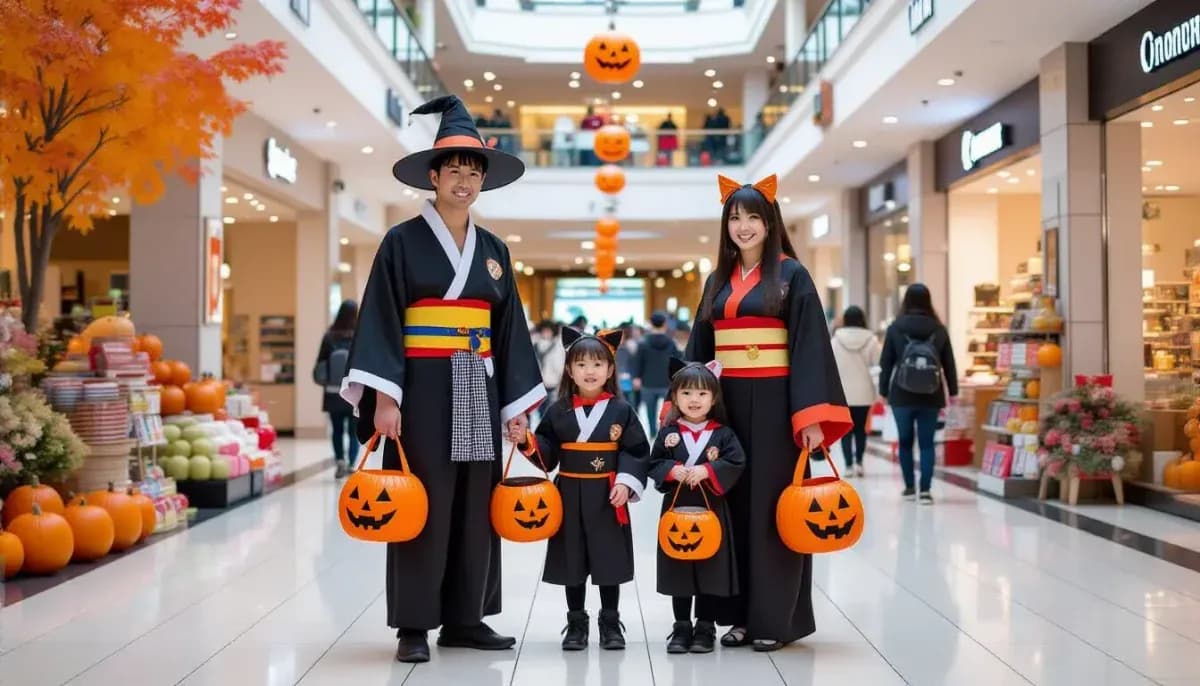
Halloween in Japan: How Families Celebrate
Discover how families celebrate Halloween in Japan: theme park events, shopping mall trick-or-treat routes, school parties, and the best family-friendly Halloween events across the country.
Read more →