
Teaching Children About Stranger Danger in Japan

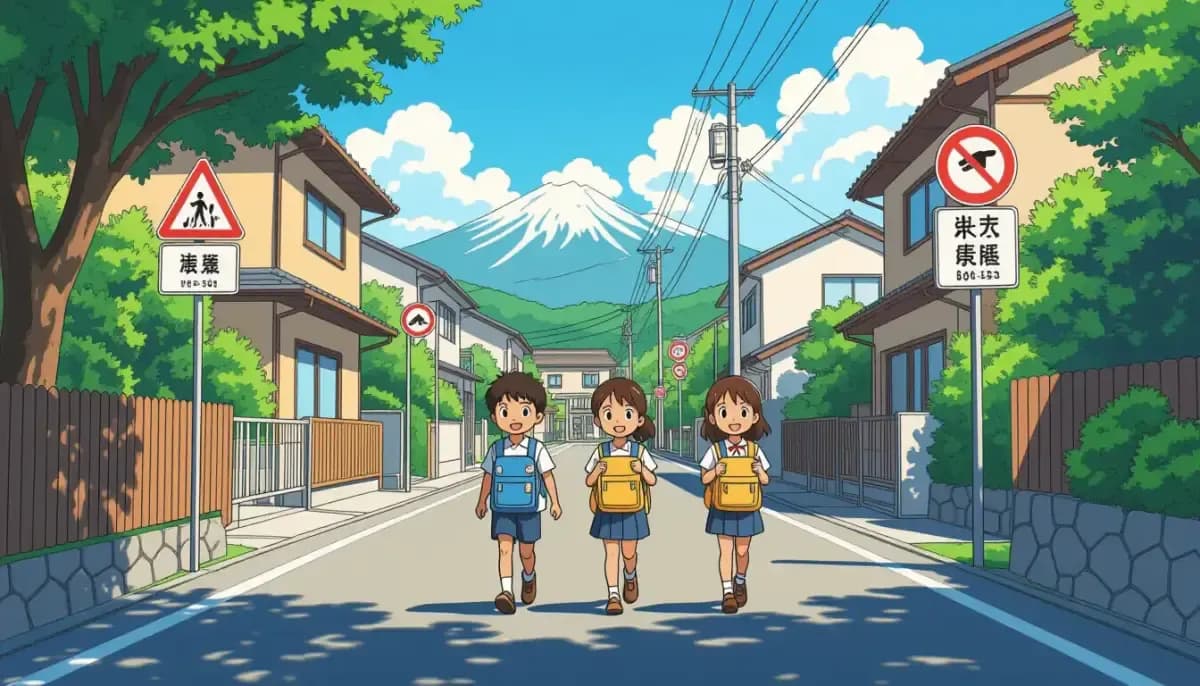
A complete guide for foreign parents on teaching children about stranger danger in Japan, covering the Kodomo 110-ban safety house system, evening chimes, age-appropriate safety conversations, and how Japan's approach differs from Western stranger-danger messaging.
Teaching Children About Stranger Danger in Japan
As a foreign parent raising children in Japan, navigating child safety education can feel both reassuring and surprisingly different from what you may be used to back home. Japan is consistently ranked among the world's safest countries — yet that doesn't mean personal safety conversations with your kids are unnecessary. Understanding how Japan approaches "stranger danger" (不審者対策, fushinsha taisaku) will help you align your family's safety practices with the community around you while building genuine, age-appropriate awareness in your children.
This guide covers Japan's unique community-based child safety systems, how to talk to your children about personal safety in a culturally appropriate way, and the key differences between Western-style "stranger danger" messaging and the more nuanced approach favored in Japan.
How Japan Thinks About Stranger Danger — and Why It's Different
If you grew up in the United States, Canada, or Australia, you may have been raised on the "stranger danger" mantra: never talk to strangers, never accept gifts from people you don't know, run away if someone approaches you. This messaging, while well-intentioned, has been broadly criticized by child safety researchers for being both inaccurate and counterproductive.
In Japan, this framing never fully took root. Children here routinely walk to school alone from age 6 or 7, ride trains unsupervised, and play in parks without parental oversight — and this is widely considered normal and even beneficial for development. Japan's approach to child safety is more community-oriented: rather than fearing all strangers, children are taught to recognize specific behaviors and situations that signal danger, and to seek help from trusted community members and designated safe spaces.
A 2017 Metropolis Japan piece noted that most crimes against children are committed by someone the child already knows — not by strangers on the street — making blanket stranger-avoidance both statistically misguided and socially harmful. In fact, a 2024 police report found that fathers accounted for 46% of child abuse cases in Japan, while mothers accounted for 26%. Police-handled child abuse cases reached 2,649 in 2024 — up 11% year-on-year, and more than triple the 822 cases recorded in 2015.
This doesn't mean Japan's streets are dangerous; quite the opposite. But it does mean that effective safety education here focuses on situational awareness and knowing who to go to for help, not on fear of all unknown adults.
For more on navigating the Japanese education system as a foreign family, see our guide: The Complete Guide to the Japanese Education System for Foreign Families.
Japan's Built-In Child Safety Systems
Japan has a sophisticated, community-based infrastructure for child safety that foreign parents should know and actively use.
Kodomo 110-ban (子ども110番)
One of Japan's most important child safety programs is Kodomo 110-ban — literally "Children's Emergency 110" — a network of designated safe houses and businesses along school routes. These locations are marked with a distinctive yellow sign or sticker and include convenience stores, pharmacies, local shops, and private homes.
If your child ever feels threatened, scared, or followed while walking to or from school, they are taught to run to the nearest kodomo 110-ban location immediately, where an adult will call the police on their behalf. Schools identify these locations for each child's route and practice the response before the school year begins.
Make sure your child knows:
- What the kodomo 110-ban sign looks like
- Where the nearest designated locations are on their daily route
- That they should go straight inside and ask for help — they don't need to explain themselves
The Evening Chime System (夕焼けチャイム)
Many Japanese municipalities broadcast an evening chime (yūyake chaimu, 夕焼けチャイム) at a set time each day, signaling children to return home. The schedule typically follows:
- March through September: Return home by 6:00 p.m.
- October through February (winter): Return home by 5:00 p.m.
This is a deeply embedded community signal, and local children universally recognize it. Teaching your child to respond to the evening chime — even if they don't fully understand Japanese yet — helps them integrate into Japan's child safety culture and ensures they're indoors before dark.
Community Patrol Volunteers
Japanese neighborhoods maintain volunteer patrol groups (mimamori, 見守り) that monitor parks, street corners, and school routes. These volunteers — often retired community members — wear distinctive vests or carry flags and regularly report any suspicious activity to schools and police via email alerts. Many Japanese elementary schools send out periodic safety alerts to parents about reported incidents in the area.
Registering with your child's school and joining the parent LINE group or email list ensures you receive these community safety notices.
For a full overview of what to expect when your child starts school in Japan, read our Elementary School in Japan guide for foreign parents.
Age-Appropriate Safety Conversations for Children in Japan
Japanese developmental psychology research published in the Japanese Journal of Developmental Psychology (Ejiri, 2010) found that children aged 4–6 can make correct safety behavioral choices — such as refusing to follow an unknown adult — but without genuine cognitive understanding of why. True comprehension of stranger-related risk typically emerges around age 6–7, when children start first grade.
This means safety education needs to be staged by age, not delivered all at once:
Preschool Age (3–5 Years)
At this stage, focus on behavioral rules rather than explanations:
- "If someone you don't know tries to take your hand, shout loudly and run."
- "If you get lost, stay where you are and find a mama with children, or go into a shop."
- Practice shouting "Tasukete!" (助けて!, "Help!") and "Iya da!" (嫌だ!, "No!")
Elementary School Age (6–12 Years)
As cognitive understanding develops, children can engage with why certain situations are dangerous:
- Teach them their parents' full names and phone numbers — not just "Mama" and "Papa"
- Practice the walking route to school before the school year begins
- Identify kodomo 110-ban locations together
- Discuss the "before you go out" rule: tell a parent where you're going, with whom, what you'll be doing, and when you'll return
Middle and High School Age (12+ Years)
At this age, digital safety becomes equally important:
- Never share personal information (full name, school, address, photos of location) with people met online
- Never arrange to meet someone in person whom you only know online
- Important communications should happen face-to-face, not over text or apps
For parents of teenagers, see our guide on Junior High School in Japan for Foreign Families for more on school-specific safety rules and mobile phone policies.
Practical Safety Rules for Your Family in Japan
Based on how Japanese schools and expat families in Japan approach child safety, here are the core rules we recommend establishing with your children:
| Rule | What to Teach | Why It Matters in Japan |
|---|---|---|
| Before going out rule | Where, with whom, what, when returning | Prevents miscommunication; standard Japanese expectation |
| Same route, every day | Always take the same path home | Schools track routes; easier to locate if child goes missing |
| Bag away before playing | Don't carry visible school bag outdoors | Signals no adult is home; reduce risk of being targeted |
| Evening chime | Return home at the community chime | Universal local signal; aligns with neighbors' expectations |
| Know the safe houses | Identify nearest kodomo 110-ban spots | Japan's built-in emergency refuge system for children |
| Lost protocol | Find a shop or a mother with children | Cultural fit; Japanese people respond well to children in need |
| Online safety rules | No personal info, no in-person meetings | Junior high schools in Japan formally enforce similar rules |
| Shout for help | Practice "Tasukete!" and "Iya da!" | Empowers children to make noise and draw community attention |
The Tokyo Chapter — a blog by long-term Japan expat parents — shares similar family safety rules adapted for Japan, including carrying hotel business cards for younger children and using the "train separation protocol" (exit at the next stop and wait on the platform if separated).
The Cultural Tension: Social Trust vs. Safety Messaging
One of the most interesting debates in Japan around child safety involves the tension between stranger-danger messaging and Japan's traditional culture of community trust.
In 2023, a condominium complex in Kobe made national news when residents — at the request of parents with elementary-age children — voted to ban residents from greeting each other in the building. The parents' reasoning: "We teach our children to run away if a stranger greets them, so we'd like to make a rule that people should not offer greetings in the building."
Critics pushed back strongly, arguing that communities where residents interact with each other have lower crime rates, and that teaching children to flee any stranger's hello will create socially isolated adults. The case highlighted a real dilemma: overly rigid stranger-danger messaging can erode the community bonds that actually make Japan safe in the first place.
As a foreign parent, finding the middle ground is important. Teach your child situational awareness — not fear. The goal is a child who can:
- Recognize when a situation feels wrong
- Know exactly what to do in an emergency
- Trust community members (while recognizing the difference between normal interaction and a threatening one)
- Call for help clearly and confidently
For bilingual families navigating cultural messages from two directions, our guide on Raising Bilingual Children in Japan covers how to handle dual cultural frameworks with children.
Mental Health: When Stranger Danger Anxiety Becomes Too Much
Some children — particularly those who have moved to Japan from countries where safety fears are more prevalent — can internalize stranger-danger messaging in ways that produce anxiety rather than confidence. Signs that safety education has tipped into fear include:
- Refusing to go outside or to school
- Difficulty interacting with any unfamiliar adults
- Hypervigilance in public spaces
- Nightmares about being taken or hurt
If your child shows these signs, the problem isn't their awareness — it's the framing. Reframe safety as capability and preparedness, not as threat management. "You know what to do if something bad happens" is more empowering than "the world is dangerous."
Japan's school counselors (sukūru kaunserā, スクールカウンセラー) are available at most public schools and can support children struggling with anxiety, including safety-related fears. For a full guide to mental health resources for children in Japan, see our article on Mental Health and Emotional Wellbeing for Foreign Children in Japan.
For more parenting resources in Japan, the comprehensive guide at Living in Nihon: Raising Children and Education in Japan covers the full landscape of raising children as a foreigner, from childcare subsidies to school enrollment. For Work in Japan's Family Life Guide also provides practical context on navigating family systems as a foreign resident. And for additional perspectives from Japanese educational contexts, visit Chuukou Benkyou, a resource on Japanese education.
Key Takeaways
Teaching children about stranger danger in Japan doesn't mean transplanting Western-style fear messaging into a society built on community trust. Japan's approach — rooted in designated safe houses, community volunteers, shared behavioral norms, and age-appropriate education — is both more effective and more sustainable than blanket stranger avoidance.
As a foreign parent, your job is to:
- Learn and use Japan's existing safety infrastructure (kodomo 110-ban, evening chimes, community alerts)
- Teach practical behavioral rules matched to your child's developmental stage
- Build your child's confidence and capability — not their fear
- Stay connected to your local school's safety communications
Japan's children walk to school alone, play in parks unsupervised, and ride trains by themselves — not because their parents don't care, but because the community has built systems that make this genuinely safe. With the right preparation, your child can navigate this world confidently too.

Originally from Vietnam, living in Japan for 16+ years. Graduated from Nagoya University, with 11 years of professional experience at Japanese and international companies. Sharing practical information for foreign parents raising children in Japan.
View Profile →Related Articles
Helping Children Recover After a Natural Disaster
A practical guide for foreign parents on helping children recover emotionally and mentally after a natural disaster in Japan, with evidence-based strategies and available support resources.
Read more →
Creating a Family Disaster Communication Plan
Learn how to create a family disaster communication plan in Japan as a foreign resident. Covers 171 dial, Safety Tips app, school protocols, and multilingual strategies for expat families.
Read more →
Emergency Contacts and Helplines for Families in Japan
Complete guide to emergency contacts and helplines for families in Japan. Police 110, ambulance 119, English hotlines, disaster messaging, and mental health support for expat families.
Read more →
Fire Safety at Home with Children in Japan
Essential fire safety guide for foreign families in Japan. Learn about smoke detectors, evacuation hatches, emergency procedures, teaching children fire safety, and protecting your home.
Read more →
Water Safety and Drowning Prevention for Kids in Japan
Essential water safety guide for parents raising kids in Japan. Learn about beach rip currents, river dangers, bathtub risks, emergency contacts, and Japan's drowning prevention resources for expat families.
Read more →
Basic First Aid for Children in Japan
Essential guide to basic first aid for children in Japan. Learn emergency numbers, common injury response, first aid kit essentials, CPR training options in English, and how Japan's pediatric healthcare system works for foreign parents.
Read more →