
Modern Parenting Trends and Changes in Japan


Explore how parenting in Japan is changing in 2025 — from landmark government reforms and childcare expansion to shifting discipline norms and the rise of involved fathers. A practical guide for foreign families.
Modern Parenting Trends and Changes in Japan
Japan is experiencing a quiet revolution in how families raise children. Decades-old traditions are being reshaped by government policy, shifting gender roles, technology, and the lived experiences of an increasingly multicultural society. Whether you are a foreign parent navigating Japan's child-rearing landscape for the first time or a long-term expat watching this transformation unfold, understanding modern parenting trends in Japan can help you raise happy, healthy children — and find your footing in a culture that is rapidly evolving.
From Traditional Values to a New Parenting Landscape
Japanese parenting has long been guided by deeply rooted cultural values. Two concepts still define much of the approach today:
- Shitsuke (しつけ): Discipline understood as patient training and modeling, not punishment. Parents coach children into habitual behaviors — removing shoes at the door, speaking quietly in public, waiting their turn — through repetition and gentle correction, typically in private rather than in front of others.
- Sunao (素直): The ideal temperament for a child: receptive, harmonious, considerate of others. A "sunao" child is not blindly obedient but rather deeply attuned to the needs of the group.
These values still carry enormous weight. Yet modern Japanese parents — and particularly the growing number of foreign parents raising children in Japan — are navigating a system where tradition is being actively renegotiated.
The shift is measurable. The government has committed a landmark ¥3.5 trillion per year (approximately $25 billion) to child-rearing support from 2024, signaling that Japan understands its parenting environment must change to survive a demographic crisis. The fertility rate hit a record low of 1.20 in 2023. Against this backdrop, parenting in Japan today looks very different from even ten years ago.
For a comprehensive overview of raising children in Japan as a foreigner, see Living in Nihon's Complete Guide to Child-Rearing and Education in Japan.
Major Policy Changes Reshaping Family Life
Government action has been the most dramatic driver of change in modern Japanese parenting. Several landmark policies deserve attention from any foreign family living in Japan.
Child Allowance Reform (2024)
The 2024 reforms to Japan's child allowance (児童手当, jidō teate) were sweeping:
- The income cap was completely abolished — all families now qualify regardless of earnings
- Payments now extend through high school (previously ended at junior high school graduation)
- Monthly amounts: ¥15,000 for children under 3; ¥10,000 for ages 3 through elementary school (¥30,000 for the third child or beyond); ¥10,000 for junior/senior high school students (¥30,000 for third+ child)
- Payment frequency changed from quarterly to every two months
Free Preschool and Childcare Expansion
Since October 2019, preschool and kindergarten have been free for all children aged 3 to 5 regardless of household income. For families with children under 3, subsidies apply for low-income households. This has dramatically increased enrollment and accessibility.
The waiting-list crisis, once a headline issue in major cities, has been substantially resolved. As of 2025, only 2,254 children remain on childcare waiting lists nationwide — a remarkable reduction from years prior when tens of thousands waited. There are now over 23,258 day care centers across Japan serving approximately 1.82 million children.
Paternity Leave Push
From April 2025, companies with 100 or more employees are required to disclose their paternity leave uptake targets. This follows years of campaigns encouraging fathers to take the legally available (but culturally underutilized) childcare leave. The traditional expectation that mothers manage all child-rearing while fathers work long hours is under direct legislative pressure for the first time.
For practical guides on navigating Japan's government benefits as a foreign family, visit For Work in Japan for work-life support resources.
Shifts in Discipline and Child Development Thinking
One of the most significant — and sometimes uncomfortable — changes in modern Japanese parenting involves the country's reckoning with physical discipline.
Reported child abuse cases in Japan rose from 34,472 in 2005 to over 103,286 in 2015. In April 2020, Japan enacted a formal ban on corporal punishment of children, amending the Act on Prevention of Child Abuse. The government launched a public campaign against "Ai no Muchi" (愛のムチ, "Whip of Love") — the cultural belief that physical discipline is an expression of parental love.
Research shows that as recently as 2010, over 60% of three-year-olds were "sometimes or always spanked." This is changing across generations, particularly as younger parents — many of whom were themselves raised with gentler methods — push back on intergenerational cycles.
The broader shift is toward what researchers call "warm control": high emotional warmth combined with clear structure. This sits closer to Japan's existing shitsuke tradition than it might appear. Japanese parents generally do not shame children publicly; they wait out tantrums rather than escalating them (what locals sometimes call "Ma no Nisai" — the Devilish Two-Year-Olds — is handled with notable calm). What is changing is the acceptance of physical methods and the growing awareness of children's emotional and psychological wellbeing as distinct priorities.
For academic research on the evolution of Japanese parenting culture, see this PMC study on changing parenting culture in Japan.
Technology, Social Media, and the Modern Japanese Parent
Technology has reshaped the parenting landscape in unexpected ways in Japan.
Parenting apps and platforms have exploded in popularity. One viral example: "Oni kara Denwa" (鬼から電話), an app that lets parents summon a call from a frightening demon character to encourage misbehaving children to cooperate. It sounds extreme, but reflects a broader integration of digital tools into daily child-rearing routines.
Social media parenting is also transforming cultural norms. A new generation of papa influencers (father influencers) now shares candid content about the realities of child-rearing — including the emotional challenges, the sleep deprivation, the housework — historically invisible in Japan's public presentation of fatherhood. This visibility is slowly normalizing fathers as active caregivers rather than peripheral breadwinners.
Mothers, too, are using platforms to build communities, share advice, and push back on unrealistic expectations. Foreign mothers in Japan have found these networks particularly valuable for navigating the language barriers and cultural differences that can otherwise lead to isolation.
Co-Sleeping, Feeding, and Physical Development Practices
Compared to Western nations, Japanese families maintain several distinctive physical parenting practices:
- Co-sleeping: Approximately 59% of Japanese children co-sleep with parents three or more times per week, compared to around 15% of American children. The traditional family sleeping arrangement (kawanoji — river character — with child between parents) remains common and culturally normalized.
- Independent mobility: Japanese children gain remarkable independence young. It is common for primary school-age children (ages 6–7) to commute to school alone on public transport. Studies on this practice have attracted international attention for its implications for children's confidence and spatial development.
- Food culture: Introducing children to a wide variety of foods early is standard. School lunch (kyūshoku) is nutritionally balanced, eaten communally, and often prepared partly by the children themselves — a deliberate education in food culture and community responsibility.
| Practice | Japan | Comparison |
|---|---|---|
| Co-sleeping (3+ times/week) | ~59% | ~15% (USA) |
| Solo school commute (age 6–7) | Common | Rare in most Western countries |
| Free preschool (ages 3–5) | Yes, since 2019 | Varies by country |
| Child allowance income cap | Abolished (2024) | Many countries still income-tested |
| Paternity leave availability | Yes (legally) | Culturally underutilized until recently |
| Childcare waiting list (2025) | 2,254 nationwide | Previously tens of thousands |
Parenting as a Foreign Family in Japan: Navigating the Shift
For expat and foreign families, modern Japan is in many ways more welcoming than ever — but gaps remain.
Language continues to be the most cited challenge. Healthcare, parent-teacher meetings, nursery enrollment paperwork, and emergency situations all require Japanese communication skills that new arrivals may not have. Over 70,000 foreign children in Japan require Japanese language instruction support; schools vary widely in how well they provide it.
Childcare access has improved substantially. The near-elimination of waiting lists and the expansion of free preschool have directly benefited foreign families. That said, enrollment processes can be complex for non-Japanese speakers. Your local kuyakusho (ward office) is the essential first step.
Social expectations remain a minefield for some. The unwritten rules of Japanese parenting in public — quiet children on trains, strict stroller etiquette, disinfecting toys mouthed by your child, breastfeeding only in designated rooms — are not posted anywhere but are observed carefully by those around you. Learning these norms quickly reduces friction in daily life.
Support networks have grown. Organizations like TELL (counseling in English, based in Tokyo and Okinawa) offer mental health support for foreign parents. Online communities and Japan-focused parenting blogs offer practical guidance that official channels often miss.
Foreign parents raising bilingual or multilingual children will also want to read our guide on raising bilingual children in Japan, as well as our article on cultural identity for hafu and mixed-race children in Japan.
For comprehensive information on Japan's education system from a foreign family perspective, visit Chuukou Benkyou for resources on middle and high school preparation.
What Has Not Changed — And Why It Matters
Amid all the transformation, several aspects of Japanese parenting culture remain remarkably stable:
- The community orientation of childhood socialization. Children are raised explicitly to be contributing members of groups — their class, their sports team, their family. Individual achievement matters less than how that achievement serves the collective.
- The importance of routine and ritual. Japanese preschools and elementary schools invest enormous time in repeated practice of small behaviors: how to enter a room, how to organize a desk, how to address a teacher. This is not rigidity for its own sake but a genuine pedagogical philosophy.
- The expectation of maternal sacrifice, though changing, still operates as a background pressure for many mothers, Japanese and foreign alike. The ideal of the kyōiku mama (教育ママ, education mother) who subordinates her own career to her child's schooling has weakened but not disappeared.
Understanding what persists alongside what is changing helps foreign parents calibrate their expectations — and find the aspects of Japanese parenting culture genuinely worth adopting.
For more on how Japan's education system shapes children from the earliest years, read our guide on daycare and hoikuen in Japan and our overview of the Japanese education system for foreign families.
To plan your family's financial path in Japan, our guide on financial planning for expat families raising children in Japan covers education funds, insurance, and government benefits in detail. You can also explore government benefits and subsidies for families in Japan for a full breakdown of what you may be entitled to.
For additional perspective on raising children in Japan as an expat, this guide from Tokyo Apartment Inc. on raising kids in Japan as a foreigner offers practical day-to-day insights.
Conclusion: Japan's Parenting Revolution Is Real
Japan's parenting culture is genuinely changing — not in a way that abandons its foundations, but in a way that is becoming more humane, more inclusive, and more aware of children's emotional needs alongside their academic and social ones. Government investment is unprecedented. The taboo around physical punishment is breaking down. Fathers are entering the picture in ways that would have been unimaginable a generation ago.
For foreign families in Japan, this moment represents both opportunity and challenge. The systems are more accessible than before. The cultural expectations, while softening, still require navigation. And the rewards — raising children embedded in one of the world's most fascinating, safe, and community-minded societies — remain profound.
Stay curious, stay connected to both your home culture and your Japanese community, and use every resource available to you. The transformation is far from complete, but Japan is moving in the right direction.

Originally from Vietnam, living in Japan for 16+ years. Graduated from Nagoya University, with 11 years of professional experience at Japanese and international companies. Sharing practical information for foreign parents raising children in Japan.
View Profile →Related Articles
Mama-Tomo Culture: Navigating Mother Friendships in Japan
Understand mama-tomo (ママ友) culture in Japan and learn practical strategies for foreign mothers to build genuine friendships through hoikuen, kodomokan, and school communities.
Read more →
The Ikumen Movement: Japan's Push for Involved Fathers
Discover Japan's ikumen movement — the cultural push for involved fatherhood. Learn about paternity leave rights, government initiatives, and what it means for foreign fathers living in Japan.
Read more →
Japanese vs Western Parenting Styles Compared
Discover the key differences between Japanese and Western parenting styles — from amae and shitsuke to co-sleeping, discipline, and public behavior. A practical guide for foreign parents in Japan.
Read more →
Group Harmony and Socialization in Japanese Child-Rearing
Understand wa (group harmony) and how Japanese schools, proximal parenting, and mimamoru shape your child's socialization. Essential guide for expat families in Japan.
Read more →
Japanese Approach to Early Childhood Development
Understand Japan's early childhood development philosophy: hoikuen, yochien, kodomoen, mimamoru, and Chi-Toku-Tai. A complete guide for foreign parents raising children in Japan.
Read more →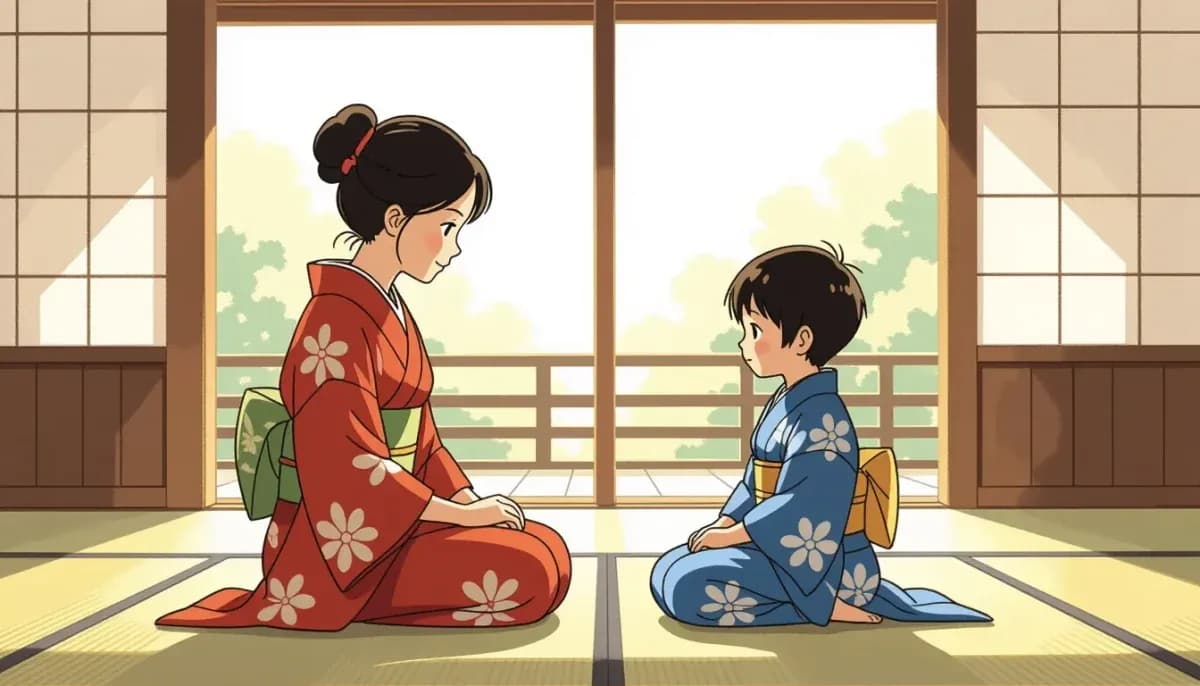
Discipline Methods in Japanese Parenting Culture
Discover how Japanese parents use shitsuke, empathy-based discipline, and group harmony to raise well-behaved children. A practical guide for foreign families in Japan.
Read more →