
Group Harmony and Socialization in Japanese Child-Rearing

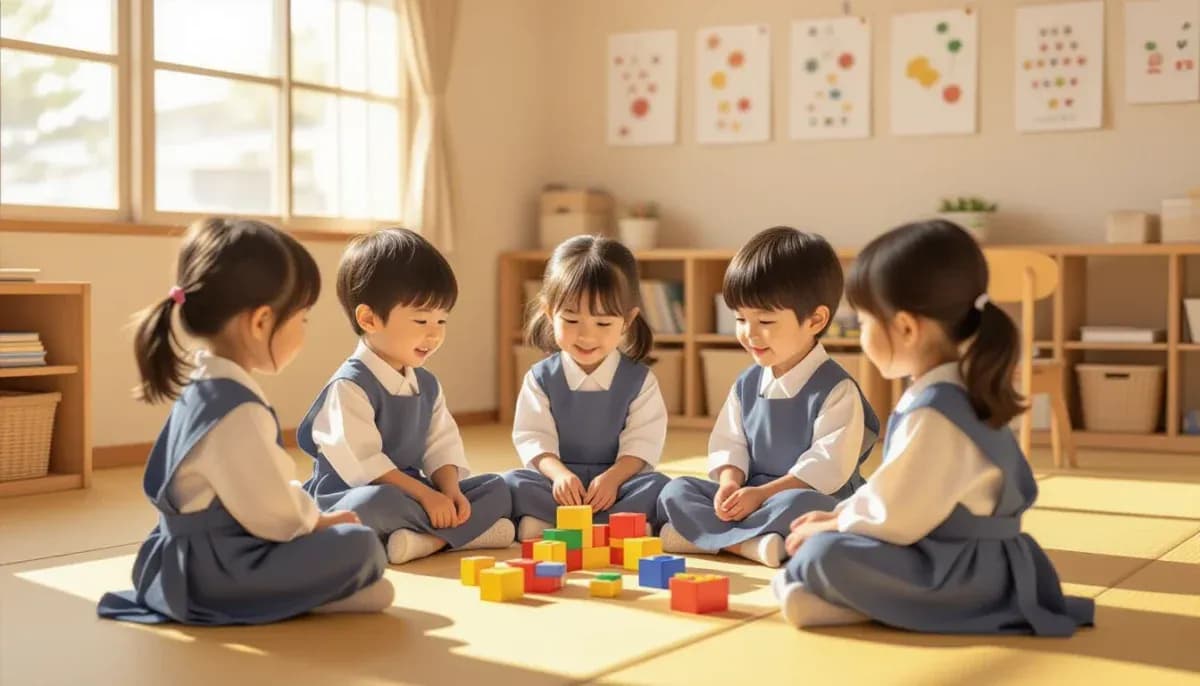
Understand wa (group harmony) and how Japanese schools, proximal parenting, and mimamoru shape your child's socialization. Essential guide for expat families in Japan.
Group Harmony and Socialization in Japanese Child-Rearing: A Guide for Expat Families
If you are raising a child in Japan as a foreign parent, one of the most striking differences you will encounter is how deeply the concept of group harmony — known as wa (和) — shapes the way children are raised, taught, and expected to behave. Understanding this cultural foundation is not optional; it is essential to helping your child thrive, whether they attend a local Japanese school or an international one.
This guide explores the philosophy, practices, and practical implications of group-oriented socialization in Japan, and what it means for your family as you navigate raising children here.
What Is Wa (和) and Why Does It Matter for Children?
Wa (和) is the Japanese concept of social harmony. It refers to the collective peace and balance of a group — a family, a classroom, a sports team, a workplace. In Japanese society, maintaining wa is a shared responsibility, and children begin learning this principle from the earliest stages of life.
One of the key social skills children develop alongside wa is the ability to kuuki wo yomu (空気を読む) — literally "read the air." This means picking up on unspoken social cues, understanding the mood of a room, and adjusting one's behavior so as not to disrupt group dynamics. For Japanese children, this is not a soft skill; it is an essential life competency taught explicitly through school culture and family habits.
For expat families, recognizing that wa underpins Japanese social expectations helps explain a great deal that might otherwise seem puzzling:
- Why your child is expected to clean the classroom
- Why lunchtime is a structured group activity, not free time
- Why standing out or drawing individual attention is often discouraged
- Why conflict is often avoided rather than confronted directly
Understanding these dynamics early will help you support your child — and will help you engage with teachers, school administrators, and other parents far more effectively.
Proximal Parenting: The Foundation of Group Harmony in Infancy
Japan's group-oriented socialization does not begin at school — it begins at birth. Japanese parenting is characterized by what researchers call proximal parenting: an extreme emphasis on physical closeness, co-sleeping, co-bathing, and constant maternal presence during infancy and toddlerhood.
Research by developmental psychologist Heidi Keller found that Japanese mothers spend approximately 2 hours per week away from their babies during the first two years of life, compared to 24 hours per week for American mothers. This intensive closeness is deliberate: it builds a secure attachment base that, paradoxically, makes children better able to integrate into group settings later on.
The logic is that a child who has been consistently attuned to — who has had their emotional states mirrored and acknowledged — develops early self-regulation skills. Japanese children consistently demonstrate superior self-regulation compared to peers in Western countries, and this is directly attributed to the proximal parenting style rather than to explicit instruction.
For expat parents who may feel cultural pressure to practice more independent parenting styles, it is worth knowing that the Japanese approach is evidence-backed and produces measurably cooperative, emotionally regulated children. That said, your own parenting philosophy is valid — and children from diverse backgrounds can absolutely thrive in Japanese social environments with the right preparation and support.
Explore more about early childhood in Japan in our guides on baby and infant care in Japan and toddler parenting in Japan.
How Japanese Schools Teach Group Harmony
Japanese schools are one of the most powerful socialization environments in the world. From the very first day of preschool, children are immersed in group-oriented routines that reinforce collective responsibility, mutual respect, and shared identity.
Classroom Cleaning (Soji)
In Japanese schools, students clean their own classrooms, hallways, and common areas every day. This is not punishment — it is pedagogy. The practice teaches children that the shared environment belongs to everyone and that maintaining it is everyone's responsibility. Foreign children who join Japanese schools are expected to participate in soji from day one, and many expat parents report that their children quickly come to find it normal and even meaningful.
School Lunch (Kyushoku) as Group Ritual
School lunch is served in the classroom by the children themselves, rotating on duty. Students put on aprons and masks, serve their classmates, and eat together at their desks facing each other. No food is wasted. The ritual teaches turn-taking, care for others, and group cohesion. It is one of the most commented-on aspects of Japanese schools by foreign observers.
Club Activities (Bukatsu) and Group Identity
From junior high school onward, club activities — sports, arts, cultural clubs — become a central part of social life. Club membership creates intense group bonds and teaches children to subordinate individual preferences to team goals. For foreign students, joining a club is often the fastest route to social integration.
Bowing and Formal Greetings
Students bow to teachers at the start and end of every lesson. This is not mere formality — it is a ritualized acknowledgment of group relationships and hierarchies. Children learn from an early age that one's relationship with others is expressed through physical and verbal rituals.
To understand more about school culture, read our full guide to elementary school in Japan for foreign parents and junior high school in Japan.
Mimamoru: Watching Over Without Intervening
One Japanese early childhood education practice that surprises many Western parents is Mimamoru (見守る), which translates roughly as "watching over." In Mimamoru-style early education, teachers deliberately step back and allow children to navigate social conflicts and group dynamics on their own.
Where a Western teacher might immediately intervene when two children argue over a toy, a Japanese teacher practicing Mimamoru would observe, wait, and allow the children to find their own resolution — stepping in only if safety is at risk. The philosophy is that children develop genuine social competence only by experiencing the natural consequences of group dynamics, not by having adults smooth every friction point.
For expat parents accustomed to more interventionist preschool environments, this can initially feel alarming. Understanding Mimamoru helps reframe it: the goal is not indifference to children's struggles, but confidence in their capacity to develop social skills through authentic experience.
This approach connects directly to Japan's preschool and kindergarten culture. Since October 2019, preschool has been free for all children aged 3–5 in Japan — meaning your child can access this socialization environment at no cost. See our detailed guide on kindergarten (yochien) in Japan and daycare and hoikuen for enrollment details.
Research Findings: How Group Socialization Shapes Japanese Children
Academic research paints a nuanced picture of group socialization outcomes in Japan.
A longitudinal study published in PLOS One tracked 1,055 Japanese children from ages 2 to 5 and found three distinct cooperation trajectory groups:
| Cooperation Trajectory | Proportion of Children |
|---|---|
| Low cooperation | 9.2% |
| Moderate cooperation | 66.2% |
| High cooperation | 24.6% |
Girls consistently scored higher than boys across measures of cooperation, self-control, and assertiveness (all p < .01). Crucially, cognitive and emotional parental involvement — not socioeconomic status — was the strongest predictor of high cooperation trajectories. This finding has direct implications for expat families: active engagement with your child's social and emotional development predicts better group socialization outcomes.
A separate study published in PMC (NCBI) examined 523 parent couples with children aged 3–5 and found that childcare support improved children's prosocial behavior entirely through its effect on parental psychological wellbeing and parenting quality — not through any direct effect on the child. This suggests that supporting parents (including expat parents navigating an unfamiliar system) is one of the most effective ways to improve children's social outcomes in Japan.
For further reading, see the original research at PLOS One and PMC/NCBI.
Challenges for Foreign Children in Japanese Social Environments
While Japan's group socialization system produces measurably positive outcomes for many children, it also presents real challenges for foreign children — and for their parents.
Language Barrier
The single biggest challenge for expat children is language. Group socialization in Japan is deeply verbal — understanding peer cues, following group instructions, and participating in classroom rituals all require Japanese proficiency. Children who arrive without Japanese language skills often experience a period of social isolation that can be distressing for both child and parent.
Strategies that help:
- Enroll in Japanese language classes before or immediately after arrival
- Use local hoikuen or yochien as language immersion environments from age 3
- Practice group-oriented play in mixed Japanese/foreign playgroups
For detailed language strategies, see our guides on teaching Japanese to foreign children and raising bilingual children in Japan.
Standing Out vs. Fitting In
Foreign-looking children may face additional pressure because they visually stand out in an environment that prizes conformity. Hafu (half-Japanese/half-foreign) children in particular often navigate complex questions of identity and belonging. Supporting your child's bicultural identity is essential — neither erasing their foreign heritage nor forcing assimilation.
Read our full guide on cultural identity for hafu and mixed-race children in Japan for in-depth strategies.
Public Behavior Standards
Japanese children are expected to behave quietly and considerately in public spaces — on trains, in restaurants, in waiting rooms — from a very young age. Parents who allow children to run through public spaces or make excessive noise may face visible social disapproval. This is not merely personal preference; it reflects the wa principle applied to shared public space. Most expat families adapt to these norms fairly quickly, and children often find Japanese public standards intuitive once they understand the reasoning.
International School vs. Public School: Socialization Trade-Offs
One of the most consequential decisions expat families face is whether to enroll children in Japanese public schools or international schools. From a socialization standpoint, the two pathways produce very different outcomes.
| Factor | Japanese Public School | International School |
|---|---|---|
| Cost | Free (compulsory education) | ¥2–3 million/year (~$13,000–$20,000) |
| Language of instruction | Japanese | English (typically) |
| Group socialization style | High — Japanese wa culture | Moderate — more individualistic |
| Social network | Japanese peers | Multinational expat peers |
| Cultural integration | Deep | Limited |
| Transition challenge | High (language barrier) | Low |
Neither option is universally better. Families planning a long-term stay in Japan often prioritize public school enrollment for the deep cultural and linguistic integration it offers. Families on shorter assignments or with children who have struggled with the transition often find international schools provide a supportive bridge environment.
For a comprehensive comparison, read our guide to international schools in Japan.
Practical Tips for Expat Parents Navigating Japanese Group Culture
- Embrace group activities early. Enroll your child in local sports clubs, neighborhood festivals (matsuri), and community events. The earlier a child builds group bonds in Japan, the faster integration happens.
- Learn the school calendar. Japanese schools have specific group rituals (undoukai sports days, gakugeikai culture festivals, end-of-year parties) that are important social events. Showing up and participating as a family signals commitment to the group.
- Don't fight the uniform. Japanese school uniforms, school supplies lists, and specific bag requirements exist to minimize visible individual differences. Comply with these requirements even when they seem excessive — non-compliance creates friction for your child.
- Communicate through the right channels. In Japan, individual complaints or requests to teachers can be seen as disrupting group harmony. Use the formal channels — renrakucho (communication notebook), parent-teacher meetings, and PTA structures — rather than informal individual approaches.
- Support your child's emotional processing. Group socialization can be exhausting for children who are also managing language acquisition and cultural adjustment simultaneously. Create space at home for your child to express individuality freely, even while adapting to group norms at school.
For mental health and emotional support resources specific to foreign children in Japan, see our guide on mental health and emotional wellbeing for foreign children.
Further Resources
- Complete Guide to Child-Rearing and Education in Japan — Living in Nihon
- For Work in Japan — Resources for Foreign Families
- Chuukou Benkyou — Educational Resources in Japan
- 10 Unwritten Social Rules of Japanese Parenting — Tsunagu Japan
- Japanese Parenting Style Overview — O'Sullivan Counseling
Group harmony and socialization in Japanese child-rearing is one of the most profound and consequential aspects of raising children in Japan. For expat families, understanding wa — and the schools, rituals, and social expectations that embody it — is the key to helping your child not just survive but thrive in one of the world's most cohesive and high-performing social environments.

Originally from Vietnam, living in Japan for 16+ years. Graduated from Nagoya University, with 11 years of professional experience at Japanese and international companies. Sharing practical information for foreign parents raising children in Japan.
View Profile →Related Articles
Modern Parenting Trends and Changes in Japan
Explore how parenting in Japan is changing in 2025 — from landmark government reforms and childcare expansion to shifting discipline norms and the rise of involved fathers. A practical guide for foreign families.
Read more →
Mama-Tomo Culture: Navigating Mother Friendships in Japan
Understand mama-tomo (ママ友) culture in Japan and learn practical strategies for foreign mothers to build genuine friendships through hoikuen, kodomokan, and school communities.
Read more →
The Ikumen Movement: Japan's Push for Involved Fathers
Discover Japan's ikumen movement — the cultural push for involved fatherhood. Learn about paternity leave rights, government initiatives, and what it means for foreign fathers living in Japan.
Read more →
Japanese vs Western Parenting Styles Compared
Discover the key differences between Japanese and Western parenting styles — from amae and shitsuke to co-sleeping, discipline, and public behavior. A practical guide for foreign parents in Japan.
Read more →
Japanese Approach to Early Childhood Development
Understand Japan's early childhood development philosophy: hoikuen, yochien, kodomoen, mimamoru, and Chi-Toku-Tai. A complete guide for foreign parents raising children in Japan.
Read more →
Discipline Methods in Japanese Parenting Culture
Discover how Japanese parents use shitsuke, empathy-based discipline, and group harmony to raise well-behaved children. A practical guide for foreign families in Japan.
Read more →