
Teaching Independence: Why Japanese Kids Do So Much Alone

Discover why Japanese children walk to school alone from age 6, run solo errands, and travel public transit independently — and the community safety systems that make it work for foreign families in Japan.
Teaching Independence: Why Japanese Kids Do So Much Alone
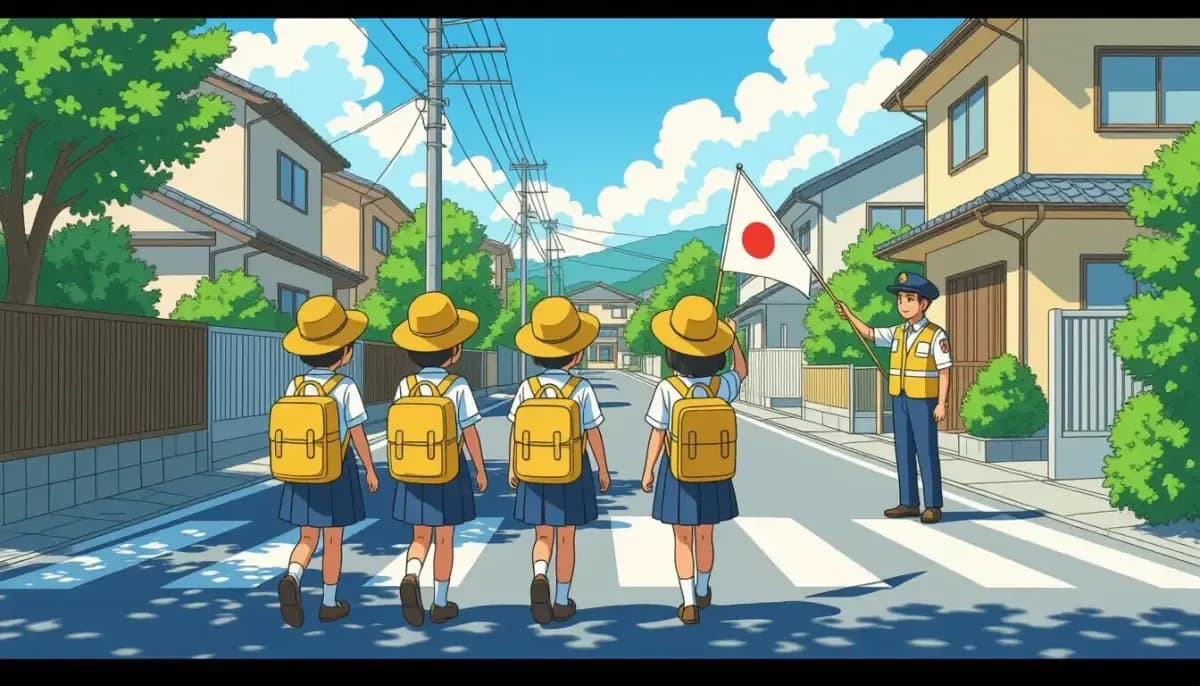
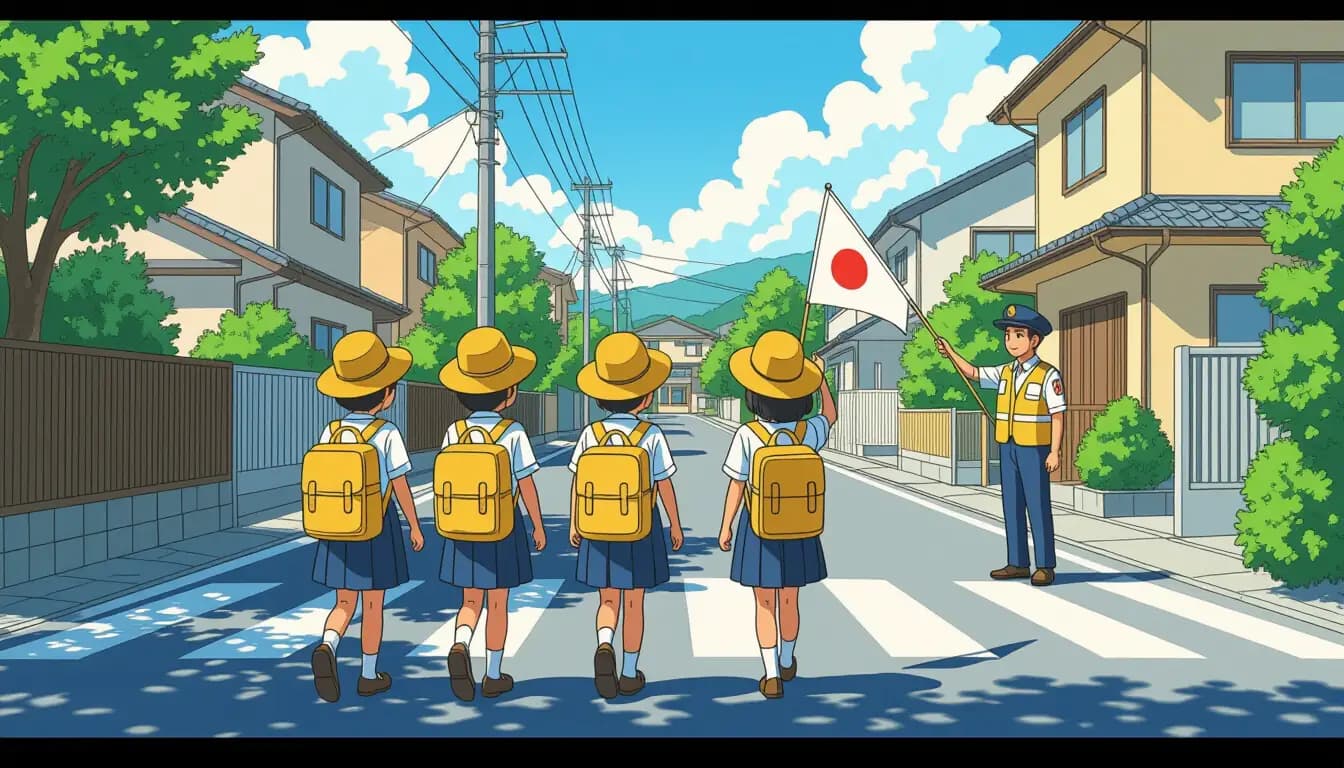
If you have ever watched a group of six-year-olds in bright yellow hats marching confidently through a Tokyo neighborhood without a parent in sight, you have witnessed one of Japan's most remarkable cultural traditions. Japanese children routinely walk to school alone, run errands by themselves, and take public transit unaccompanied at ages that would cause widespread concern in most Western countries. This is not neglect — it is a deeply intentional, community-supported approach to raising capable, self-reliant individuals.
For foreign families living in Japan, understanding why Japanese kids do so much independently — and how the system supports them — can be both eye-opening and reassuring. This guide explores the philosophy, the safety infrastructure, and the practical steps behind Japan's celebrated culture of childhood independence.
The Cultural Philosophy Behind Japanese Child Independence
At the heart of Japan's approach to child-rearing is a proverb that has guided parents for generations: "Kawaii ko ni wa tabi o saseyo" — loosely translated as "Send the beloved child on a journey." The idea is that the children you love most are precisely the ones you should challenge, because struggle builds character and competence.
This philosophy stands in contrast to the "helicopter parenting" trend common in many Western countries. In Japan, allowing children to face and overcome challenges independently is considered an expression of love and respect for the child's growing capabilities. Sheltering a child from all risk is viewed not as protective, but as limiting.
This mindset shapes everyday life from very early on. By age four or five, many Tokyo children accompany parents on the train and are expected to stand quietly and follow instructions. By first grade (age six), independent school commuting is the cultural norm. The popular Netflix documentary series Hajimete no Otsukai ("Old Enough!") captures children as young as two and three completing solo errands — and the show resonates deeply with Japanese audiences because it reflects a genuine cultural expectation, not an exception.
For expat parents, this can feel jarring at first. But understanding the robust safety infrastructure that supports this independence helps explain why it works. For more context on how Japanese schools operate and what to expect as a foreign parent, see our complete guide to elementary school in Japan.
How Japanese Schools Systematically Teach Independence
The Japanese school system doesn't simply expect children to be independent — it trains them to be, through structured systems that build confidence gradually.
The Tsugakuro: Designated Walking Routes
Before a child starts elementary school, parents are required to submit a detailed walking route map to the school. Schools designate official paths called tsugakuro — carefully chosen routes that use sidewalks, avoid high-traffic roads, and pass through areas with good visibility. Local governments collaborate with schools to improve these routes, adding guardrails, pedestrian signals, and road markings.
Parents are strongly encouraged to walk the route with their child multiple times before school begins. The typical progression looks like this:
- Parent walks the full route with child
- Parent follows a block behind while child leads
- Parent watches from the front door until child is out of sight
- Child completes the route fully independently
This gradual handover reduces anxiety for both parent and child while building genuine competence.
Shudan Togeko: Group Travel System
Most elementary schools in Japan use a system called shudan togeko, in which neighborhood children travel together in organized groups. These groups, called han, are led by older students — typically fifth or sixth graders — who are responsible for ensuring younger children arrive safely.
This system accomplishes several things simultaneously: it gives older children meaningful leadership responsibility, provides younger children with role models, creates natural safety in numbers, and relieves parents of the need to escort children every day. Teachers monitor arrival times closely, and parents are notified if a child does not arrive within the designated window (usually 20-30 minutes after departure).
Classroom Chores and Self-Governance
Independence training extends far beyond the commute. Japanese classrooms famously have no janitors — students clean their own classrooms, hallways, and bathrooms daily. School lunch is served by student teams in rotating shifts. Children manage their own belongings, track their own homework, and are expected to resolve minor conflicts without adult intervention.
These practices are detailed in our guide to the Japanese education system for foreign families.
The Safety Infrastructure That Makes It Work
Japan's child independence culture is not naive. It is underpinned by one of the most comprehensive community safety networks in the world.
Low Crime Rates
The statistical foundation of Japan's approach is its extraordinarily low crime rate. Japan records less than one-quarter of the homicide rate of Australia despite having more than five times the population. For children ages 6-19, the National Police Agency recorded only 58 murders in 2013 — an almost vanishingly small number for a country of 127 million people. Stranger abductions, while they do occur, are rare enough to be national news events.
This does not mean risk is zero, but it does mean the calculus is genuinely different from countries with higher crime rates.
Kodomo 110-Ban: The 110 House Network
Throughout Japan's residential neighborhoods, you will notice small stickers or signs marking homes, convenience stores, and shops with the words "Kodomo 110-ban no ie" (子ども110番の家) — "Children's 110 House." These are registered safe havens where any child in distress can knock on the door and receive help.
Participating households register with local police and commit to being available during school commute hours. The network is remarkably dense — in most urban neighborhoods, there is at least one 110 House within a few minutes' walk in any direction. Children are taught from kindergarten to look for these signs if they feel unsafe or lost.
High-Visibility Safety Gear
Japanese children are remarkably visible in public. The iconic randoseru — the structured square backpack that virtually every elementary student carries — is typically red for girls and black for boys, making children instantly identifiable. Children also wear bright yellow hats, especially in the early elementary years.
Modern randoseru often include reflective panels and emergency whistles. Many schools require children to carry GPS-enabled devices or cell phones with emergency contact features. The combination of visible gear, distinctive uniforms, and GPS tracking gives parents real-time reassurance without requiring physical presence.
| Safety Feature | Description | Who Provides It |
|---|---|---|
| Tsugakuro routes | Designated safe walking paths | School + municipality |
| Shudan togeko | Organized group travel with older leaders | School community |
| 110 House network | Safe haven homes/shops | Police + volunteers |
| Yellow hats | High-visibility hats for early grades | School |
| GPS randoseru | Backpacks with tracking capability | Parents (optional) |
| Crossing guards | Volunteer safety monitors at intersections | PTA volunteers |
| Emergency whistles | Attached to school bags | School |
Volunteer Crossing Guards
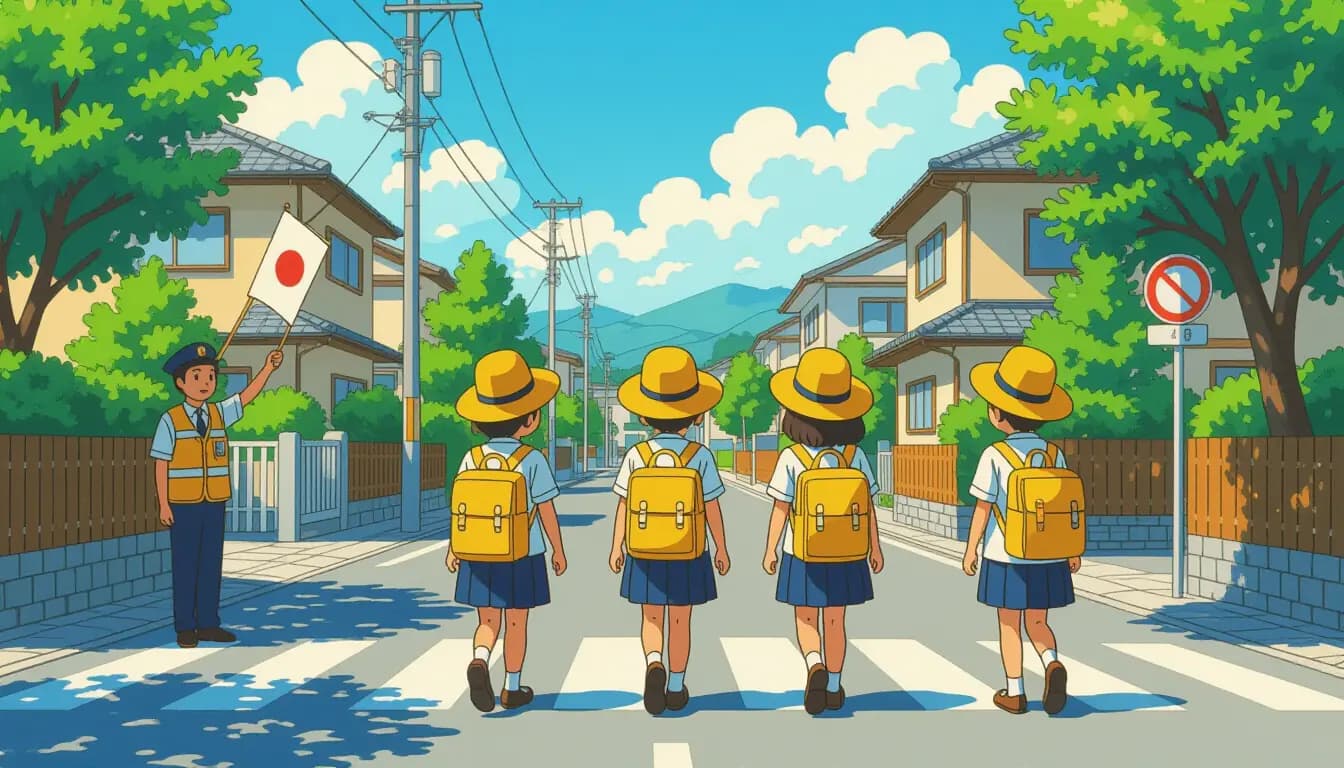
At major intersections along school routes, volunteer crossing guards — many of them retired community members — stand watch during morning commute hours. These volunteers are organized by school PTAs and rotated among parents. Seeing the same familiar faces every morning also creates a sense of community continuity for children.
For more on navigating the Japanese school community as a foreign parent, including PTA involvement, see our guide to elementary school in Japan.
Age-by-Age Expectations: What Japanese Children Do Independently
Understanding the typical developmental expectations in Japan helps foreign parents calibrate their own approach. These are cultural norms, not rigid rules, but they reflect widely shared expectations.
| Age | Typical Independent Activities |
|---|---|
| 2-3 years | Simple errands with clear instructions (popularized by Hajimete no Otsukai) |
| 4-5 years | Walking short distances in the neighborhood, visiting nearby shops |
| 6 years (Grade 1) | Walking to school alone or in han groups, basic public transit |
| 7-8 years | Longer transit routes, after-school activities alone |
| 9-10 years | Leading han groups, complex transit journeys |
| 11-12 years | Fully independent transit across the city, after-school part-time activities |
These milestones often surprise Western parents. But they are supported at every stage by the community infrastructure described above — children are not simply set free, they are gradually released into a prepared environment.
What This Means for Foreign Families in Japan
For expat parents, Japan's independence culture presents both an opportunity and a genuine decision point. You will find that Japanese peers, teachers, and neighbors have specific expectations — and you may feel implicit or explicit pressure to align with local norms.
Practical Steps to Prepare Your Child
If you decide to embrace local practice and allow your child to walk to school independently, here is a recommended preparation process:
- Walk the route together repeatedly until your child knows every landmark, turn, and crossing
- Identify all 110 Houses along the route and ensure your child knows what the sticker means
- Practice what to do if something goes wrong — who to approach, how to ask for help in Japanese
- Start with the group — connect your child with their han before attempting solo travel
- Use GPS if needed — many families use smartwatches or GPS chips in school bags during the transition period
- Talk to the homeroom teacher — Japanese teachers are deeply attentive to students' commute safety and will alert you to any concerns
For families raising bilingual children and navigating cultural expectations at school, our guide on raising bilingual children in Japan covers related challenges around identity and belonging.
Respecting Your Own Boundaries
It is also completely valid to move at a slower pace than Japanese families around you. Japan's independence culture evolved in specific cultural and safety conditions, and you should assess your own child's readiness, your neighborhood's safety profile, and your family's comfort level independently.
Many expat families find a middle path: embracing the group commute system while continuing to accompany children on non-school journeys longer than typical Japanese peers. This is accepted and understood by Japanese teachers and neighbors, especially for families new to Japan.
You can find additional support for navigating parenting decisions in Japan at Living in Nihon, which covers a broad range of guides for foreign residents. For those working in Japan and balancing work and family schedules, For Work in Japan has resources on work-life balance for expat parents. Families interested in Japan's broader education approach may also find Chuukou Benkyou useful for understanding how Japanese academic expectations evolve through middle and high school.
The Broader Benefits: What Research Shows
Beyond the cultural and practical dimensions, there is growing research support for the kind of independent childhood Japan has long practiced. Studies consistently link childhood autonomy with:
- Greater executive function — the ability to plan, self-regulate, and solve problems
- Reduced anxiety in adolescence and adulthood
- Stronger social skills from navigating peer dynamics without adult mediation
- Higher intrinsic motivation in academic and extracurricular settings
For in-depth analysis, the Savvy Tokyo article How Japan Prepares Children for Independence covers the research context well, and Notes of Nomads offers an expat parent's first-hand account of navigating Japan's school independence culture.
Japan's approach is not without its critics — there are valid debates about the pressure it places on children and the rigidity of group systems. But for many foreign families, witnessing the confidence and competence of Japanese children navigating the world independently is one of the most striking and ultimately instructive aspects of life in Japan.
Conclusion: A Different Kind of Care
Japanese parents are not less caring than parents elsewhere — they simply express that care differently. Allowing a child to walk to school alone is, in Japan, an act of love: a signal that you believe in your child's capability and that you trust the community you live in.
For foreign families in Japan, this culture is an invitation to reflect on what independence really means, and how much of it we extend to our own children. The answer will be different for every family — but understanding the Japanese approach, its philosophy, and its safety infrastructure is the essential starting point.
For more on how Japan's education system shapes children's development at every stage, explore our complete guide to the Japanese education system and our articles on mental health and emotional wellbeing for foreign children in Japan.

Originally from Vietnam, living in Japan for 16+ years. Graduated from Nagoya University, with 11 years of professional experience at Japanese and international companies. Sharing practical information for foreign parents raising children in Japan.
View Profile →Related Articles

Modern Parenting Trends and Changes in Japan
Explore how parenting in Japan is changing in 2025 — from landmark government reforms and childcare expansion to shifting discipline norms and the rise of involved fathers. A practical guide for foreign families.
Read more →
Mama-Tomo Culture: Navigating Mother Friendships in Japan
Understand mama-tomo (ママ友) culture in Japan and learn practical strategies for foreign mothers to build genuine friendships through hoikuen, kodomokan, and school communities.
Read more →
The Ikumen Movement: Japan's Push for Involved Fathers
Discover Japan's ikumen movement — the cultural push for involved fatherhood. Learn about paternity leave rights, government initiatives, and what it means for foreign fathers living in Japan.
Read more →
Japanese vs Western Parenting Styles Compared
Discover the key differences between Japanese and Western parenting styles — from amae and shitsuke to co-sleeping, discipline, and public behavior. A practical guide for foreign parents in Japan.
Read more →
Group Harmony and Socialization in Japanese Child-Rearing
Understand wa (group harmony) and how Japanese schools, proximal parenting, and mimamoru shape your child's socialization. Essential guide for expat families in Japan.
Read more →
Japanese Approach to Early Childhood Development
Understand Japan's early childhood development philosophy: hoikuen, yochien, kodomoen, mimamoru, and Chi-Toku-Tai. A complete guide for foreign parents raising children in Japan.
Read more →