
Technology and Computer Education in Junior High Japan

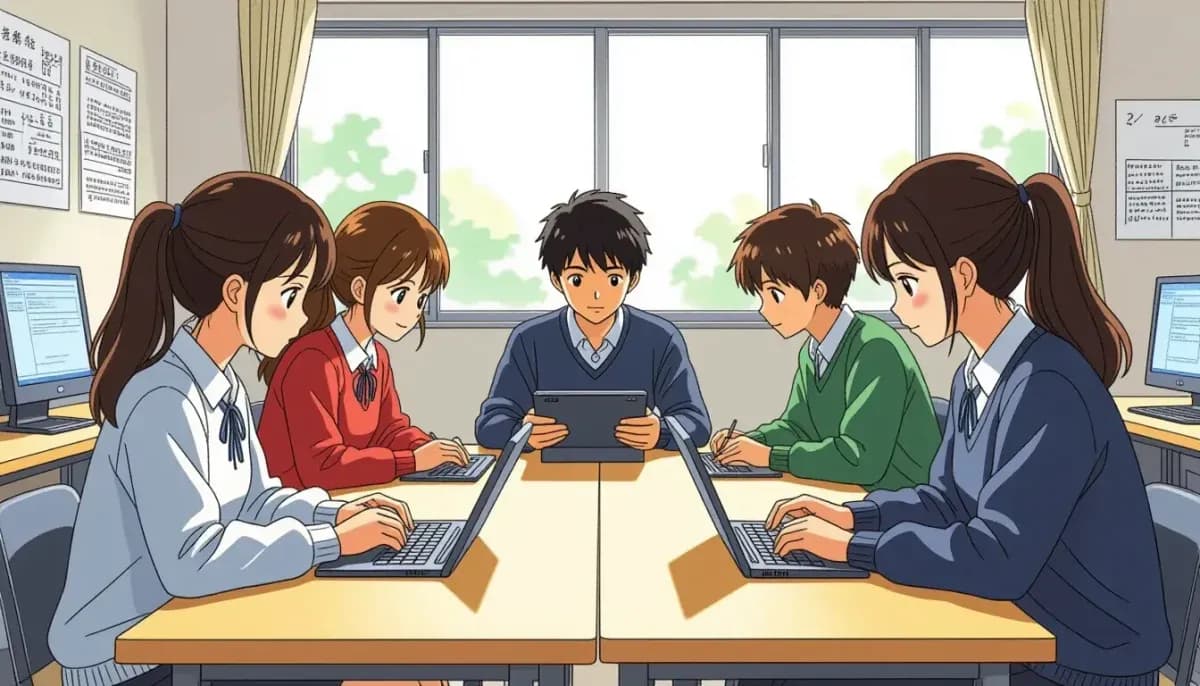
Discover how technology and computer education works in Japanese junior high schools. Learn about Gijutsu Katei, the GIGA School Program, mandatory programming, and what foreign families can expect.
Technology and Computer Education in Junior High Japan: A Guide for Foreign Families
When your child enters junior high school in Japan, they'll encounter a unique blend of traditional craftsmanship and cutting-edge digital skills. Japan's approach to technology education is unlike anything you might find in Western countries — rooted in hands-on making, expanded dramatically through national digital initiatives, and now including mandatory programming for all students. This guide explains exactly what foreign families can expect from technology and computer education in Japanese junior high schools.
What Is "Technology" Class in Japanese Junior High School?
The technology subject in Japanese junior high schools is called Gijutsu Katei (技術・家庭) — officially translated as "Technology and Home Economics." It has been a mandatory subject in all lower secondary schools since 1958, making it one of the longest-standing technical education programs among developed nations.
Despite its name, Gijutsu Katei is far more than a basic shop class. It combines practical engineering skills with home management and, since the 2022 curriculum reforms, dedicated computer programming instruction. The subject runs across all three years of junior high (grades 7, 8, and 9) and is split roughly equally between the technology component and the homemaking component.
The technology half covers:
- Design and technical drawing — reading blueprints, drafting plans
- Woodworking and metalworking — making real objects from scratch
- Electricity and basic electronics — circuits, motors, simple devices
- Cultivation and biotechnology — growing plants, understanding life sciences
- Information technology and programming — the newest and fastest-growing area
This wide scope is intentional. Japan's Ministry of Education (MEXT) wants students to understand how technology shapes daily life, not just how to use gadgets. Students learn to design, build, troubleshoot, and think systematically — skills that transfer well beyond any single field.
For foreign families accustomed to more narrowly defined "computer class" or "IT class," the breadth of Gijutsu Katei can be a pleasant surprise. Your child won't just be staring at a screen — they'll be sawing wood, soldering circuits, and writing code all within the same subject.
The GIGA School Program: One Device Per Student
The single biggest change in Japanese school technology in recent years is the GIGA School Program (Global and Innovation Gateway for All), launched in fiscal year 2019 by the national government.
The program's goal is straightforward: every student in Japan gets a personal computing device, and every school gets high-speed internet. Originally planned to roll out gradually over several years, the COVID-19 pandemic accelerated the timeline dramatically. By April 2021, nearly all of Japan's 35,000+ public schools had achieved one-to-one device coverage.
What this means for your child:
- They will have a tablet or laptop assigned to them for use in class
- Most schools use either Chromebooks, iPads, or Windows tablets
- High-speed wireless LAN covers classrooms, gymnasiums, and common areas
- Digital tools are integrated across all subjects, not just technology class
Some cities were ahead of the curve. Shibuya City in Tokyo, for example, provided tablets to all 8,700 of its elementary and junior high students as early as 2017 — four years before the national program reached full deployment.
The results have been impressive. A 2018 international survey (ICILS — International Computer and Information Literacy Study) ranked Japan among the top-performing countries, with a score of 106 against an international average of 496. A 2022 assessment found that Japanese secondary school teachers scored 85/100 on digital competency evaluations, and OECD TALIS data shows 75% of Japanese teachers now use ICT tools daily in their classrooms.
For expat families, the practical upshot is that your child will have access to good digital infrastructure from day one. You won't need to supply a personal computer unless the school specifically requests it.
Programming: Now Mandatory in All Junior High Schools
One of the most significant curriculum changes in Japan's recent educational history is the introduction of mandatory programming education at all school levels.
Here's the timeline:
- 2020: Programming became compulsory in all elementary schools
- 2021: Junior high schools began integrating programming into Gijutsu Katei
- 2022: Full implementation of programming requirements across junior high
- 2025: Programming and informatics became mandatory for all high school students
At the junior high level, programming is embedded within the technology component of Gijutsu Katei rather than existing as a standalone class. Students learn the fundamentals of how programs work, write simple code to control devices or solve problems, and explore how digital systems connect to daily life.
The approach emphasizes computational thinking — breaking problems into steps, identifying patterns, and designing logical solutions — more than mastery of any single programming language. Schools may use Scratch, Python, micro:bit physical computing kits, or Japan-developed educational platforms depending on the teacher and equipment available.
This is good news for foreign children with prior coding experience. If your child already knows Scratch or basic Python from international school or home learning, they'll have a head start. At the same time, because the curriculum is designed for beginners, children with no coding background aren't at a disadvantage — Japan's teachers are specifically trained to introduce programming from scratch.
| Grade | Typical Technology Topics | Programming Focus |
|---|---|---|
| Grade 7 (Year 1) | Technical drawing, woodworking basics | Introduction to computational thinking |
| Grade 8 (Year 2) | Electronics, cultivation, electricity | Hands-on coding with micro:bit or Scratch |
| Grade 9 (Year 3) | Advanced projects, network basics | Problem-solving with programming |
For more context on how the full junior high curriculum works for foreign families, see our guide to Junior High School in Japan: Guide for Foreign Families.
How Technology Class Differs From What Your Child May Know
If your family is moving from North America, Europe, or Australia, you may find Japan's technology education both familiar and surprising. Here are the key differences to understand:
More hands-on than expected. Japanese technology class still devotes significant time to physical making — students actually build a wooden bookshelf or small cabinet during the woodworking unit, and wire a functional electrical circuit during the electronics unit. This is not simulation or theory; students use real tools in a real workshop.
Less individualized device use. While Japan has made tremendous progress with the GIGA Program, the culture of classroom technology use is still evolving. In many schools, tablets are used for specific lessons rather than all day, and teachers balance digital and analog instruction carefully. Expect a blended approach.
Group-oriented learning. Japanese education generally emphasizes collaboration and group problem-solving over individual performance. Technology projects often involve small groups designing and building together, then presenting their process to the class. This mirrors real-world engineering team dynamics.
Assessment focuses on process. Students are evaluated not just on the final product but on their design sketches, notes, reflection journals, and ability to explain their choices. Foreign students who may struggle initially with Japanese-language written components should be reassured that practical skills count significantly.
Teacher quality varies. Japan has a national curriculum standard, but individual teacher expertise in programming can vary significantly between schools, especially in rural areas. Urban schools in Tokyo, Osaka, or Nagoya typically have better-equipped classrooms and more digitally experienced teachers.
For a broader look at how Japan's education system compares to international norms, the NCEE Japan Country Profile provides detailed analysis from independent education researchers.
What Foreign Students and Parents Should Prepare
For expat families entering Japan's junior high technology program, a little preparation goes a long way. Here's practical advice from families who've navigated this transition:
Don't worry about the language barrier in workshop. Practical tasks often transcend language. Your child can follow demonstrations visually, and most teachers make allowances for language learners in hands-on activities. The vocabulary for tools and processes (kanna for plane, nomi for chisel, etc.) is a finite set that can be learned quickly.
Bring a bilingual dictionary app. For written components — technical drawing specifications, worksheet instructions, project planning forms — a good translation app helps enormously. Many schools also have support teachers or international student coordinators who can translate key instructions.
Understand the device policy. Ask the school which device your child will be using and whether they need to create any accounts in advance. Google Workspace for Education and Microsoft 365 are common platforms. Some schools issue devices for home use; others require students to leave them at school.
Connect with other expat families. Schools with established expat populations often have informal networks where parents share notes on curriculum, grade expectations, and how to support children through specific projects. For advice on raising children in Japan's education system generally, Living in Nihon is a helpful resource for daily life guidance.
Talk to your child about expectations. Japanese technology class moves at a set pace for the whole class. If your child finishes woodworking ahead of schedule, they typically wait or help classmates rather than moving to the next unit. This cooperative pacing is the norm, and understanding it in advance prevents frustration.
For parents working in Japan who want to understand the professional technology landscape their children may eventually enter, For Work in Japan provides career-focused guidance that can contextualize the skills being built in school.
Japan's Vision for Digital Education Through 2030
Japan's approach to technology education is not static. The country is actively investing in a more ambitious digital future for its schools, guided by the Digital Agency's Education Roadmap released in 2025.
Key priorities for the next several years include:
- AI-powered personalized learning: Digital textbooks with adaptive features are being piloted in primary schools, with expansion to junior high planned. These tools adjust content difficulty based on individual student progress.
- Reduced teacher administrative burden: Digital systems for attendance, grading, and parent communication are being standardized so teachers can focus more on instruction.
- Data-driven education policy: Schools will collect and analyze learning outcome data to continuously improve curriculum design.
- Lifelong digital literacy: The curriculum is being expanded to ensure all students graduate with practical data skills, not just device familiarity.
For foreign families planning a long-term stay in Japan, this trajectory is encouraging. The country is investing seriously in digital education infrastructure, and students who go through Japan's junior high system over the next decade will graduate with stronger computational skills than the generation before them.
The 2021 GIGA Program already put Japan ahead of many OECD peers on device provision. The next challenge — and the one MEXT is now focused on — is translating hardware access into genuine learning outcomes. Early evidence from schools like Takamori Junior High School in Kumamoto, which has been a model ICT school since 2012, shows that when infrastructure and teacher training come together, student outcomes improve significantly. Takamori students showed higher independence, more peer teaching, and better self-directed problem solving after full ICT integration.
For context on the full sweep of Japan's education system and how technology fits within it, our comprehensive Guide to the Japanese Education System for Foreign Families is a good starting point. You can also explore how technology skills connect to Elementary School in Japan: A Complete Guide for Foreign Parents when preparing your child for the junior high transition.
For additional research on Japan's school ICT programs, JAPAN Educational Travel's report on utilizing ICT in Japanese schools and the Japan Government's overview of the GIGA School Program are authoritative primary sources worth bookmarking.
For study support resources specific to Japanese junior and senior high students, Chuukou Benkyou provides subject-specific study guides that can help children navigate the academic demands alongside technology coursework.
Summary
Technology and computer education in Japanese junior high schools combines hands-on making traditions with modern digital tools. Through the mandatory Gijutsu Katei subject, students learn woodworking, electronics, cultivation, and programming across all three years of junior high. The national GIGA School Program ensures every student has a device, and programming became compulsory across all grade levels in the 2020–2022 curriculum reforms.
Foreign families can expect a learning environment that values both practical skills and computational thinking. The language barrier is manageable in hands-on contexts, and Japan's steady investment in teacher digital competency means the quality of instruction continues to improve. For children who arrive with some coding background, junior high technology class is an opportunity to deepen those skills in an applied, project-based setting.

Originally from Vietnam, living in Japan for 16+ years. Graduated from Nagoya University, with 11 years of professional experience at Japanese and international companies. Sharing practical information for foreign parents raising children in Japan.
View Profile →Related Articles
Part-Time Rules and Responsibilities for Junior High Students
Can junior high school students work part-time in Japan? Learn the legal restrictions, school regulations, and what foreign families need to know about teen employment rules in Japan.
Read more →
Preparing for High School Entrance Exams in Japan
Complete guide for foreign families preparing for Japanese high school entrance exams (koukounyuushi). Covers special provisions for foreign students, naishinsho, juku, study strategies, and exam timeline.
Read more →
Student Council and Leadership in Japanese Junior High
A complete guide to student council (seitokai) in Japanese junior high schools — how elections work, leadership roles, responsibilities, and how foreign children can participate in school governance.
Read more →
English Education in Japanese Junior High Schools
Comprehensive guide to English education in Japanese junior high schools: curriculum, ALT teachers, proficiency data, tips for foreign families, and entrance exam preparation advice.
Read more →
Private Junior High School Entrance Exams in Japan
Everything foreign families need to know about private junior high school entrance exams in Japan: subjects, competition ratios, returnee pathways, costs, and how to prepare.
Read more →
Career Guidance and Course Selection in Japanese Junior High
A complete guide to career guidance (shinro shidou) and high school course selection in Japanese junior high schools for foreign families — covering entrance exams, juku, and special admissions for international students.
Read more →