
How to Apply for Hoikuen Daycare in Japan Step by Step

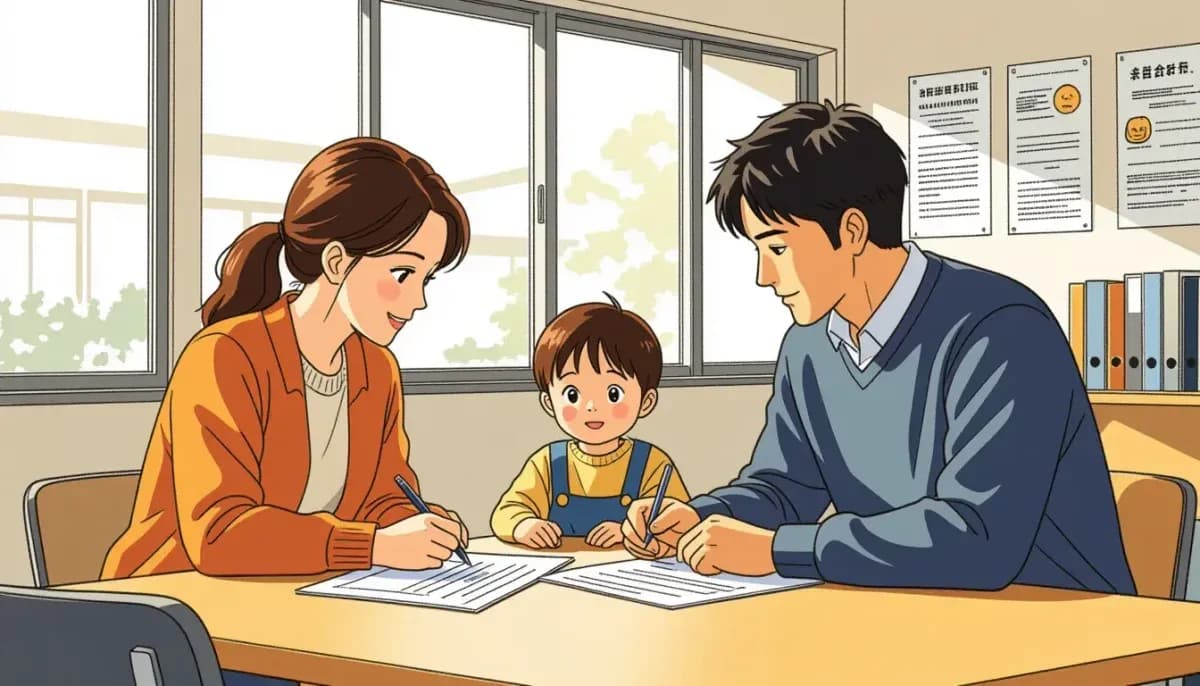
Complete step-by-step guide to applying for hoikuen daycare in Japan as a foreign parent. Learn about the timeline, required documents, point system, costs, and tips to increase your chances of acceptance.
How to Apply for Hoikuen Daycare in Japan Step by Step
Finding daycare for your child in Japan can feel overwhelming, especially as a foreign parent navigating an unfamiliar system. Hoikuen (保育園) are licensed daycare centers that accept children from as young as two months old up to school age. The application process is centralized through your local municipal office, not the individual daycare centers. This guide walks you through every step of the hoikuen application process, from understanding the timeline to maximizing your chances of acceptance.
If you are new to the Japanese daycare system, start with our complete guide to daycare and hoikuen in Japan for an overview of all childcare options available to foreign families.
Understanding the Hoikuen Application Timeline
The most important thing to know about hoikuen applications is that timing is everything. Most municipalities operate on a fixed annual cycle, with the primary enrollment period targeting an April 1 start date, which aligns with the Japanese school year.
Here is the typical timeline you should follow:
| Period | Action |
|---|---|
| June–August | Research hoikuen in your area, attend facility tours and open days |
| September–October | Municipal offices release application forms and guidelines |
| October–November | Main application submission window (deadlines vary by city) |
| December–January | Municipal officials score applications using the point system |
| Late January–February | First-round results announced |
| February–March | Second-round applications for remaining spots |
| April 1 | Children begin attending hoikuen |
If you miss the main application window, do not panic. Most cities accept monthly rolling applications throughout the year. You can typically submit your application by the 10th of the month prior to your desired start date. However, mid-year spots are much more limited than April openings.
Step 1: Research and Visit Hoikuen in Your Area
Before applying, spend time researching the hoikuen options available in your ward or city. Your municipal office website will have a list of all licensed daycare facilities, including their capacity, age ranges, and operating hours.
What to look for during facility visits:
- Staff-to-child ratios and overall atmosphere
- Daily schedule and educational approach
- Meal programs (most hoikuen prepare meals on-site)
- Outdoor play space and facilities
- Proximity to your home or workplace
- Extended hours (延長保育) availability
Most hoikuen hold open house events (見学会) between June and September. Call ahead to schedule a visit, as many facilities require advance reservations. Some hoikuen staff may not speak English, so consider bringing a Japanese-speaking friend or using a translation app.
You can list up to 10 hoikuen preferences on your application, so visit as many as possible. Use all available preference slots to maximize your chances. For more tips on navigating life in Japan as a foreign family, check out this guide to raising children in Japan.
Step 2: Gather Your Required Documents
The application requires several documents that can take time to collect. Start gathering them at least one month before the deadline. Here is what you will need:
Standard required documents:
- Hoikuen admission application form (入所申込書)
- Childcare benefit certification form (支給認定申請書)
- Employment certificate (就労証明書) — must be completed by your employer, typically within the last 3 months
- Child health report (医療・保育調査票)
- Copy of MyNumber cards for the child and both guardians
- Residence certificate (住民票)
- Consent form for municipal tax information access
Additional documents for foreign parents:
- Copy of Residence Card (在留カード), front and back
- Passport copies (some municipalities request this)
If you are self-employed, you will need to provide tax returns or business registration documents instead of an employment certificate. Students need enrollment verification from their school, including Japanese language schools. For a broader look at visa and legal considerations, see our article on visa and legal issues for foreign families.
Step 3: Understand the Point System
Japanese municipalities use a point-based scoring system (指数) to determine which families receive hoikuen spots. Understanding this system is crucial for maximizing your chances, especially in competitive areas like Tokyo.
Base points are calculated per parent based on work hours:
| Monthly Work Hours | Points Per Parent |
|---|---|
| 160+ hours (full-time) | 100 points |
| 120–159 hours | 90 points |
| 80–119 hours | 80 points |
| 64–79 hours (minimum) | 70 points |
| Job seeking | 40–50 points |
Common adjustment factors:
| Situation | Point Adjustment |
|---|---|
| Single parent household | +20 points |
| Sibling already enrolled at same hoikuen | +10 points |
| Twins or multiples applying | +10 points |
| Currently on waitlist (reapplying) | +1 to +2 points |
| Using unauthorized daycare while waiting | +1 point |
| Grandparent living nearby who could provide care | -2 points |
In competitive cities like Tokyo, families typically need 200 to 240 combined points to secure a spot. This means both parents working full-time (100 + 100 = 200) is essentially the baseline in popular areas. Every adjustment point matters. For more information about family life planning in Japan, understanding these systems early is essential.
Step 4: Submit Your Application
Take your completed documents to your municipal ward office (区役所 or 市役所) during the application window. Here is what to expect:
Submission process:
- Go to the childcare section (保育課) of your ward office
- Submit all documents — staff will review them on the spot
- Ask any questions about the point system or your specific situation
- Receive a confirmation receipt with your application number
- Some municipalities now allow online or mail-in submissions
Tips for the submission visit:
- Arrive early, as wait times can be long during peak application periods
- Bring originals and copies of all documents
- If your Japanese is limited, some ward offices have multilingual consultation counters — call ahead to check availability
- Ask the staff to explain your estimated point score so you know where you stand
If both parents cannot attend together, one parent can submit on behalf of the household. Make sure all signatures are completed in advance.
Step 5: After Submitting — Results and Next Steps
After the application deadline closes, the municipal office scores all applications and assigns children to hoikuen based on points and preferences. The process typically takes 2 to 3 months.
If you are accepted:
- You will receive a notification letter (内定通知) by mail, usually in late January or February
- Attend the mandatory orientation session at your assigned hoikuen
- Submit final paperwork including updated health forms
- Your child starts on April 1 — most hoikuen have a gradual adjustment period (慣らし保育) during the first 1 to 2 weeks
If you are not accepted (waitlisted):
- You will be placed on a waiting list (待機児童)
- Apply again in the second round (February–March) for remaining spots
- Continue submitting monthly applications — spots open throughout the year as families move or circumstances change
- Consider alternative childcare options while waiting, such as unauthorized daycare (認可外保育施設) or small-scale nurseries
The good news is that Japan's waitlist situation has improved dramatically. Nationwide, the number of waitlisted children reached a historic low of just 2,567 in April 2024, down from tens of thousands just a few years ago. However, popular urban areas and the 0 to 1 age group remain competitive.
Hoikuen Costs: What to Expect
One of the biggest benefits of licensed hoikuen is the cost structure. Since October 2019, Japan's free early childhood education policy covers all children ages 3 to 5, making hoikuen tuition-free for this age group.
For children ages 0 to 2, monthly fees are calculated on a sliding scale based on household income:
| Household Income Level | Approximate Monthly Fee |
|---|---|
| Low income / tax exempt | ¥0 |
| Moderate income | ¥20,000–¥35,000 |
| Above average income | ¥35,000–¥50,000 |
| High income | ¥50,000–¥60,000+ |
Additional costs may include:
- Extended hours fees (延長保育料): ¥2,000–¥5,000/month
- Bedding and supplies: ¥1,000–¥3,000/month
- Special event fees and field trip costs
These fees are significantly lower than private or international daycare options. For more information about managing your family budget in Japan, see our guide on financial planning for expat families.
Tips to Increase Your Chances of Acceptance
Competition for hoikuen spots varies greatly by location and age group. Here are proven strategies to improve your odds:
1. Apply for the 0-year-old class. Counterintuitively, applying when your child is very young (around 6 months) often gives better odds because there are more spots relative to applicants compared to the 1-year-old class.
2. Consider small-scale nurseries (小規模保育事業). These facilities serve children ages 0 to 2 and typically have less competition. They are a great stepping stone, and children often receive priority transfer to regular hoikuen at age 3.
3. List your maximum preferences. Use all available preference slots on your application. Ranking 8 to 10 facilities gives you significantly better odds than listing only 2 or 3.
4. Both parents should maintain full-time employment. Since the point system heavily weighs working hours, both parents working 160+ hours per month maximizes your base score.
5. Start childcare before the application. Using an unauthorized daycare or babysitter while applying can earn you additional adjustment points in many municipalities.
6. Research specific ward competitiveness. If you have flexibility in where you live, some wards and cities have much lower competition. Moving to a less competitive area before applying can dramatically improve your chances.
For additional resources on childcare and education options in Japan, Chuukou Benkyou offers helpful study guides for older children preparing for school entrance exams.
Common Mistakes Foreign Parents Make
Navigating the hoikuen system as a foreigner comes with unique challenges. Avoid these common pitfalls:
- Missing the deadline: The October–November window is strict. Mark it on your calendar months in advance.
- Not visiting facilities: Applying without visiting can lead to placement at a hoikuen that does not match your family's needs.
- Incomplete documents: Missing even one form can delay or invalidate your application. Double-check everything.
- Only listing a few preferences: Listing just 1 or 2 hoikuen dramatically reduces your chances. Always maximize your preference list.
- Not asking for help at the ward office: Staff at the childcare counter are generally helpful, even with limited English. Do not hesitate to ask questions.
- Assuming rejection is final: The monthly rolling application system means new spots open regularly. Keep reapplying.
If you are expecting a baby and planning ahead, our guide on pregnancy and giving birth in Japan covers what to prepare before your child arrives, and our baby and infant care guide helps you navigate the early months.
Conclusion
Applying for hoikuen in Japan follows a structured process that rewards preparation and persistence. Start researching facilities early, gather your documents well before the deadline, and understand the point system to maximize your score. Even if you do not get accepted in the first round, the improving waitlist situation and monthly application cycles mean that persistence pays off. The key is to start early, apply broadly, and stay engaged with your municipal office throughout the process.
For a complete overview of all childcare and education options from birth through high school, explore our guide to the Japanese education system.

Originally from Vietnam, living in Japan for 16+ years. Graduated from Nagoya University, with 11 years of professional experience at Japanese and international companies. Sharing practical information for foreign parents raising children in Japan.
View Profile →Related Articles

Extended Hours and Overnight Daycare Services in Japan
Complete guide to extended hours daycare (encho hoiku), overnight childcare (yakan hoiku), baby hotels, and 24-hour babysitter services in Japan for foreign parents with non-standard work schedules.
Read more →
Daycare Meals and Nutrition Standards in Japan
Complete guide to daycare meals and nutrition standards in Japan for foreign parents. Learn about meal structure, shokuiku food education, allergy management, and tips for helping your child adjust to Japanese nursery school food.
Read more →
How to Choose the Best Daycare in Your Area of Japan
A complete guide for foreign parents on choosing the best daycare in Japan. Learn about hoikuen, yochien, the point system, costs, subsidies, and application tips for your area.
Read more →
Home-Based and Family Daycare in Japan Explained
Everything foreign parents need to know about hoiku mama and family daycare in Japan, including costs, how to apply, pros and cons, and tips for finding the right home-based childcare provider.
Read more →
Corporate and Workplace Daycare Options in Japan
Discover corporate daycare and workplace nursery options in Japan including jigyosho nai hoikuen, kigyou shudougata hoiku, costs, eligibility, and tips for foreign families navigating company-sponsored childcare.
Read more →
Free Daycare in Japan: Eligibility and How to Apply
Complete guide to Japan's free daycare policy for foreign families. Learn about eligibility for ages 0-5, the hoikuen application process, points system, required documents, and costs covered under the muenshouka program.
Read more →