
Digital Literacy Education in Japanese Schools

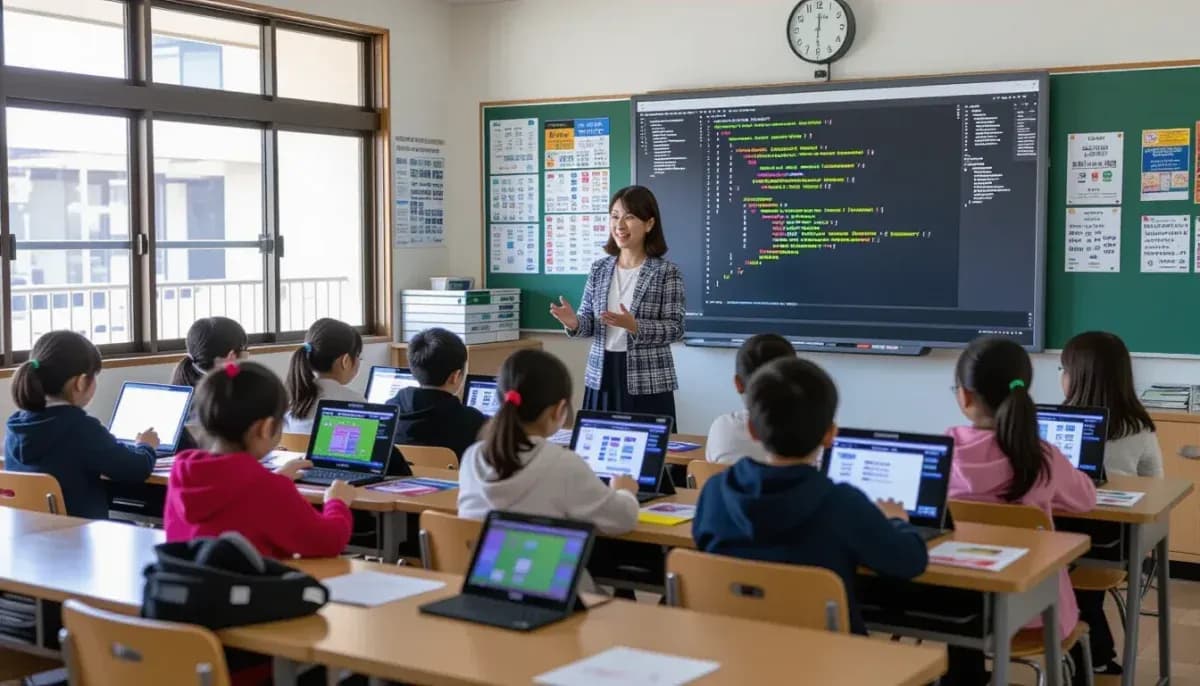
Complete guide to digital literacy education in Japanese schools for foreign families. Covers GIGA School initiative, mandatory programming, Information I entrance exam, and tips for expat children.
Digital Literacy Education in Japanese Schools: A Complete Guide for Foreign Families
Japan has made remarkable strides in digital literacy education over the past decade. From the nationwide GIGA School initiative that put a device in every student's hands to a new university entrance exam subject focused on information and programming, Japanese schools are actively reshaping how children engage with technology. For foreign families raising children in Japan, understanding this landscape is essential — whether your child attends a local public school, an international school, or something in between.
This guide covers everything you need to know about digital literacy education in Japanese schools: what the curriculum looks like, how the GIGA School program works, what the "Information I" exam means for university preparation, and how expat families can navigate and support their children's digital education journey.
What Is Digital Literacy Education in Japan?
Digital literacy in Japan's educational context encompasses a broad set of skills: the ability to use technology effectively, think critically about information online, program and code at a basic level, protect personal data and privacy, and participate safely and responsibly in digital society.
Japan's Ministry of Education, Culture, Sports, Science and Technology (MEXT) has progressively integrated digital skills across all grade levels. The approach shifted in the 2020s from treating ICT (Information and Communication Technology) as a standalone subject to embedding digital skills across the curriculum.
Key pillars of Japan's digital literacy education include:
- Programming logic and computational thinking (mandatory from elementary school since 2020)
- Information ethics and online safety (cyberspace rules, copyright, privacy)
- Data literacy (reading statistics, analyzing information critically)
- Media literacy (evaluating sources, identifying misinformation)
- Hands-on device and software skills (word processing, spreadsheets, presentations, digital communication)
For foreign families exploring what Japanese schools actually teach their children, understanding these pillars helps you assess whether the school's approach aligns with your family's expectations. For more on the overall structure of Japanese schooling, see our Complete Guide to the Japanese Education System for Foreign Families.
The GIGA School Initiative: One Device Per Student
The single most transformative development in Japanese digital education is the GIGA School Initiative (Global and Innovation Gateway for All), announced by MEXT in December 2019 and rapidly rolled out from 2020 onward.
The goals of GIGA School are straightforward but ambitious:
- Provide every student (elementary through junior high) with their own personal learning device
- Build high-speed, large-capacity school networks nationwide
- Enable personalized, cloud-based learning for all students
By March 2021, approximately 96% of Japanese schools had completed device deployment — an achievement accelerated significantly by the COVID-19 pandemic, which created urgent demand for distance learning infrastructure.
What Devices Do Students Use?
Schools participating in GIGA received devices through competitive bidding; most schools now use Chromebooks, with some opting for Windows tablets or iPads. The devices are generally owned by the school district and loaned to students, though policies vary by municipality on whether students can bring devices home.
Phase 2 of GIGA School (2024 Onward)
Japan's second phase of the GIGA School initiative, launched in 2024, goes beyond hardware. Key priorities include:
- Generative AI integration: Guidelines for responsible use of AI tools in learning
- Cloud infrastructure expansion: Moving from local storage to cloud-based collaborative environments
- High school rollout: Extending the 1-to-1 device model to senior high schools
- Teacher professional development: Addressing the gap in educators' technical confidence
For foreign families in Japanese public schools, this means your child is learning in an environment that is actively becoming more digital — and the pace of change is real. For related information on how elementary schooling works for expat children, visit our Elementary School in Japan: A Complete Guide for Foreign Parents.
You can also find research on the GIGA initiative's implementation through Oxford University's Department of Education project on the digitalization of education in Japan.
Programming Education: Mandatory from Elementary School
One of the most significant policy changes in Japanese education came in 2020, when programming education became mandatory in elementary schools. This was part of MEXT's broader effort to prepare students for a society increasingly shaped by AI and automation.
What Do Students Actually Learn?
Importantly, the mandatory programming curriculum at the elementary level is not about learning specific coding languages. Instead, the goal is to develop computational thinking — the ability to break down problems logically, identify patterns, and create step-by-step solutions.
At the elementary level, teachers often use visual block-based tools like Scratch or Japan's own プログル (Puguru) to make programming accessible without requiring syntax knowledge. The subject is typically integrated into existing classes (math, science, or general activity time) rather than taught as a standalone class.
At the junior high school level, programming instruction becomes more structured and explicit. Students learn basic programming concepts more formally, often including spreadsheet data analysis as a component.
At senior high school, the dedicated subject "Information I" (情報I) is a required subject that all students must study before graduation.
The Teacher Training Gap
There is a well-documented challenge: most Japanese elementary teachers have not received specialized ICT training. Because elementary teachers instruct multiple subjects (unlike the subject-specialist model in secondary schools), a homeroom teacher who majored in Japanese literature may be responsible for leading programming lessons. MEXT has implemented training programs, but consistency remains uneven across schools and regions.
Foreign parents at public schools may notice this variability. International schools, by contrast, typically have dedicated technology or computing teachers. For information on international school options in Japan, see our International Schools in Japan: The Definitive Guide for Families.
"Information I": The New University Entrance Exam Subject
For families with children heading toward Japanese university entrance exams, the introduction of "Information I" (情報I) as a required exam subject starting in January 2025 is a major development.
Information I covers four domains tested on the 共通テスト (Common University Entrance Test):
| Domain | Content |
|---|---|
| Information Society & Ethics | Problem-solving, copyright, privacy, information security |
| Communication & Information Design | Design thinking, effective digital communication, UX concepts |
| Computing & Programming | Algorithms, the DNCL pseudocode language, basic logic |
| Networks & Data Utilization | Internet infrastructure, data analysis, statistics basics |
The exam is 60 minutes, 100 points, multiple choice format only. Nearly all national and public universities now require or accept Information I scores, and engineering programs at many private universities factor it into admissions calculations.
For expat families aiming to have their children enter Japanese universities, awareness of this subject is critical — it is now a core part of high school preparation alongside math, Japanese, English, and science. Read more about high school options and university pathways in our High School in Japan: Options and Guidance for Foreign Families.
The chuukoubenkyou.com guide on the GIGA School initiative and its relationship to university entrance exams offers an excellent deep dive into how ICT education connects to examination preparation.
Japan's Digital Literacy Gap: The Hidden Paradox
Despite Japan's global reputation as a technology innovator and despite impressive infrastructure investments, research reveals a surprising practical digital skills gap — particularly among young people.
Key findings from recent studies:
- Only 6% of surveyed Japanese university students could correctly identify poor email etiquette in one study
- About 50% of students could identify search engines correctly; roughly one-third answered "I don't know" to basic digital questions
- Japan's IT skills among 16-34 year olds show a notable decline in those aged 24 and under — the inverse of most other developed countries, where this age group is strongest
- Japan's 2018 ICILS (International Computer and Information Literacy Study) score was 106, placing it in the global top tier for assessed computer literacy — yet this doesn't translate directly to real-world skills
Why the Gap Exists
Researchers and educators identify several root causes:
- Theory over practice: Traditional Japanese education emphasizes knowledge transmission and exam preparation. Digital tools are often taught as theory without sufficient hands-on practice.
- Teacher confidence: Many teachers are not confident digital users themselves, leading to conservative, limited classroom applications.
- Exam focus: Until Information I was introduced, digital skills were rarely tested, so schools deprioritized them relative to exam subjects.
- Passive device use: Students may use devices in school but primarily for consumption (watching, reading) rather than creation or problem-solving.
The 2023 government shift — moving from a "digital risk avoidance" model toward a "digital citizenship" model — represents a conscious policy response to this paradox. The new approach emphasizes building practical, applied skills rather than simply warning students about online dangers.
For insight into why Japan lags in digital practical skills despite its tech reputation, the GaijinPot article on Japan's digital literacy gap provides useful context for expats.
Digital Literacy for Foreign Children in Japanese Schools
Foreign children in Japanese public schools face a dual challenge: navigating digital literacy education in a second language while adapting to Japanese school culture and expectations.
As of 2024, approximately 129,000 foreign children attend Japanese public schools, a 9% increase year-over-year, reflecting Japan's growing international population. Of these, roughly 70,000 students require Japanese language instruction — double the number from a decade ago.
What This Means for Digital Learning
For foreign children who are still developing Japanese language proficiency:
- Device-based learning can be beneficial: Visual tools, educational apps, and interactive software often reduce the language barrier compared to textbook-based instruction
- Scratch and visual programming are largely language-independent at the elementary level
- ICT tools may actually support Japanese language acquisition when used with language-learning apps approved by schools
- Some municipalities offer multilingual device settings or translated digital materials for foreign students
However, as children advance to junior high and high school — where Information I becomes more text-heavy and exam-focused — language proficiency becomes more critical for digital literacy success.
International Schools vs. Public Schools
Foreign families have a meaningful choice to make regarding schooling format. Here is how digital literacy education compares:
| Feature | Japanese Public School | International School |
|---|---|---|
| Curriculum framework | MEXT / GIGA School | IB, Cambridge, US, or UK curriculum |
| Device provision | Government-provided (GIGA) | School-provided or bring-your-own |
| Programming focus | Computational thinking, Info I | Varies; often more applied coding |
| Language of instruction | Japanese | English (usually) |
| Teacher ICT specialization | Variable | Typically dedicated IT teachers |
| Cost | Free | ¥1.5M–¥3M+/year |
Over 80 international schools operate in Japan (approximately 60 in the Tokyo area), teaching digital literacy within their own pedagogical frameworks. For families weighing these options, our guide to International Schools in Japan covers the full landscape.
For broader context on raising children across educational systems in Japan, Living in Nihon's guide for foreign families raising children in Japan is a helpful reference.
How to Support Your Child's Digital Literacy at Home
Whether your child is in a Japanese public school or an international school, parental involvement meaningfully shapes digital literacy development. Here are practical approaches:
Build Positive Digital Habits
- Establish consistent screen time boundaries, but balance restriction with guided productive screen time (creative projects, coding, reading)
- Use screen time for co-learning: explore educational platforms together, discuss what your child encountered online
- Japan's Ministry of Internal Affairs and Communications provides free online safety resources for families (available in Japanese); some prefectures offer English-language versions
Supplement School Learning
- Code.org, Scratch (MIT), and Khan Academy are excellent free resources compatible with what Japanese schools teach
- Introduce Google Workspace or Microsoft Office tools early, as these are used heavily in Japanese schools under the GIGA initiative
- For high school students preparing for Information I, MEXT publishes sample questions; practice materials are also available through cram schools (juku)
Communicate with Teachers
- Japanese public schools appreciate parent engagement; asking about digital learning plans at parent-teacher meetings (面談) is entirely appropriate
- Some schools have digital literacy newsletters or share app recommendations; ask the homeroom teacher about these resources
- For junior high and high school, confirm whether your child's school uses Teams, Google Classroom, or another LMS so you can reinforce learning continuity
For guidance on mental wellbeing alongside digital challenges, see our article on Mental Health and Emotional Wellbeing for Foreign Children in Japan.
For further resources on working in and around Japanese schools and education, For Work in Japan's English teaching guide offers useful context on how English educators interact with Japan's digital learning environment.
The Road Ahead: Japan's Digital Education Future
Japan's trajectory in digital literacy education is clearly upward, though the pace of change is uneven. The ¥100 billion government investment in digital education infrastructure, the mandatory Information I exam subject, and the Phase 2 GIGA expansion to high schools all signal a sustained, serious commitment.
For foreign families in Japan, the key takeaways are:
- Your child is in a system actively investing in digital education — GIGA devices, programming from elementary school, and Information I all represent genuine change
- Practical skills still lag infrastructure — supplement school learning with hands-on digital projects at home
- Language matters more as children advance — early digital learning is more language-accessible; high school digital education requires solid Japanese
- International school options are robust — if Japanese language acquisition is a barrier, international schools offer strong digital literacy programs in English
- The 2025 Information I entrance exam is real — if your child may apply to Japanese universities, begin preparing for this subject in high school
Japan is transitioning from a nation that used technology extensively in industry but taught it sparingly in schools to one that treats digital citizenship as a core educational outcome. For foreign families raising children here, that is a positive development — and one worth engaging with actively.
For more guidance on raising children in Japan, explore our related articles:

Originally from Vietnam, living in Japan for 16+ years. Graduated from Nagoya University, with 11 years of professional experience at Japanese and international companies. Sharing practical information for foreign parents raising children in Japan.
View Profile →Related Articles
Impact of Technology on Child Development in Japan
A comprehensive guide for foreign parents on screen time, AI use, and digital education in Japan. Backed by Japanese research data and practical parenting tips for expat families.
Read more →
Balancing Digital and Outdoor Activities for Children
Practical guide for expat families on balancing screen time and outdoor play in Japan. Research-backed strategies, Japanese seasonal activities, and school-level tips for raising healthy, balanced children.
Read more →
Coding and Programming Classes for Kids in Japan
Find the best English-friendly coding classes for kids in Japan. Compare Tokyo Coding Club, Little Hackers, Coding Lab Japan, and more — with prices, ages, and enrollment tips for foreign families.
Read more →
Parental Controls and Monitoring Tools Available in Japan
Complete guide to parental controls and monitoring tools for families in Japan. Covers Apple Screen Time, Google Family Link, LINE safety, Japanese regulations, and expert tips for foreign parents raising kids in Japan.
Read more →
Cyberbullying Prevention and Online Safety for Kids
Learn how to protect your child from cyberbullying in Japan. Covers warning signs, laws, English-language resources, and practical online safety rules for foreign families.
Read more →
Smartphone Rules and Policies for Children in Japan
Complete guide to smartphone rules and policies for children in Japan — school bans, regional ordinances, screen time data, and practical tips for foreign families navigating Japanese digital culture.
Read more →