
School Entrance Ceremony (Nyuugakushiki) Guide

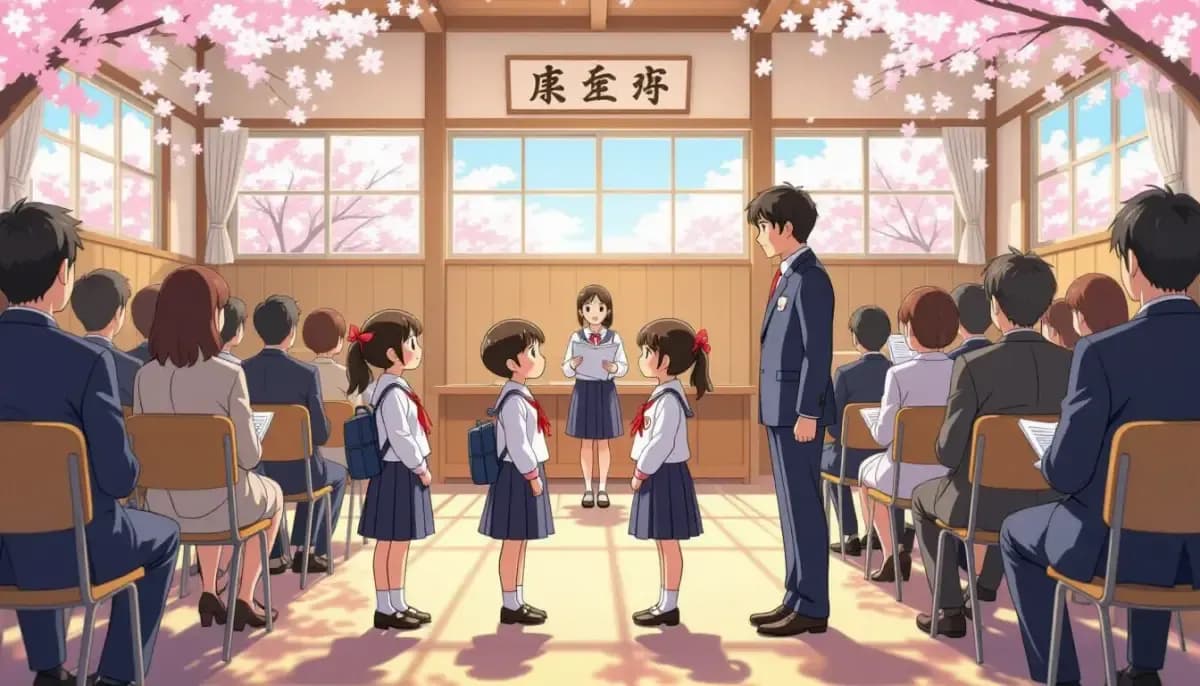
Complete guide to Japan's school entrance ceremony (nyuugakushiki) for foreign families. Learn what to wear, what to bring, the ceremony schedule, and how to prepare your child for this important Japanese tradition.
School Entrance Ceremony (Nyuugakushiki) Guide for Foreign Families in Japan
The school entrance ceremony — known in Japanese as nyuugakushiki (入学式) — is one of the most emotionally significant events in a Japanese family's calendar. Whether your child is starting elementary school, junior high, high school, or even university, the ceremony marks a formal and celebrated transition into a new stage of education. For foreign families living in Japan, understanding the traditions, etiquette, and logistics behind nyuugakushiki can transform a potentially confusing experience into a deeply meaningful one.
This guide covers everything you need to know: what happens during the ceremony, how to dress, what to bring, how foreign children participate, and how to navigate this quintessentially Japanese event with confidence.
What Is Nyuugakushiki? A Deeply Rooted Japanese Tradition
Nyuugakushiki (入学式) literally translates to "school entry ceremony." It is a formal event held every April at Japanese schools across all levels — from elementary schools (shougakkou) through to universities. The tradition is deeply embedded in Japanese culture and dates back to the Meiji era, when the government restructured the education system in the 1870s. The April start date was formalized around 1868, aligning academic and fiscal calendars — a system that remains unique to Japan among major nations.
The ceremony typically takes place in the school gymnasium (taiikukan) and lasts between 60 to 90 minutes. What makes nyuugakushiki distinctive is its formality: it is not a casual orientation but a structured, ceremonial event that signifies official enrollment. New students are formally welcomed, names are called, speeches are given, and the school song is sung — all in front of the assembled school community and families.
Cherry blossom season (hanami) coincides perfectly with these April ceremonies, and sakura are deeply woven into the symbolism. The fleeting beauty of cherry blossoms represents new beginnings — a sentiment entirely appropriate for the start of a new school chapter.
For foreign parents who may be attending their first nyuugakushiki, this guide on Living in Nihon provides helpful context about life milestones in Japan, while Savvy Tokyo's preparation guide offers detailed practical advice.
The Ceremony Program: What to Expect Step by Step
Understanding the structure of nyuugakushiki helps foreign families feel prepared and present on the day. Here is a typical ceremony flow:
Before the Ceremony
- Arrive at school early (at least 30 minutes before the start)
- Submit the shuugaku tsuuchisho (就学通知書) — the official school enrollment notification letter — at the reception desk
- Children separate from parents and proceed to their assigned classroom or staging area
- Parents are seated in the gymnasium
During the Ceremony
- Opening remarks by a school official
- National anthem (Kimigayo) — everyone stands
- Name-calling (点呼 tenko) — homeroom teachers call each new student's name; students respond clearly
- Principal's address — a formal welcoming speech
- PTA representative speech — typically a congratulatory message from the parent-teacher association
- Welcome speech from senior students — an older student formally welcomes the new students
- Reply speech from a new student representative — a new student speaks on behalf of their cohort
- School song (kouka seishou 校歌斉唱) — everyone sings the school song
- Closing remarks and dismissal
After the Ceremony
- Families visit the homeroom classroom
- Homeroom teachers distribute materials, explain rules, and answer questions
- Commemorative photos are taken — both informal family photos outside and sometimes a class photo
- The school day typically ends mid-morning; many families celebrate with lunch out together
This is NOT a regular school day. Students are released after the ceremony and classroom visit.
What to Wear: Dress Code for Parents and Children
Nyuugakushiki has a clearly defined dress code that Japanese families follow closely. As a foreign parent, dressing appropriately demonstrates respect for the occasion and helps you feel comfortable. Avoid casual clothing entirely — this is a formal ceremony equivalent to a graduation event.
| Who | Recommended Attire | Colors | What to Avoid |
|---|---|---|---|
| Mothers | Dress + jacket or formal pantsuit | Navy, gray, beige, black, white, soft pastels | Bright colors, flashy patterns, casual fabrics |
| Fathers | Dark business suit + white shirt + tie | Navy, dark gray, charcoal | Casual shirts, no tie, bright colors |
| New students (uniform required) | School uniform (prescribed by school) | Per school policy | Civilian clothes unless school has no uniform |
| New students (no uniform schools) | Smart formal wear — dark blazer, dress | Neutral, formal | Casual jeans, t-shirts, sneakers |
Tips for mothers:
- Low heels or formal flats are preferable (the gym floor may require indoor shoes)
- A small clutch or structured handbag is ideal
- Pearl jewelry or a flower brooch are common and appropriate accessories
- Avoid excessive jewelry or accessories that may attract attention
Tips for fathers:
- Dark business suit is the standard
- White dress shirt with a conservative tie
- Black or dark leather dress shoes
Note that indoor shoes (uwabaki 上履き) are often required — parents are expected to bring a pair of indoor shoes in a separate bag, as outdoor shoes are typically stored at the school entrance.
What to Bring: Your Nyuugakushiki Checklist
Being prepared with the right items will make your day run smoothly. Below is a comprehensive checklist for families attending the ceremony.
| Item | Why You Need It |
|---|---|
| Shuugaku tsuuchisho (school enrollment letter) | Required for check-in at the reception desk |
| Indoor shoes (uwabaki) | Outdoor shoes are removed at the entrance; many schools require indoor shoes |
| Shoe bag | For carrying your outdoor shoes once you change into indoor shoes |
| Multiple reusable shopping bags (2–3) | Schools hand out many materials, books, and supplies |
| Black pen and pencil | Many forms need to be filled in on the spot |
| Personal seal (hanko/inkan) | Some documents require your official seal |
| Permanent marker | For labeling school supplies with your child's name |
| Camera or smartphone | For commemorative photos; check school photography rules first |
| Handkerchief and tissues | Cultural standard in Japan; also useful for emotional moments |
For foreign families, understanding these logistical details is part of a broader orientation to Japanese school culture. See our complete guide to elementary school in Japan for foreign families for more information on day-to-day school life after the ceremony.
Foreign Children at Nyuugakushiki: What You Need to Know
Foreign families are warmly welcomed at nyuugakushiki. Here is what you need to know specifically as a non-Japanese family:
Enrollment Eligibility
Foreign children with a valid long-term residence visa who live with at least one parent in the local area are entitled to enroll in Japanese public schools on exactly the same basis as Japanese children. Public school enrollment is free, and the local municipal office (shiyakusho or kuyakusho) will guide you through the process. School applications for April enrollment typically need to be submitted in December or January of the preceding year.
Language Considerations
The entire ceremony is conducted in Japanese. Speeches, name-calling, songs — everything will be in Japanese. While this can feel overwhelming at first, foreign families are not expected to participate verbally unless specifically called upon. Simply standing and sitting at the appropriate moments is sufficient.
Some schools in areas with large foreign populations have interpretation services available or provide translated summaries. If your school has international support, they may introduce themselves during the classroom visit portion.
Your Child's Name-Calling Moment
One of the most important moments for any new student is when their name is called by the homeroom teacher (tenko). Practice your child's name in Japanese pronunciation in advance — Japanese teachers will read names as they appear in the school register, which may be in katakana (カタカナ) for non-Japanese names. Help your child practice responding clearly with "hai!" (はい! — "here!") and standing briefly.
Cultural Etiquette
- Do not call out to your child during the ceremony — applause is the appropriate response when names are called
- Silence your phone before entering the gymnasium
- Do not record or photograph without permission — many schools have specific rules about photography during the ceremony itself (photos are usually allowed after)
- Follow the flow — Japanese ceremonies are highly synchronized; watch others and follow their lead
For a broader picture of navigating the Japanese school system as a foreign family, read our guide on the Japanese education system for foreign families.
Nyuugakushiki at Different School Levels
The nyuugakushiki tradition exists at every level of Japanese education, though there are subtle differences:
| Level | Japanese Name | Age | Notable Features |
|---|---|---|---|
| Kindergarten | Nyuuenshiki (入園式) | 3–6 | Smaller, shorter, more informal; called nyuuenshiki not nyuugakushiki |
| Elementary School | Shougakkou nyuugakushiki | 6–7 | Most emotionally significant for families; large gym ceremony |
| Junior High School | Chuugakkou nyuugakushiki | 12–13 | Transition to more academic rigor; uniforms strictly observed |
| High School | Koukou nyuugakushiki | 15–16 | Often club activity introductions follow the ceremony |
| University | Daigaku nyuugakushiki | 18+ | Held in large auditoriums or halls; often university-wide |
Note that kindergarten uses the term nyuuenshiki (入園式) rather than nyuugakushiki, as the formal "school" (gakkou) terminology doesn't apply at that level. See our guide on kindergarten in Japan for foreign parents and our junior high school guide for foreign families for ceremony-specific details at those levels.
After the Ceremony: Celebrating and What Comes Next
The days following nyuugakushiki are typically orientation days. Your child's regular school schedule begins a few days after the ceremony. Here is what to expect:
- Week 1: Meet teachers, learn classroom rules, bring in required supplies
- Week 2: Normal class schedules begin, lunch (kyuushoku) routines start
- Month 1: Clubs and after-school activities information distributed (especially for junior high and high school)
Many Japanese families mark nyuugakushiki by taking commemorative photos under cherry blossom trees — a tradition called ランドセルショット (randoseru shot) for elementary school students, referring to the iconic backpack (randoseru). For foreign families, recreating this tradition makes for beautiful memories regardless of cultural background.
If your child attends a school with an international division or a school that serves many foreign students, there may be welcome materials or parent orientation sessions available in multiple languages. For more information on schools with international support, see our guide to international schools in Japan.
Key Japanese Vocabulary for Nyuugakushiki
Knowing a handful of key terms will help you navigate the ceremony and related school communications:
| Japanese | Romaji | Meaning |
|---|---|---|
| 入学式 | Nyuugakushiki | School entrance ceremony |
| 新入生 | Shin-nyuusei | New student |
| 担任 | Tan'nin | Homeroom teacher |
| 校長 | Kouchou | Principal |
| 校歌斉唱 | Kouka seishou | Singing of the school song |
| 国歌 | Kokka | National anthem |
| 歓迎の言葉 | Kangei no kotoba | Words of welcome |
| 就学通知書 | Shuugaku tsuuchisho | School enrollment notification |
| 上履き | Uwabaki | Indoor shoes |
| 保護者 | Hogosha | Parent/Guardian |
| 体育館 | Taiikukan | Gymnasium |
| 点呼 | Tenko | Name-calling/Roll call |
Frequently Asked Questions
Can foreign parents attend the ceremony even if they don't speak Japanese? Absolutely. Foreign parents attend nyuugakushiki regularly. The ceremony is visual and structured — you do not need to speak Japanese to participate. Simply arrive prepared, dress appropriately, and follow along with the crowd.
What if my child is very nervous? This is very common — even for Japanese children. Practice saying "hai!" clearly, walk through what will happen that morning, and remind your child that all their new classmates are experiencing the same thing for the first time. Meeting their homeroom teacher during the classroom visit portion often helps calm anxieties.
Are there any costs associated with the ceremony? The ceremony itself is free at public schools. However, you will likely need to purchase school supplies, the randoseru (backpack) for elementary school, and potentially uniform items before the ceremony. These can range from modest costs to significant expenses depending on the school.
What happens if we miss the ceremony? Missing the ceremony is not ideal, as it is a significant formal event. However, your child's enrollment is not voided if they are absent due to illness or emergency. Notify the school as soon as possible if attendance is not possible.
For more detailed guidance on navigating Japanese schools as a foreign family, JapanesePod101's nyuugakushiki guide provides cultural context and vocabulary, and Fun Japan's ceremony schedule guide covers dates and timing details. Additionally, For Work in Japan and Chuukou Benkyou are useful resources for navigating broader aspects of Japanese professional and academic life.
The school entrance ceremony is far more than a formality — it is a meaningful ritual that marks the beginning of a lifelong relationship with Japanese education. For foreign families, embracing nyuugakushiki with preparation and openness transforms it from an unfamiliar event into a cherished memory. Your child's first bow in their school uniform, the sound of their name being called, and the shared applause of an entire gymnasium welcoming them — these are moments worth every ounce of preparation.

Originally from Vietnam, living in Japan for 16+ years. Graduated from Nagoya University, with 11 years of professional experience at Japanese and international companies. Sharing practical information for foreign parents raising children in Japan.
View Profile →Related Articles

Creating Family Traditions That Blend Both Cultures
Discover practical strategies for multicultural families in Japan to blend two cultures through intentional traditions, bilingual rituals, and bicultural identity-building for children.
Read more →
How to Mark Milestones Across Two Cultures
A complete guide for bicultural and expat families in Japan on how to celebrate childhood milestones across two cultures — from Shichi-Go-San to birthday traditions, with practical tips for blending both worlds.
Read more →
Half Coming of Age (Nibun no Ichi Seijinshiki)
Everything foreign parents need to know about the Nibun no Ichi Seijinshiki - Japan's Half Coming of Age Ceremony for 10-year-olds. What it is, what happens, and how to participate.
Read more →
School Photo Day and Memory Traditions in Japan
Everything expat parents need to know about school photo day traditions in Japan — from the entrance ceremony shot to graduation albums (sotsugyou arubamu), shashin hanbai ordering systems, yosegaki, and purikura culture.
Read more →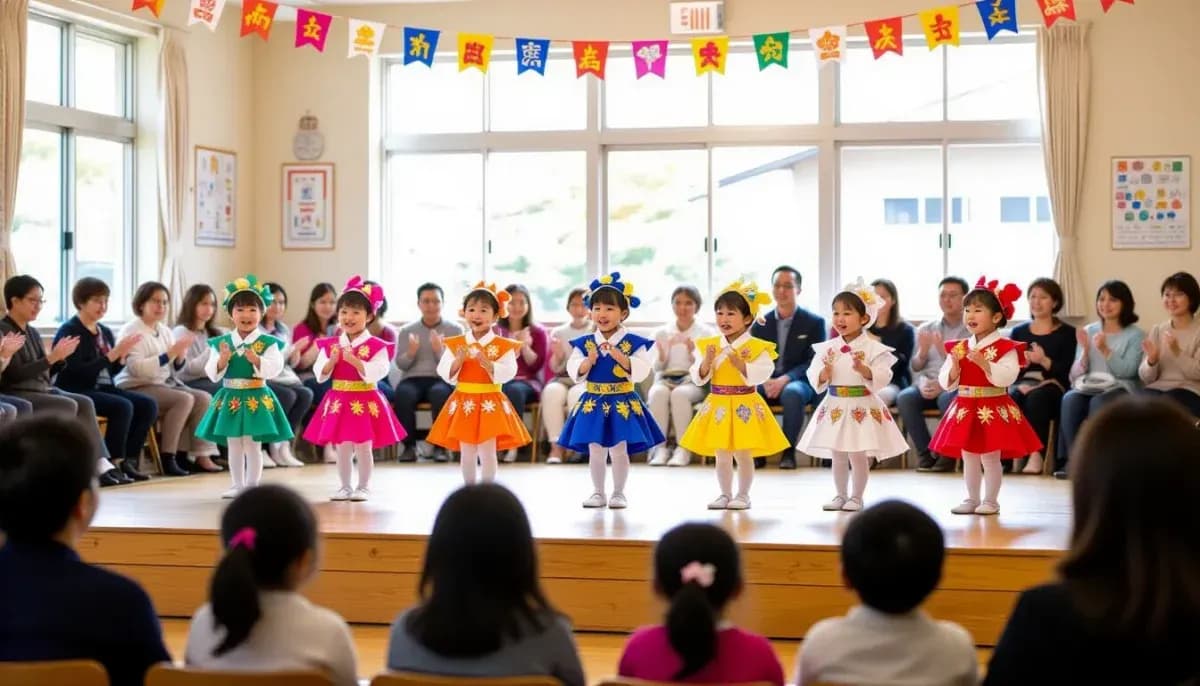
Preschool Recitals and Performance Events
Everything foreign parents need to know about preschool recitals and performance events in Japan — happyokai, undoukai, sotsuenshiki, and more. Practical tips for expat families.
Read more →
Randoseru Buying: Choosing Your Child's School Bag
Everything foreign families need to know about buying a randoseru in Japan — prices, materials, colors, brands, and when to shop. Practical tips for expat parents.
Read more →