
Creating Family Traditions That Blend Both Cultures

Discover practical strategies for multicultural families in Japan to blend two cultures through intentional traditions, bilingual rituals, and bicultural identity-building for children.
Creating Family Traditions That Blend Both Cultures in Japan
Living in Japan as a multicultural family is one of life's most enriching experiences — and one of its most complex. You celebrate Christmas and Oshogatsu, pack bento boxes alongside home-country snacks, and navigate the daily dance between two languages, two worldviews, and two sets of deeply held customs. As of 2024, Japan's foreign resident population has reached approximately 3.77 million, a 10.5% increase year-over-year, and over 20,000 international marriages are registered annually. Multicultural families are not the exception — they are a growing, vibrant part of Japanese society.
But building a family identity that honors both heritages doesn't happen automatically. It requires intentional effort, creative thinking, and a genuine desire to weave two cultural threads into something new and uniquely your own. This guide offers practical strategies, ideas, and frameworks for creating family traditions that blend both cultures — so your children grow up proud of who they are, wherever they come from.
Why Intentional Tradition-Building Matters for Multicultural Families
Cultural identity doesn't maintain itself. Research and the lived experience of long-term expats in Japan alike confirm that without deliberate effort, it's surprisingly easy to let your home-culture traditions fade as you adapt to Japanese life. Japan Today has explored how long-term expats gradually adopt Japanese communication styles, food preferences, and social norms — sometimes without even noticing. This drift can leave children with a lopsided cultural identity, fluent in Japanese life but disconnected from their other heritage.
The flip side is equally problematic: clinging rigidly to home-country customs while resisting Japanese culture creates alienation and misses the profound opportunity of raising a truly bicultural child.
The sweet spot — the goal this article is about — is intentional blending. Rather than choosing one culture or the other, multicultural families in Japan can deliberately craft a family culture that holds both. Named and intentional hybrid traditions signal continuity to children: this is who we are, and this is beautiful.
Key principles for intentional tradition-building:
- Adapt rather than abandon: Modify traditions to suit your Japanese context without losing their core meaning
- Create new traditions from scratch: Some of the most beloved family rituals are invented, not inherited
- Foster open intergenerational dialogue: Share the "why" behind traditions with children at every age
- Embrace hybrid identities: Teach children that being from two cultures is an asset, not a contradiction
- Document your family culture: A shared archive — photos, journals, recipes — gives children a touchstone they can return to throughout their lives
For more on supporting your children's bicultural identity, see our guide on Cultural Identity for Hafu and Mixed-Race Children in Japan.
Blending Japanese Seasonal Celebrations with Home-Country Holidays
Japan's ritual calendar is extraordinarily rich, and it offers multicultural families a ready-made structure for year-round tradition-building. The key is to layer your home-country celebrations on top of — not instead of — the Japanese seasonal cycle.
The Japanese Festive Year for Multicultural Families
| Japanese Tradition | Date | Multicultural Family Opportunity |
|---|---|---|
| Oshogatsu (New Year) | January 1–3 | Combine osechi meals with home-country New Year foods; write new year wishes in both languages |
| Setsubun (Bean Throwing) | February 3 | Pair with home-country winter traditions; explain the concept of driving out bad luck across cultures |
| Hinamatsuri (Doll Festival) | March 3 | Girls' celebration; pair with equivalent home-country traditions honoring daughters |
| Children's Day (Kodomo no Hi) | May 5 | Fly koinobori; add a parallel celebration from home culture honoring children |
| Tanabata | July 7 | Write wishes on tanzaku paper in both languages; discuss the legend and parallel stories from home culture |
| Obon | August | Ancestor remembrance; discuss parallel concepts of honoring ancestors from home culture |
| Shichigosan | November 15 | Shrine blessing for ages 3, 5, 7; combine with home-country milestone traditions |
| Christmas/Home-Country Holidays | Varies | Celebrate fully; explain to Japanese relatives the meaning and traditions involved |
The goal is not to celebrate everything at maximum intensity — that path leads to burnout. Instead, choose the Japanese traditions that resonate most deeply with your family and the home-country holidays that feel most essential. Make each celebration meaningful rather than obligatory.
For guidance on Japanese seasonal traditions in depth, see the Japanese Seasons, Traditions & Events Complete Guide at Living in Nihon.
Creating New Hybrid Traditions Unique to Your Family
Some of the most powerful family traditions are neither purely Japanese nor purely from your home country — they are something new, born from the intersection of both. These invented traditions carry particular meaning because they belong entirely to your family.
Ideas for hybrid traditions:
The Bilingual New Year Letter: Each family member writes a short letter summarizing the past year and their hopes for the next — in both languages. These are sealed and opened the following year. Over time, this archive becomes a treasured record of your family's growth across two cultures.
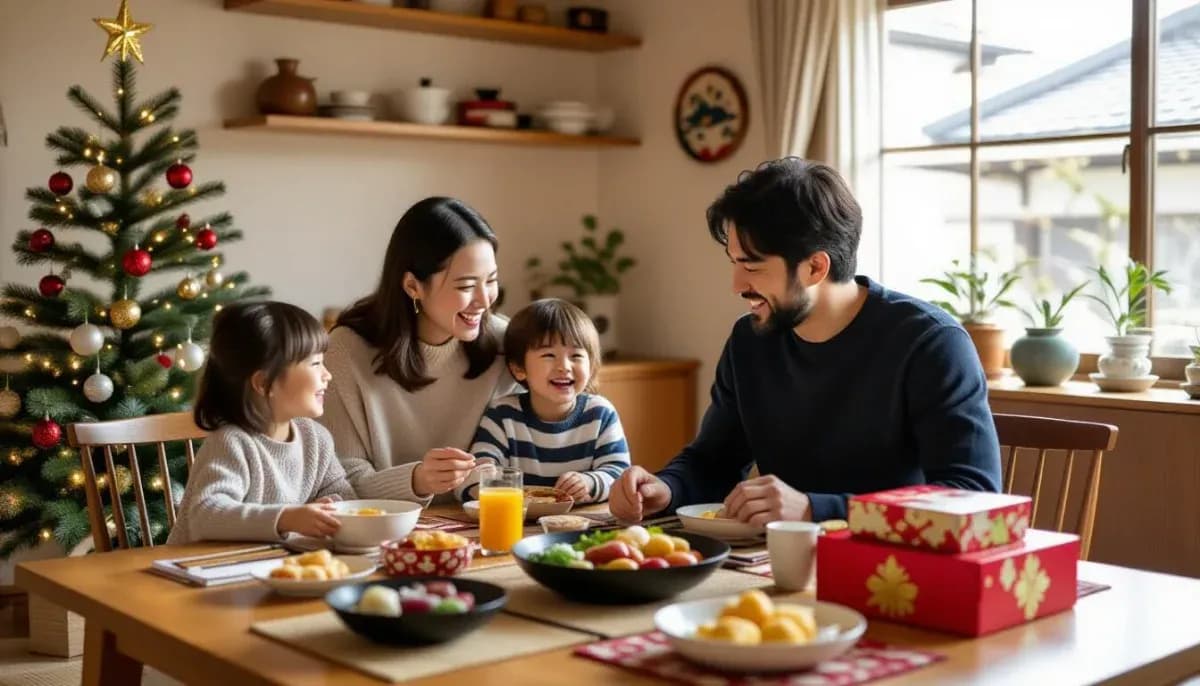
The Two-Table Dinner: For major holidays, set the table with dishes from both cultures. Miso soup alongside your home-country soup. Japanese rice alongside home-country bread. Chopsticks and forks together. Filipino-Japanese families report this as one of the most natural and joyful daily expressions of blended identity — miso soup alongside adobo, sushi with pancit, shared by everyone at the table.
The Family Culture Map: Create a visual map — physical or digital — marking meaningful places in both Japan and your home country. Update it with each trip, each family story. Children who grow up with this map develop a spatial sense of their dual heritage.
The Monthly Culture Night: Once a month, one parent "hosts" a cultural evening — choosing a film, a recipe, a piece of music, or a craft from their home culture. The other family members are the guests. This builds genuine curiosity and respect, and gives children ownership of both heritages.
The Bilingual Story Hour: Read the same story in both languages — either the same book in translation, or paired stories with similar themes. This reinforces both languages while making story time feel like an adventure across cultures.
For language strategies that support these traditions, see our guide on Raising Bilingual Children in Japan: Strategies and Best Practices.
!Multicultural family sharing a meal with Japanese and home-country dishes on the table together
Navigating Cultural Differences in Parenting Style
One of the subtler challenges in multicultural families is that the two parents may have been raised with fundamentally different assumptions about how children should be raised — and those assumptions are often invisible until they collide.
Japanese parenting culture tends to emphasize harmony, group belonging, and quiet self-discipline. Children are expected to learn the concept of kuuki wo yomu (空気を読む) — "reading the air" — from an early age, picking up unspoken social cues. Emotional expressiveness is often modulated; direct confrontation is avoided.
Many Western and Southeast Asian parenting cultures emphasize verbal expressiveness, direct communication, and explicit affirmation. Filipino parenting, for example, combines warmth and emotional closeness (labeling children with affectionate nicknames, physical affection) with a strong emphasis on family loyalty.
Neither approach is wrong — but they can create confusion for children when inconsistently applied, and friction between parents who haven't explicitly negotiated their shared approach.
A practical framework for negotiating parenting styles:
- Name three core household values: Sit down with your partner and agree on three non-negotiable values that will guide your family — regardless of cultural origin. (Examples: honesty, kindness, perseverance.) Write them down.
- Establish one weekly ritual: A consistent, low-stakes shared ritual — a Sunday breakfast, a Friday movie night, a Saturday walk — anchors the family week and communicates stability to children.
- Schedule a monthly cultural check-in: A brief, calm conversation (not during a conflict) where both parents share what cultural moments they've noticed in the family that week. What went well? What felt confusing?
- Document your agreements: Written decisions — even informal ones — are invaluable during emotionally charged moments when cultural defaults reassert themselves.
For deeper reading on the cross-cultural dynamics of raising children in Japan, the Cross-Cultural Understanding Guide at Living in Nihon provides excellent context on navigating Japan's high-context communication culture as a foreign parent.
Connecting Children to Extended Family Across Borders
One of the most poignant challenges of raising children in Japan is the physical distance from grandparents and extended family in your home country. These relationships are not just emotionally important — they are a primary conduit for children's connection to their heritage culture, language, and family stories.
Intentional strategies for maintaining these connections:
Regular video calls with a ritual structure: Rather than open-ended catch-up calls that can feel awkward for children, build a ritual into the call. Grandparents can read a story, teach a recipe, play a game, or share a memory. Children engage more deeply with structured activities than with abstract conversation.
Shared digital archive: Use a shared photo album, family blog, or messaging group where grandparents post photos and short stories — and your children can post their Japanese life in return. This creates an ongoing, asynchronous conversation across borders.
Care packages and recipe exchanges: Receiving a package of home-country foods, crafts, or seasonal items from grandparents is a powerful physical connection to heritage. Teaching children to prepare a Japanese dish to "send" the recipe to grandparents creates the same bridge in reverse.
Annual visits with cultural immersion: When visiting your home country, structure at least part of the visit around cultural experiences — a local festival, a family recipe cooking session, a visit to a meaningful place. Don't let the visit be only logistics; make it a deliberate heritage experience for your children.
Storytelling as legacy: Ask grandparents to record audio or video stories about their lives — childhood memories, family history, cultural traditions. These recordings become irreplaceable for children as they grow older and begin to form their own sense of identity.
For practical guidance on supporting your children's heritage language alongside Japanese, see our article on Heritage Language Maintenance for Children in Japan.
Building Community: Finding Your Multicultural Tribe in Japan
Tradition-building doesn't happen in isolation. One of the most important resources for multicultural families in Japan is community — other families who are navigating the same questions, celebrating the same blended holidays, and raising the same bicultural children.
Where to find multicultural community in Japan:
- Municipal international exchange associations (国際交流協会): Most cities and wards have these, offering Japanese language support, cultural events, and connections to other foreign residents. They are often the fastest way to meet other multicultural families in your area.
- International school communities: Even if your children attend Japanese public school, international school communities often run events open to the broader expat family community.
- Foreign resident Facebook groups and online communities: City-specific groups (Tokyo, Osaka, Nagoya, Fukuoka, etc.) are active with advice, event listings, and community support.
- Neighborhood festivals (matsuri): Attending your local neighborhood association (町内会) events is one of the most effective ways to build genuine local relationships — and to give your children a sense of belonging in their Japanese community.
- Cultural heritage groups: Many embassies and cultural organizations run heritage events for families — Filipino community groups, French cultural institutes, British councils, and similar organizations provide regular programming.
The visitinsidejapan.com guide on Real Life in Multicultural Families in Japan offers candid perspectives from families who have navigated these challenges firsthand.
For practical settlement logistics that support multicultural family life, including health insurance and registration, For Work in Japan's family insurance guide covers essential administrative steps for foreign families.
Supporting Children's Bicultural Identity Through the School Years
As your children move through the Japanese school system, the question of cultural identity becomes increasingly complex. Japanese schools are designed around cultural homogeneity — not because of malice, but because Japan's school culture reflects a society that has historically been ethnically uniform. Foreign or mixed-heritage children can feel invisible, or alternately, conspicuously "different."
The family traditions you build at home are a critical counterbalance to this pressure. When children have a strong, positive, named family culture — one they can articulate and feel proud of — they are far better equipped to navigate questions about their identity at school and among peers.
Age-appropriate conversations about identity:
- Ages 3–6: Focus on concrete, positive experiences. "We celebrate both Christmas and Oshogatsu because our family comes from two special places." Avoid complexity; emphasize joy and belonging.
- Ages 7–10: Children can begin to understand that different doesn't mean lesser. Explain traditions with their "why." Involve children in choosing which traditions to carry forward.
- Ages 11+: Teenagers often grapple most intensely with identity questions. Create space for honest conversation about the experience of being between two cultures — without dismissing their struggles or over-romanticizing the experience.
The Psychology Today research on blending intercultural traditions confirms that the most successful multicultural families develop strong communication skills and mutual respect — and model these explicitly for their children.
For comprehensive guidance on the Japanese school experience from a foreign family's perspective, see our Complete Guide to the Japanese Education System for Foreign Families.
For support with your children's emotional wellbeing through these identity questions, our article on Mental Health and Emotional Wellbeing for Foreign Children in Japan provides targeted resources.
Practical Tips for Getting Started Today
You don't need a grand plan to begin building blended family traditions. Small, consistent actions accumulate over time into the family culture your children will remember and carry forward.
Start this week:
- Choose one Japanese seasonal tradition coming up in the calendar and plan a simple, meaningful way to celebrate it together as a family
- Ask your partner to share one tradition from their childhood that they most want your children to experience
- Write down three values you both agree should define your family culture — regardless of cultural origin
Start this month:
- Host your first "Culture Night" — one parent chooses the food, film, or activity; the whole family participates
- Set up a regular video call with grandparents or extended family, with a structured activity built in
- Visit a neighborhood community event or matsuri to begin building local roots alongside your international identity
Start this year:
- Create a family culture archive — a shared album, a box of meaningful objects, a recipe book that grows over time
- Establish one annual tradition that is uniquely yours — invented by your family, belonging entirely to you
- Have an honest conversation with your children (at an age-appropriate level) about what it means to belong to two cultures, and what that means for your family
Building a bicultural family culture is not a project with a finish line — it is an ongoing, living practice. The traditions you create now will be the stories your children tell their own children someday.
For more resources on raising children in Japan as a multicultural family, explore our guides on Raising Bilingual Children in Japan, Cultural Identity for Hafu and Mixed-Race Children, and Teaching Japanese to Foreign Children.

Originally from Vietnam, living in Japan for 16+ years. Graduated from Nagoya University, with 11 years of professional experience at Japanese and international companies. Sharing practical information for foreign parents raising children in Japan.
View Profile →Related Articles
How to Mark Milestones Across Two Cultures
A complete guide for bicultural and expat families in Japan on how to celebrate childhood milestones across two cultures — from Shichi-Go-San to birthday traditions, with practical tips for blending both worlds.
Read more →
Half Coming of Age (Nibun no Ichi Seijinshiki)
Everything foreign parents need to know about the Nibun no Ichi Seijinshiki - Japan's Half Coming of Age Ceremony for 10-year-olds. What it is, what happens, and how to participate.
Read more →
School Photo Day and Memory Traditions in Japan
Everything expat parents need to know about school photo day traditions in Japan — from the entrance ceremony shot to graduation albums (sotsugyou arubamu), shashin hanbai ordering systems, yosegaki, and purikura culture.
Read more →
Preschool Recitals and Performance Events
Everything foreign parents need to know about preschool recitals and performance events in Japan — happyokai, undoukai, sotsuenshiki, and more. Practical tips for expat families.
Read more →
Randoseru Buying: Choosing Your Child's School Bag
Everything foreign families need to know about buying a randoseru in Japan — prices, materials, colors, brands, and when to shop. Practical tips for expat parents.
Read more →
First Day of School Traditions and Customs in Japan
Everything foreign parents need to know about Japan's first day of school: the nyuugakushiki entrance ceremony, randoseru, dress codes, indoor shoes, and daily school customs.
Read more →