
Amae: Understanding Emotional Closeness in Japanese Families

Discover amae (甘え), the Japanese concept of emotional closeness and presumed indulgence in family life. Learn how this untranslatable concept shapes Japanese parenting, child development, and daily relationships — with practical insights for foreign families in Japan.
Amae: Understanding Emotional Closeness in Japanese Families
If you have spent any time with Japanese families, you may have noticed a kind of quiet, deeply felt closeness between parents and children that is difficult to name in English. Children lean into their parents without words; parents respond with patient attentiveness rather than verbal reassurance. This invisible thread connecting Japanese family members has a name: amae (甘え). Understanding amae is one of the most valuable keys any foreigner can have for making sense of Japanese family life, parenting philosophy, and even workplace culture.
Whether you are raising children in Japan, working with Japanese families, or simply trying to understand your neighbors and colleagues, this guide explains what amae really means, where it comes from, and how it shapes everyday life for families in Japan.
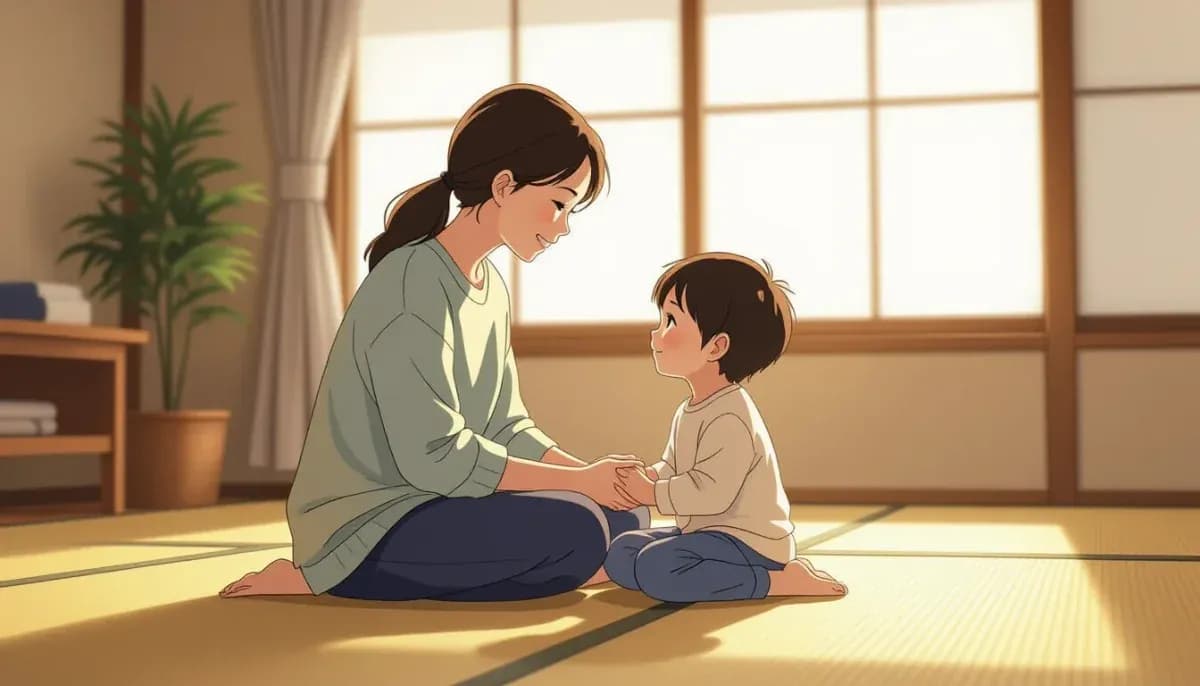
!Japanese mother and child sharing a warm moment of emotional closeness on tatami mat
What Is Amae? The Concept That Has No English Equivalent
The word amae (甘え) is derived from the verb amaeru, meaning to presume upon another's goodwill — to lean on someone's indulgence in the expectation that they will not refuse. The closest English translation might be "presumed acceptance" or "desire to be indulged," but no single English phrase captures the full nuance.
Amae was introduced to the international academic community by Japanese psychiatrist and psychoanalyst Takeo Doi in his landmark 1971 book The Anatomy of Dependence (甘えの構造, Amae no Kōzō). Doi argued that amae was not simply a Japanese quirk, but a fundamental human emotion that Japanese culture had developed a rich vocabulary for — and that other cultures had simply failed to name.
The concept begins in infancy. When a baby recognizes their mother as a separate person and actively seeks her closeness, the child is engaging in amae. The infant is not helpless; rather, the child is making a deliberate bid for connection. This is a crucial distinction: amae is not passive dependency but an active, relational strategy rooted in trust.
Importantly, Doi extended the concept well beyond childhood. Amae operates throughout Japanese social life — between students and teachers, employees and bosses, friends and spouses. Wherever there is a relationship of trust and difference in status, amae can appear.
The Three Core Functions of Amae in Family Life
Understanding why amae happens helps foreigners recognize it in action. Researchers have identified three primary functions that amae serves within relationships:
| Function | Description | Family Example |
|---|---|---|
| Goal Achievement | Requesting help from someone more capable or powerful when acting independently is too difficult | A child asking to be carried when tired, even though they can walk |
| Testing Affection | Making an unreasonable or minor request to gauge how much the other person cares | A child insisting on a specific snack to see if a parent will accommodate them |
| Relationship Strengthening | Deliberately initiating dependence to maintain closeness and reinforce the bond | A teenager still seeking a parent's opinion on small decisions, maintaining family ties |
What makes amae elegant as a concept is that all three functions serve the relationship, not just the individual. Amae is inherently other-oriented: it only works because the person being depended upon responds with warmth, patience, and willingness. In this sense, amae creates a loop of mutual affirmation — the child's bid for closeness is answered, reinforcing both the child's sense of security and the parent's sense of being needed and trusted.
For foreign parents living in Japan, recognizing these three functions can help decode behaviors that might otherwise seem puzzling. A Japanese child who asks a parent to do something they clearly could do themselves may not be "lazy" — they may be doing relationship maintenance in the most natural way they know.
Amae vs. Dependency: A Critical Misunderstanding
One of the most common mistakes Westerners make when first encountering amae is to dismiss it as straightforward dependency or spoiling. This misreading misses the essential structure of the concept.
In clinical psychology, dependency typically refers to a state in which a person surrenders control over their own life to another. The dependent person is passive; the controlling party holds power. Amae works differently. In an amae interaction, the person initiating amae actually retains a form of agency — they are choosing to seek indulgence from someone they trust, and they expect the trusted person to respond. The power, paradoxically, rests partly with the person who is asking.
British psychiatrist John Bowlby, whose attachment theory has shaped global understanding of parent-child bonding, explicitly cautioned against confusing attachment with dependency. Bowlby considered "dependency" a pejorative term that distorted what was actually happening in healthy parent-child closeness. A frightened child clinging to their parent is not exhibiting dependency in a problematic sense — they are exercising healthy attachment behavior.
Amae sits within this space. When a Japanese child runs to a parent for comfort, or an adult employee defers to a senior colleague's judgment, this is not weakness. It is the activation of a trust relationship that both parties have built and maintain together.
Cross-cultural research published in the journal Emotion (2006) found that when participants from both the United States and Japan were placed in scenarios describing amae situations, both groups reported more positive emotion and greater perceived closeness to the person who was seeking indulgence. The universal positive response suggests that amae taps into something deeply human — even if only Japanese has a word for it.
How Amae Shapes Japanese Parenting Practice
For foreigners raising children in Japan, or for those who send their children to Japanese schools and childcare, the practical influence of amae is visible in several distinct parenting approaches.
Non-verbal communication over verbal declaration. Japanese parents are typically less likely than Western parents to say "I love you" aloud on a daily basis. Love is expressed through consistent action: preparing specific meals, waiting patiently, physical presence, and quiet attentiveness. Children raised in amae-oriented environments learn to read this non-verbal language fluently.
The tatami mat dynamic. Researchers studying infant mental health in Japan have noted that traditional floor-level living (sitting and sleeping on tatami mats) places parents and babies at the same eye level. This physical equality creates conditions for reciprocal, non-verbal communication that reinforces the amae bond from the earliest weeks of life.
Balancing closeness with cultivated independence. Contrary to what some Western observers expect, amae-based parenting does not produce permanently dependent children. Japanese parents deliberately cultivate independence alongside closeness. The famous "first errand" (hajimete no otsukai) — in which children as young as five or six complete solo errands to a nearby shop — is a celebrated milestone in Japanese family life. There is even a long-running television program dedicated to filming children on these independent missions. The emotional security that amae provides actually becomes the foundation for confident independence.
Academic expectations alongside emotional warmth. Education is central to Japanese family life, and many children attend juku (cram schools) from elementary school age. However, early childhood (before age six) typically emphasizes social and emotional development over academics. The emotional attunement that amae fosters is seen as a prerequisite for the discipline and perseverance required in later schooling.
For practical guidance on navigating Japanese education from a foreign parent's perspective, see our guide to the Japanese education system for foreign families.
Amae in the Context of Cultural Change
Amae as a lived practice has not remained static. Takeo Doi himself noted in a 2007 postscript to The Anatomy of Dependence that younger Japanese were increasingly associating amae with "one-sided pampering or childish selfishness." This represents, in Doi's view, a fundamental distortion of the original concept — amae is not about selfishness, but about reciprocal trust.
This cultural shift reflects broader changes in Japanese society. Urbanization, smaller family units, longer working hours, and greater exposure to Western individualism have all altered the landscape in which amae is practiced. Fewer households contain multiple generations under one roof, which historically was one of the key environments in which amae operated across different relationship types simultaneously.
For foreign families in Japan, this means that the Japan you encounter today contains a spectrum: some families practice deeply traditional amae-oriented parenting, while others have moved toward approaches that emphasize more explicit verbal communication and earlier independence training. Neither is "more Japanese" than the other — both reflect the evolving reality of family life in contemporary Japan.
If you are navigating questions of cultural identity and belonging for your children, our article on cultural identity for hafu and mixed-race children in Japan explores related themes in depth.
Practical Insights for Foreign Parents and Expats
Understanding amae can improve your daily experience of life in Japan in concrete ways:
At school and daycare: Japanese teachers and childcare workers often rely on amae-like dynamics to create a sense of safety for young children. If your child seems to have formed an unusually close attachment to their sensei and wants constant reassurance from them, this is often normal and encouraged — not a sign of unhealthy attachment. See our guide to daycare and hoikuen in Japan for foreign parents for more on what to expect.
In conflict situations: When a Japanese colleague or neighbor seems to expect you to simply "know" what they want without being asked directly, or when requests are phrased in highly indirect ways, amae dynamics may be at play. The expectation of being understood without explicit statement is a natural extension of amae into adult social life.
With your own children: If you are raising children in Japan, your children may pick up amae-style communication from their Japanese peers and caregivers. This is not a problem — it is cultural adaptation. Being aware of amae helps you distinguish between a child who is seeking connection (healthy amae) and a child who is genuinely struggling (requiring a different response).
In your own relationships: Many foreigners find that relationships with Japanese friends, colleagues, and neighbors deepen significantly when they begin to understand and even participate in amae dynamics — allowing themselves to rely on others and accepting that being relied upon is an expression of trust, not imposition.
For a broader perspective on the mental and emotional dimensions of raising children in Japan, our guide to mental health and emotional wellbeing for foreign children in Japan covers related ground from a practical expat standpoint.
External Resources for Deeper Understanding
For foreigners living in Japan across all aspects of daily life, Living in Nihon offers practical guides covering housing, healthcare, and community integration. Those working in Japan can find detailed guidance on employment and workplace culture at For Work in Japan. For families concerned with education and academic support in Japan, Chuukou Benkyou covers the examination and school preparation landscape in detail.
For academic and deeper reading on amae, the World Association for Infant Mental Health has published a thoughtful exploration of how amae is applied in infant mental health practice. The Intercultural Word Sensei provides an accessible cross-cultural breakdown of the concept.
Conclusion: Amae as a Window into Japanese Family Life
Amae is far more than a parenting technique or a cultural quirk — it is a window into the Japanese understanding of what relationships are for. Rather than viewing human connection primarily through the lens of individual autonomy and self-sufficiency, amae culture understands relationships as the medium through which people become fully themselves. To depend on someone you trust, and to be depended upon, is not weakness — it is the texture of a good life.
For foreigners navigating family life in Japan, grasping amae can transform confusing situations into comprehensible ones, and deepen your appreciation for a parenting philosophy that has produced generations of emotionally attuned, socially skilled, and often surprisingly independent children. The next time a Japanese child reaches up without words, or a parent responds without being asked, you will recognize what is happening: the quiet, powerful language of amae.
For more on raising children and navigating family life in Japan as a foreigner, explore our guides to toddler parenting in Japan, raising bilingual children in Japan, and baby and infant care in Japan.

Originally from Vietnam, living in Japan for 16+ years. Graduated from Nagoya University, with 11 years of professional experience at Japanese and international companies. Sharing practical information for foreign parents raising children in Japan.
View Profile →Related Articles

Modern Parenting Trends and Changes in Japan
Explore how parenting in Japan is changing in 2025 — from landmark government reforms and childcare expansion to shifting discipline norms and the rise of involved fathers. A practical guide for foreign families.
Read more →
Mama-Tomo Culture: Navigating Mother Friendships in Japan
Understand mama-tomo (ママ友) culture in Japan and learn practical strategies for foreign mothers to build genuine friendships through hoikuen, kodomokan, and school communities.
Read more →
The Ikumen Movement: Japan's Push for Involved Fathers
Discover Japan's ikumen movement — the cultural push for involved fatherhood. Learn about paternity leave rights, government initiatives, and what it means for foreign fathers living in Japan.
Read more →
Japanese vs Western Parenting Styles Compared
Discover the key differences between Japanese and Western parenting styles — from amae and shitsuke to co-sleeping, discipline, and public behavior. A practical guide for foreign parents in Japan.
Read more →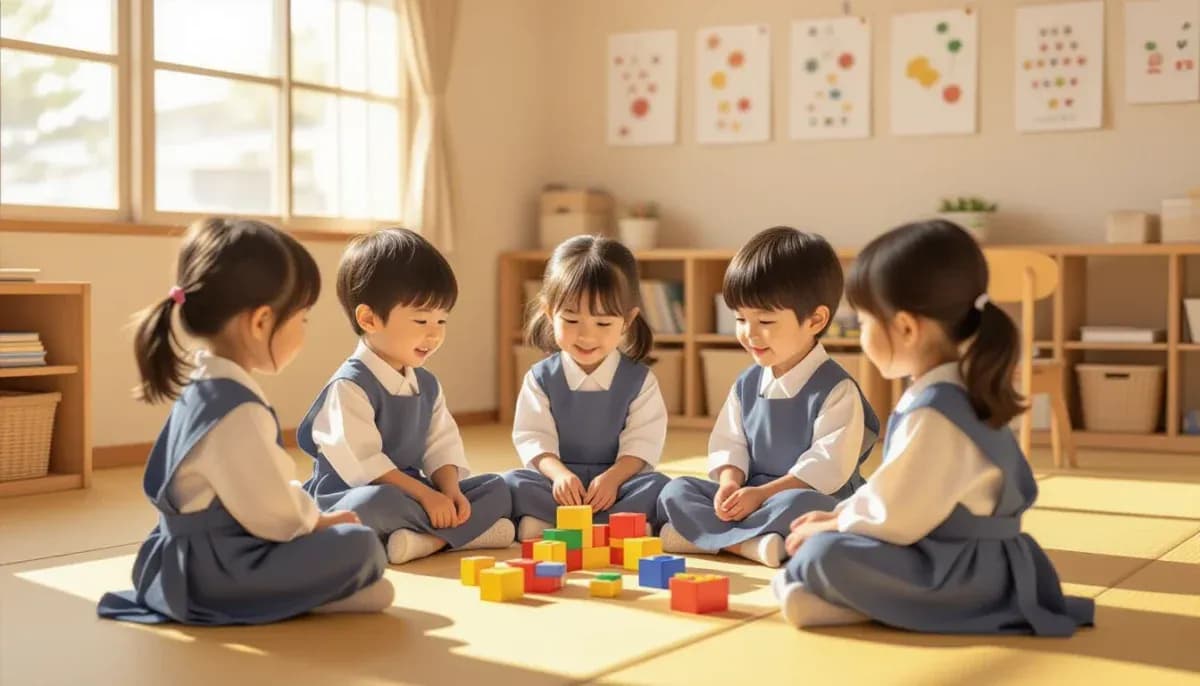
Group Harmony and Socialization in Japanese Child-Rearing
Understand wa (group harmony) and how Japanese schools, proximal parenting, and mimamoru shape your child's socialization. Essential guide for expat families in Japan.
Read more →
Japanese Approach to Early Childhood Development
Understand Japan's early childhood development philosophy: hoikuen, yochien, kodomoen, mimamoru, and Chi-Toku-Tai. A complete guide for foreign parents raising children in Japan.
Read more →