
Understanding Ijime: Bullying in Japanese Schools


A complete guide to understanding ijime (bullying) in Japanese schools for foreign families. Learn what ijime is, warning signs, legal protections, and how to report bullying effectively.
Understanding Ijime: Bullying in Japanese Schools
Bullying — known in Japan as ijime (いじめ) — is one of the most serious and widespread issues facing children in the Japanese education system. For foreign families raising children in Japan, understanding what ijime is, how it operates differently from bullying in Western countries, and what steps can be taken if your child becomes a victim is essential knowledge.
Japan's Ministry of Education (MEXT) reported a staggering 769,022 bullying cases in FY2024, a record high and an increase of roughly 5% compared to the previous year. Among these, 1,405 were classified as "serious cases" involving major physical or psychological harm. These numbers reflect both the scale of the problem and a growing willingness to report — but they also signal that ijime is not a marginal issue. It sits at the heart of Japanese school culture and affects students across all grade levels, from elementary school through high school.
This guide explains what ijime is, why it takes the distinctive form it does in Japan, the warning signs parents should watch for, and the steps you can take to protect your child and seek help.
What Is Ijime? The Official Definition
The term ijime (いじめ) is most often translated simply as "bullying," but the Japanese legal definition is more specific — and importantly, more victim-centered — than that word suggests.
Under the 2013 Ijime Prevention Methods Promotion Law (いじめ防止対策推進法), ijime is defined as:
"An act by a student or students toward another student in a relationship where there is a power imbalance, conducted through physical actions, verbal abuse, or behavior (including acts through the internet), that causes physical or psychological suffering, as judged from the standpoint of the child who feels bullied."
The critical phrase is "as judged from the standpoint of the child who feels bullied." This means that whether or not the perpetrator intended harm, if the victim experiences suffering, it legally qualifies as ijime. This victim-centered framework puts schools and teachers under a legal obligation to respond — regardless of whether they personally observed the behavior or agree that it was intentional.
For foreign families, this is important: your child does not need to prove intent or have physical evidence. Their experience of suffering is itself the starting point for a legal response from the school.
How Ijime Differs from Western Bullying
One of the most striking features of ijime for foreign parents is how structurally different it is from the individual-vs-individual bullying more common in Western school contexts.
Group Dynamics Are Central
In Japanese schools, group cohesion is a fundamental value. Students eat together, clean the classroom together, and are evaluated partly on their contribution to group harmony. The flip side of this strong group identity is a powerful mechanism for exclusion. Murahachibu (村八分) — the traditional practice of ostracizing members who deviate from group norms — has a long cultural history in Japan, and its echoes are visible in modern ijime.
The most typical pattern of ijime is shūdan ijime (集団いじめ): a group targeting a single individual. In severe cases, this can escalate to an entire class turning against one student, with the teacher either unaware or implicitly allowing it to continue. The power asymmetry is extreme, and the social isolation can be total.
The Five Most Common Forms of Ijime
| Form | Japanese Term | Description |
|---|---|---|
| Verbal abuse | 暴言・悪口 | Name-calling, mocking, spreading rumors |
| Social exclusion | 無視・仲間はずれ | Silent treatment, deliberately excluding from groups |
| Physical harassment | 暴力 | Hitting, pushing, taking belongings — often disguised as "joking" |
| Online/Cyber bullying | ネットいじめ | Harassment via LINE, social media, anonymous sites |
| Extortion | 金品の強要 | Demanding money or possessions under threat |
Verbal abuse and social exclusion are by far the most common. Research shows that boys tend toward physical intimidation, while girls more commonly use verbal and emotional tactics — often amplified through social media platforms like LINE and Instagram.
When Bullying Peaks: The Transition Years
MEXT data consistently shows that ijime cases surge during a specific developmental window: from 5th grade of elementary school through 1st year of junior high school (approximately ages 10–13). This period coincides with intense social pressure to conform, the formation of peer group hierarchies, and the high-stakes transition to junior high school in Japan.
A Tokyo study found that 66.2% of surveyed children had experienced some form of bullying, and 46.9% had been both a victim and a perpetrator at different times. This underscores that ijime is not simply about bad children — it is a structural feature of how Japanese school social dynamics operate.
Warning Signs Your Child May Be Experiencing Ijime
Children — especially those who feel shame or fear retaliation — rarely report ijime directly. Parents must know the behavioral and physical warning signs.
Behavioral Changes to Watch For
- Reluctance or refusal to go to school — particularly around specific classes or days
- Sudden loss of friendships — former friends stop visiting or contacting your child
- Changes in appetite or sleep — nightmares, insomnia, refusing meals
- Loss of interest in previously enjoyed activities
- Unusual requests for money — may indicate extortion
- Damaged or missing belongings without explanation
- Withdrawal and social isolation at home
- Aggression or irritability that seems out of character
Physical signs include unexplained bruises or injuries, especially if your child is reluctant to explain them. In more severe cases, children may express hopelessness or talk about not wanting to go to school indefinitely — a warning sign that warrants immediate attention.
Ijime is a leading cause of school refusal (futōkō/不登校) in Japan. In 2024, 353,970 elementary and junior high school students were classified as futōkō cases — a 12-consecutive-year record high. If your child is showing signs of stress and anxiety, connect these signals early rather than waiting.
For a detailed breakdown of specific warning signs, see our guide: Signs Your Child Is Being Bullied in a Japanese School.
The Particular Vulnerability of Foreign Children
Foreign children — whether hafu (half-Japanese), returnees from abroad, or non-Japanese nationals attending public school — face a specific and elevated risk of ijime.
The forms of bullying that target foreign children include:
- Language-based ridicule: Mocking a child's Japanese pronunciation, accent, or vocabulary level
- Racial and ethnic harassment: Comments about skin color, hair, eye color, or national origin
- Cultural mockery: Laughing at the contents of their bento lunchbox, their clothes, or family customs
- Deliberate social exclusion: Systematic exclusion from group activities, conversations, and school cliques
A distinctive feature of the Japanese classroom is the bystander culture: even students who privately disagree with the bullying behavior are unlikely to intervene, because doing so risks making themselves the next target. This means foreign children can find themselves socially isolated even in classrooms where most students do not actively bully them.
For a deeper look at this topic, see: Bullying of Foreign Children in Japanese Schools.
For those attending international schools in Japan, the risk profile is different — but not zero. Peer dynamics in international schools can be intense, and social exclusion is still common.
Japan's Legal Framework for Bullying Prevention
Japan's legal approach to ijime is comprehensive, and parents can and should use it.
The 2013 Ijime Prevention Law
The Ijime Prevention Methods Promotion Law (Act No. 71 of 2013) created a nationwide legal framework with the following requirements for schools:
- Mandatory regular surveys: Schools must periodically survey students to detect ijime early
- Immediate reporting: Schools must report ijime cases to the board of education
- Formal response plans: Each school must have a written anti-bullying policy
- Teacher training: Schools are required to train staff on how to identify and respond to ijime
This means parents have the legal right to request documentation. If you report a bullying incident, ask the school in writing for their formal response plan and what steps they have taken. Schools are legally required to respond.
More information on legal protections is available at Legal Protections Against Bullying in Japan.
The Role of the School and Board of Education
The anti-bullying programs and policies at Japanese schools generally follow a three-tier escalation:
- Homeroom teacher (担任/tanin) — first point of contact for reporting
- School administrator (校長・教頭/kōchō, kyōtō) — escalate if the teacher's response is inadequate
- Board of Education (教育委員会/kyōiku iinkai) — escalate if the school fails to act
If your child is being bullied, always document everything: dates, locations, descriptions of incidents, the names of any witnesses, and copies of all communications with the school.
For step-by-step reporting guidance, see: How to Report Bullying to Japanese Schools.
Online and Cyberbullying: The Digital Dimension
Ijime is no longer confined to the school building. Cyberbullying among children in Japan has become a significant and growing problem, with LINE being the primary platform.
Common forms of online ijime include:
- Exclusion from group chats: Creating a class LINE group that deliberately excludes one student
- Screenshotting private messages and sharing them with the wider class
- Posting embarrassing images or videos to Instagram or TikTok
- Anonymous harassment via sites like Whisper or Tellonym
LINE group exclusion is particularly devastating in Japan because class LINE groups are the primary means of communicating school information, assignments, and social events. Being excluded from the group means being cut off from the social life of the class.
What Parents Can Do: A Step-by-Step Response Guide
If you believe your child is experiencing ijime, take the following steps:
Step 1: Create a Safe Space at Home
Before taking any action outside the home, ensure your child feels safe telling you what is happening. Japanese children often internalize shame about being bullied — they may believe it reflects poorly on them. Reassure your child clearly: being bullied is not their fault, and you will support them unconditionally.
Step 2: Document Everything
Keep a written log of incidents including:
- Date and time
- What happened, in your child's words
- Who was involved (perpetrators, bystanders)
- Any physical evidence (damaged belongings, screenshots)
Step 3: Speak to the Homeroom Teacher
Request a face-to-face meeting (mendan) with the homeroom teacher. Bring your documentation. Ask the teacher directly:
- What have they observed?
- What will they do in response?
- When will they follow up with you?
If language is a barrier, ask the school to provide an interpreter (tsūyaku) or bring a bilingual friend.
Step 4: Escalate If Needed
If the teacher's response is inadequate, request a meeting with the principal (kōchō sensei). If the school's response remains unsatisfactory, contact the local board of education (kyōiku iinkai).
Step 5: Seek External Support
Several multilingual support resources are available:
| Support Service | Contact | Language |
|---|---|---|
| TELL Lifeline | 0800-300-8355 | English (9am–11pm daily) |
| Foreign Language Human Rights Hotline | 0570-090911 | 10 languages (weekdays) |
| 24-Hour Children's SOS Hotline | 0120-0-78310 | Japanese |
| Tokyo Metropolitan Education Consultation | 03-3360-4175 | English (Fridays, 1–5pm) |
For additional emotional support resources, see: Supporting Your Child Emotionally After Bullying.
After Bullying: Recovery and Next Steps
Recovery from ijime takes time. Children who have been bullied — especially those who experienced social exclusion for extended periods — may need professional psychological support.
Japan's schools have access to School Counselors (スクールカウンセラー) and School Social Workers (スクールソーシャルワーカー), whose services are free. Ask the school to arrange sessions with the school counselor.
If the bullying was severe, or if the school environment remains unsafe, consider whether a transfer to another school may be in your child's best interest. This is a significant decision, but the child's safety and wellbeing must come first.
For parents interested in longer-term prevention, see our guide on bullying prevention strategies parents can use, and peer pressure and conformity challenges in Japanese schools.
Further Reading and Resources
For families navigating the full landscape of ijime, we recommend the following resources:
- Living in Nihon has a comprehensive guide on school refusal, bullying, and support resources for foreign families, including multilingual hotline information: School Refusal and Bullying Support Resources (Living in Nihon)
- Gaijin Pot offers practical advice for expats facing bullying situations: Beating Bullies: Tackling Ijime in Japan (Gaijin Pot)
- Savvy Tokyo provides detailed FY2024 MEXT data, the legal framework, and verified hotline numbers: Bullying in Japanese Schools (Savvy Tokyo)
- For workplace harassment context — important for understanding Japanese social norms around power and reporting — see: Harassment in the Japanese Workplace (For Work in Japan)
- For academic pressures that can compound bullying-related stress, Chuukou Benkyou provides guidance for foreign and returnee students navigating the Japanese exam system: Returnee and Foreign Student Exam Options (Chuukou Benkyou)
Conclusion
Ijime is a serious, widespread, and legally recognized problem in Japan's schools. With 769,022 reported cases in a single year, it is not a fringe issue — it is a structural feature of Japanese school social dynamics that every parent raising children in Japan should understand.
The most important things to know: the legal definition of ijime is victim-centered, meaning your child's experience matters regardless of intent; schools are legally required to respond; there is a clear escalation path from homeroom teacher to school board; and multilingual support is available.
If you suspect your child is experiencing ijime, act early, document carefully, and do not hesitate to escalate. For the full picture of how the Japanese education system works and how to navigate it as a foreign family, see our comprehensive guide: Bullying (Ijime) in Japanese Schools: Prevention and Response Guide.

Originally from Vietnam, living in Japan for 16+ years. Graduated from Nagoya University, with 11 years of professional experience at Japanese and international companies. Sharing practical information for foreign parents raising children in Japan.
View Profile →Related Articles
Recovery and Building Resilience After Being Bullied
Learn how to help your child recover from bullying (ijime) in Japan. Practical steps, support resources, and proven resilience strategies for foreign families navigating Japanese schools.
Read more →
Bullying Prevention Strategies Parents Can Use
Learn effective bullying prevention strategies for parents raising children in Japanese schools. Understand ijime culture, warning signs, school escalation steps, and English support resources for expat families.
Read more →
When to Consider Changing Schools Due to Bullying
Learn the warning signs, escalation steps, and school transfer process for bullied children in Japan. A practical guide for foreign parents navigating ijime in Japanese schools.
Read more →
Peer Pressure and Conformity Challenges in Japanese Schools
Understand how conformity culture and peer pressure affect children in Japanese schools — especially foreign and mixed-heritage kids. Practical strategies, warning signs, and expert guidance for expat families.
Read more →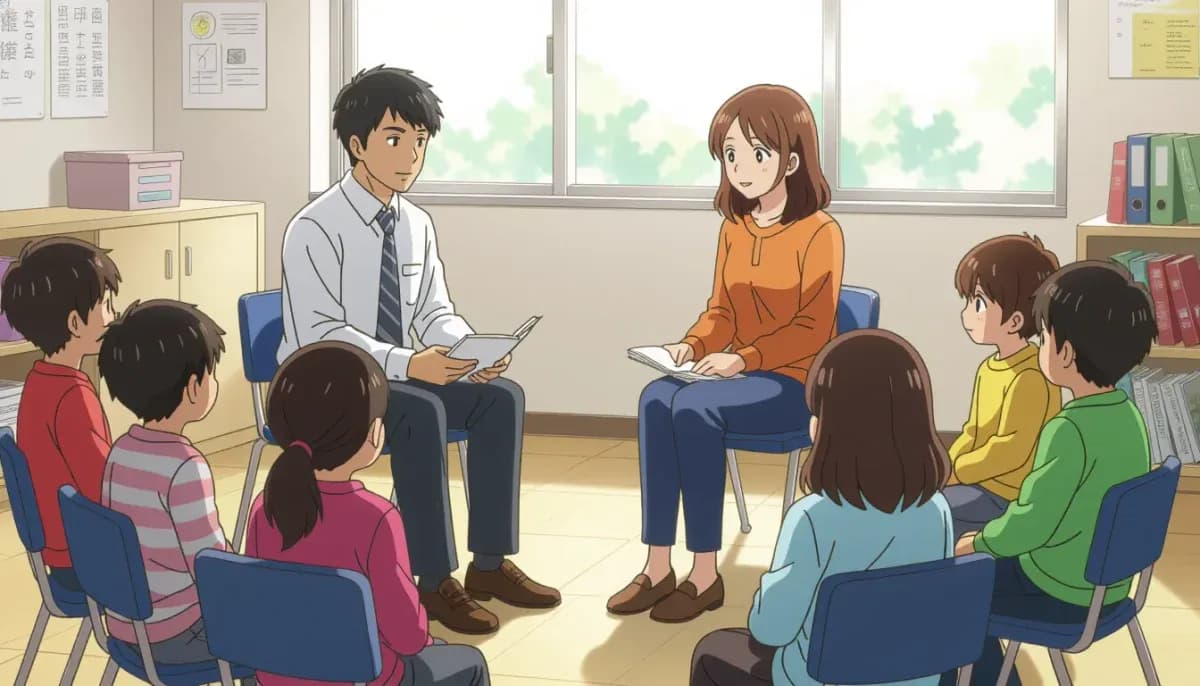
The Role of Teachers in Preventing Bullying in Japan
Learn how Japanese teachers prevent and respond to bullying (ijime). Understand the 2013 law, teacher responsibilities, systemic barriers, and what foreign parents can do.
Read more →
Bullying of Foreign Children in Japanese Schools
Foreign children in Japan face a 52.2% bullying rate if they speak a non-Japanese language at home. Learn the warning signs, how to report ijime, and what resources are available to protect your child.
Read more →