Emergency Preparedness and Child Safety in Japan: The Complete Guide for Foreign Families
Japan is one of the most disaster-prone countries in the world. Earthquakes, typhoons, tsunamis, floods, and volcanic eruptions are part of daily life here — not distant possibilities. As a foreign parent raising children in Japan, understanding emergency preparedness is not optional. It is one of the most important things you can do for your family's safety.
The good news is that Japan is also a world leader in disaster preparedness infrastructure, public education, and emergency response systems. When you know how the system works and take a few key steps in advance, you and your children can be ready for almost anything.
This guide covers everything foreign families need to know: earthquake safety, typhoon preparation, emergency kits, school policies, useful apps, and how to build a family action plan that actually works.
Understanding Japan's Disaster Landscape
Japan experiences around 1,500 earthquakes per year, with dozens strong enough to be felt. The country sits on four tectonic plates and has more than 100 active volcanoes. Typhoon season runs from June to October, bringing heavy rain, strong winds, and flooding. In coastal areas, tsunamis are a real threat following large offshore earthquakes.
Despite all this, Japan has one of the lowest disaster fatality rates in the world per capita. This is because disaster preparedness is embedded into the national culture, school curriculum, and urban planning. Annual drills, hazard maps, early warning systems, and multilingual alert infrastructure are all standard.
However, international residents are often the least prepared. A 2025 survey by Macromill found that 72.8% of parents with children worried about confirming the safety of family members during a major disaster — the highest concern of any household type. And a 2019 Bandai survey of 900 families found that only 5.9% of households with children had thoroughly discussed emergency meeting places and contact methods. If you have not had this conversation with your children yet, now is the time.
Step 1: Build Your Family Emergency Plan
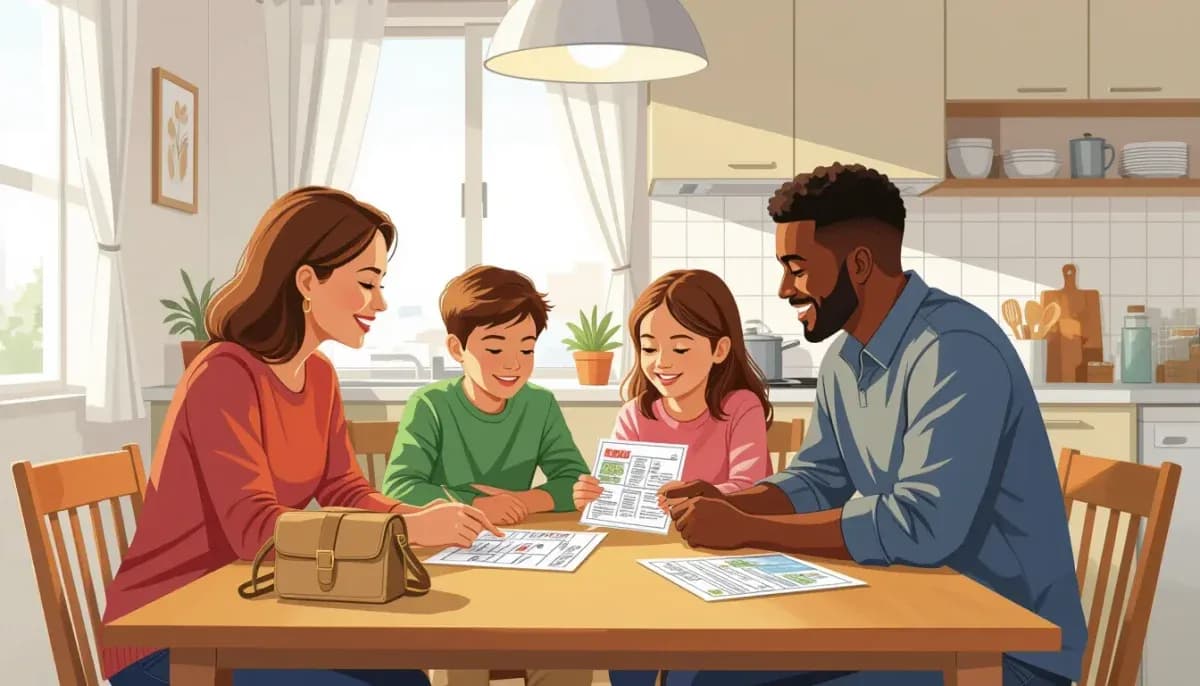
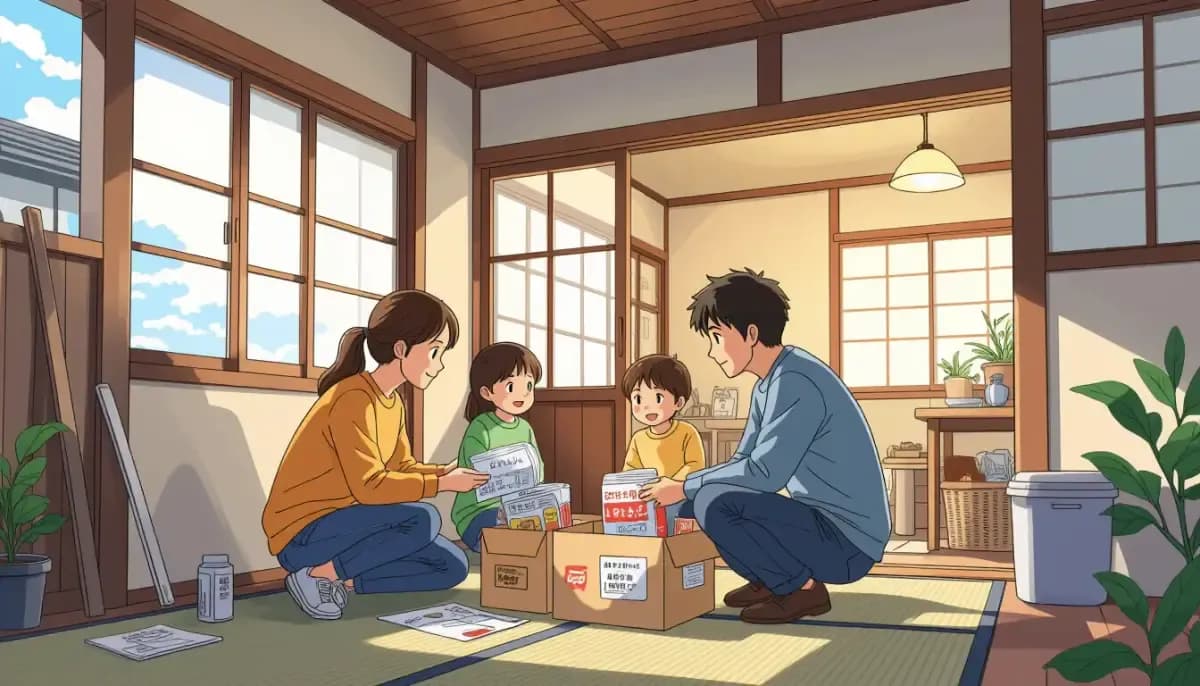
Before buying a single item for an emergency kit, you need a family communication and action plan. This is the foundation of all disaster preparedness.
Designate Gathering Points
Choose two meeting locations:
- Nearby (in-neighborhood): A specific spot within walking distance of your home — a park corner, a neighbors' building entrance, or a convenience store. Use this if a disaster happens when everyone is nearby.
- Farther away: A local evacuation center (避難所, hinanjo) or your children's school. Use this if the disaster is serious and you are separated.
A useful tip from experienced expat families in Tokyo: designate the genkan (entrance hall) as your in-home gathering point during an earthquake. Unlike other rooms, it has no large windows and is structurally reinforced — less risk of broken glass and falling debris.
Decide Who Stays, Who Walks
If one parent is at home with the children and the other is at work, agree in advance on what happens:
- The parent at home stays put with the children and leaves a note on the door with time, names, and destination.
- The parent away walks home if transit stops (trains will halt automatically in earthquakes above a certain level).
- Never both go searching — you can miss each other and both end up lost.
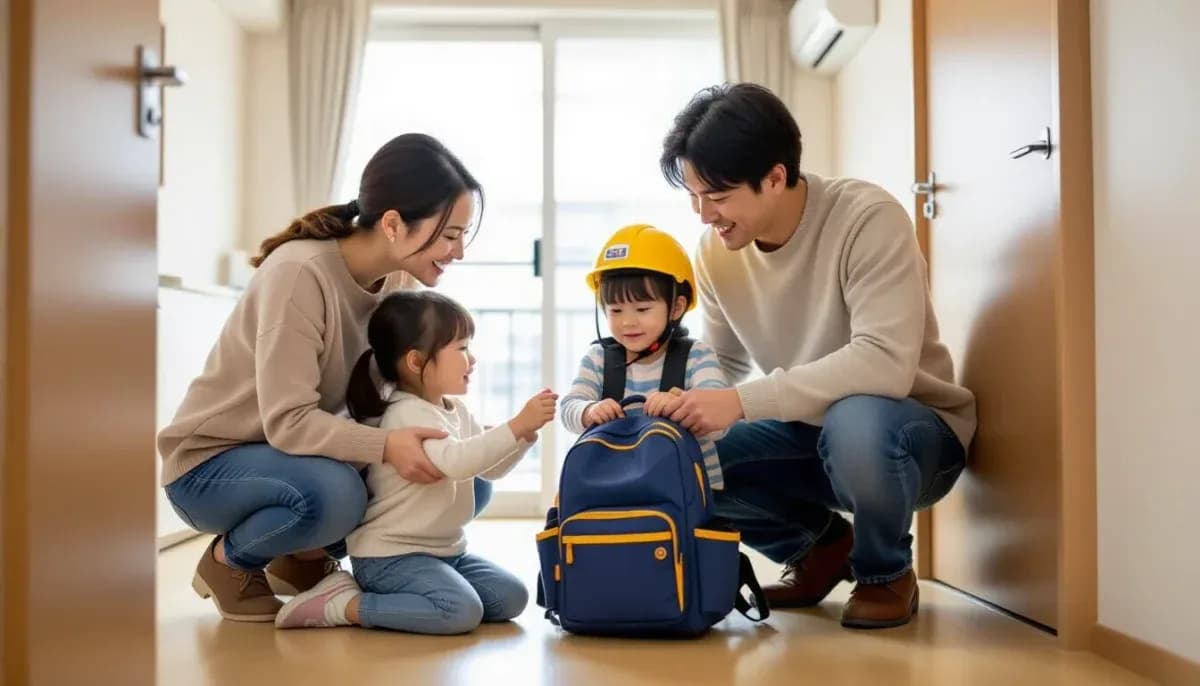
Teach Your Children the Plan
Only 22.7% of children in Japan know where their family's emergency supplies are stored, despite 46.7% knowing the supplies exist. Make sure your children know:
- The family gathering points
- Each parent's mobile number (memorized, not just in a phone)
- Their home address in both English and Japanese
- What to do at school if an earthquake happens
Consider making a small help card for each child's backpack with emergency contacts, key addresses, medical information, and your children's names in Japanese. This is essential if first responders cannot communicate in English.
Step 2: Pack Your Emergency Bags (Bōsai Baggu)
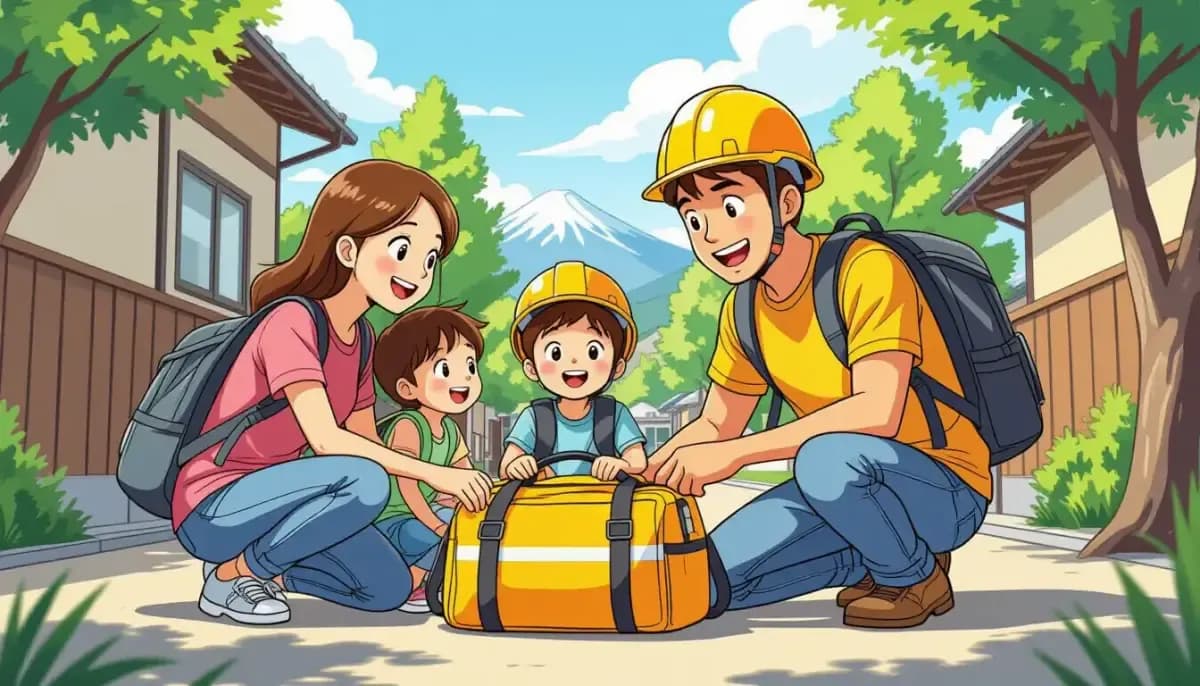
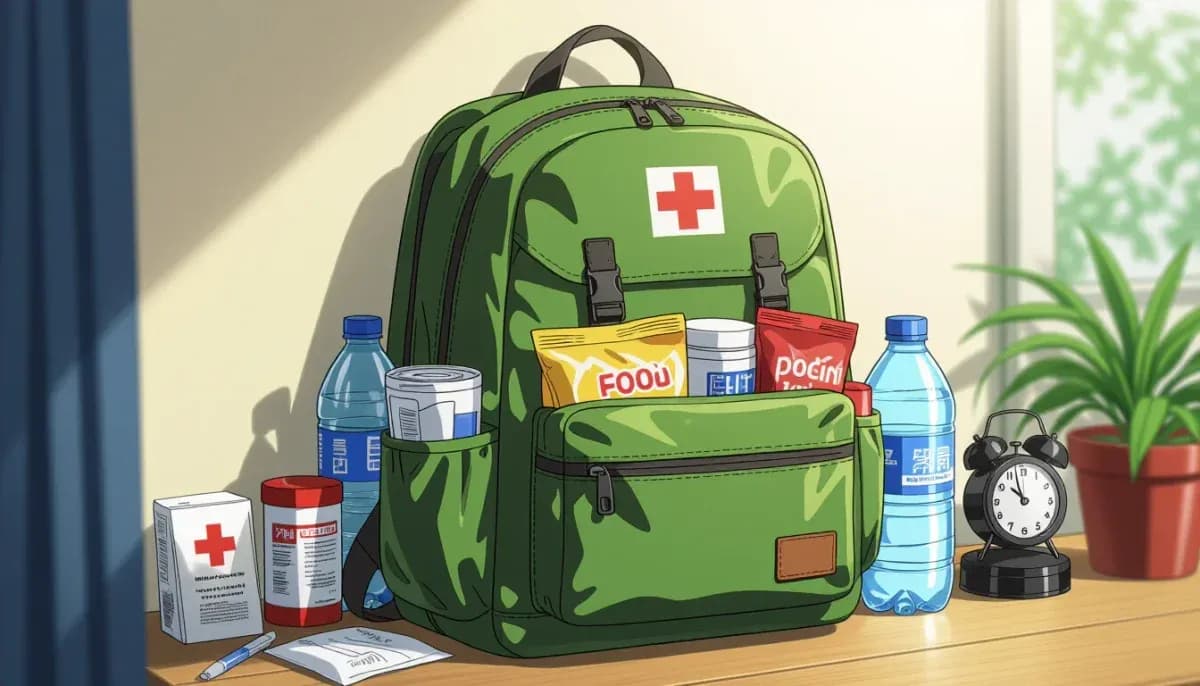
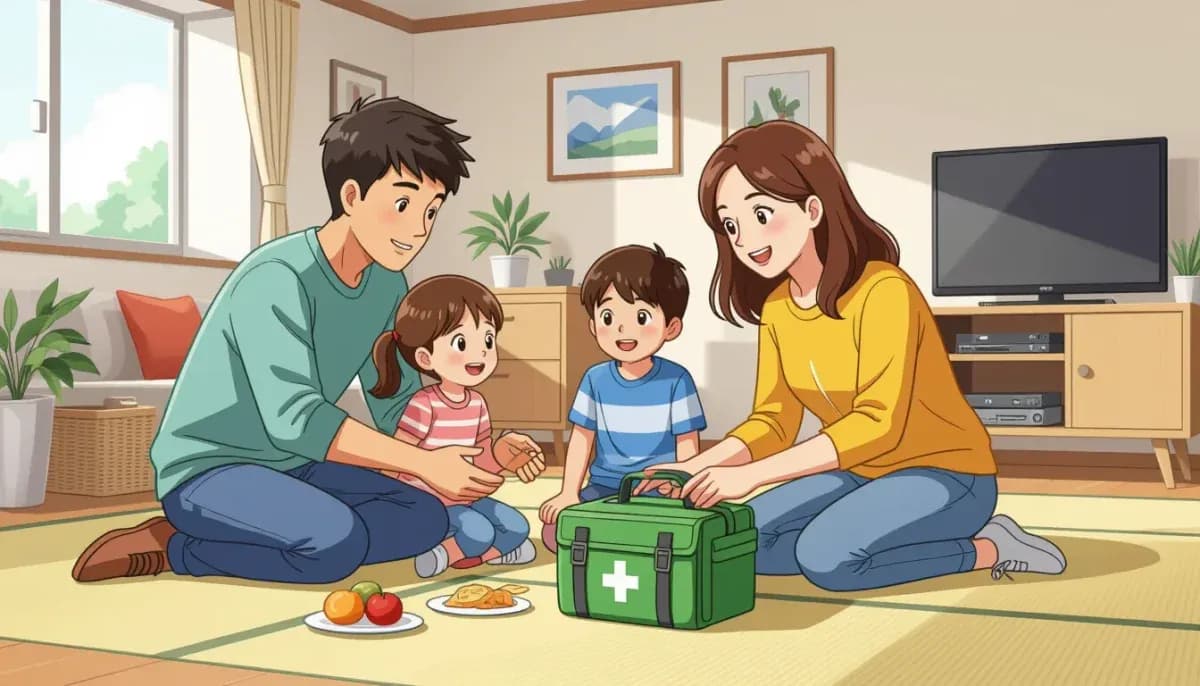
Every family in Japan should have a bōsai baggu (防災バッグ, emergency preparedness bag) for each member of the household. This is a bag you can grab in 30 seconds and walk out the door with.
Keep it near the front door or in the genkan.
Essential Items for Families with Children
| Category | Items |
|---|
| Water | 1 liter per person per day (3-day minimum); foldable water containers |
| Food | Instant rice packets, energy bars, powdered soup, snacks children like; for infants: powdered milk, disposable bottles, paper cups |
| Power & Lighting | Portable battery (charged), hand-crank or solar charger, flashlight, spare batteries |
| First Aid | Basic first aid kit, personal medications, fever reducers (children's), thermometer |
| Documents | Passport copies, residence card (zairyu card), health insurance card copies, in waterproof pouch |
| Cash | ¥10,000–¥50,000 in small bills; 10-yen and 100-yen coins for public pay phones |
| Tools | Whistle, work gloves, dust masks, duct tape, rope, multitool |
| Children's items | Comfort toys, small books, coloring materials, spare change of clothes |
| Communication | Pen and paper, printed emergency contact list, local hazard map |
Why coins? Public pay phones in Japan are maintained as emergency infrastructure. During disasters, they often work when mobile networks are congested. The 10-yen coin is the key denomination.
Pre-packaged bōsai bags are sold at Japanese hardware stores (ホームセンター), drugstores, and online. These are a good starting point — supplement them with items specific to your family's needs.
For more detailed guidance on emergency supplies for families, Living in Nihon covers relocation and daily life topics for international residents in Japan.
Step 3: Know Your Local Evacuation Routes and Centers
Every neighborhood in Japan has designated evacuation centers (避難所, hinanjo). These are typically schools, community centers, or sports facilities that open during disasters to provide shelter, food, water, and information.
How to Find Your Evacuation Center
- Your city/ward office website: Search "[your city name] 避難所 map" or visit the disaster preparedness page (防災, bōsai) of your local government website.
- Hazard maps (ハザードマップ): These show flood zones, tsunami inundation areas, and landslide risks in your neighborhood. Available free from your city office or online at the national portal.
- Walking the route: Once you know your evacuation center, walk the route with your children at least once so they are familiar with it.
For foreign residents: Many major cities publish disaster preparedness materials in English, Chinese, Korean, and other languages. Tokyo's Metropolitan Government provides a comprehensive English booklet — Tabunka Tokyo is an excellent multilingual resource for residents.
Note that some evacuation centers in Japan may have limited facilities for families with infants or children with special needs. Ask your ward office in advance about facilities for:
- Breastfeeding and diaper changing
- Dietary restrictions
- Children with disabilities or medical conditions
Step 4: Essential Apps and Alert Systems
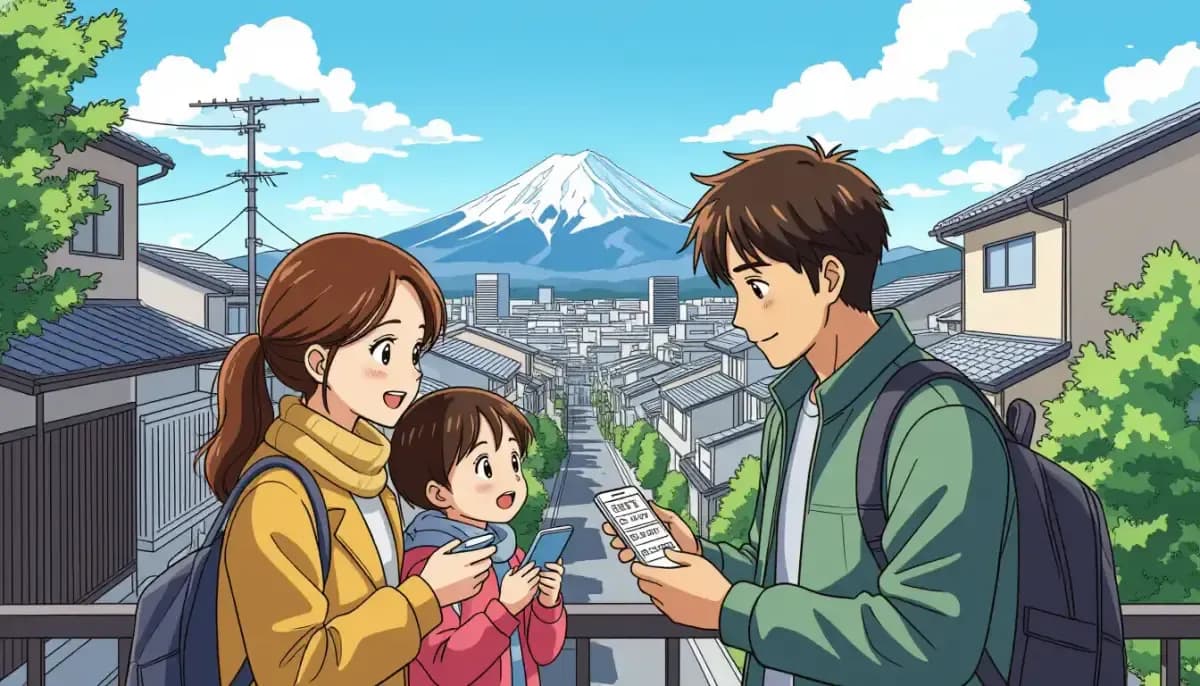
Japan's early warning and alert systems are excellent — but you need to opt into them.
Apps Every Foreign Family Should Have
Yurekuru Call (ゆれくる Call) The gold standard earthquake early warning app. It delivers alerts up to 30 seconds before shaking arrives at your location — enough time to take cover. Highly recommended by expat families throughout Japan.
Safety Tips (セーフティ チップス) The official multilingual disaster alert app from the Japan Tourism Agency. Available in English, Chinese, Korean, and other languages. Sends push notifications for earthquakes, tsunamis, typhoons, eruptions, and heavy rain warnings.
NHK World For real-time news in English during and after a disaster. NHK is Japan's public broadcaster and the most reliable source for disaster information — more reliable than social media, where misinformation spreads quickly after major events.
Yahoo! Bosai (Yahoo! 防災速報) Popular among Japanese residents for local-level alerts. The interface is in Japanese but covers granular alerts for your specific area.
Emergency Numbers
| Service | Number |
|---|
| Police | 110 |
| Ambulance / Fire | 119 |
| Japan Visitor Hotline (multilingual, 24/7) | +81-50-3816-2787 |
| Tokyo English Lifeline (TELL) | 03-5774-0992 |
| NHK World radio (disaster info) | Available via app and website |
During a major disaster, mobile phone lines get congested quickly. Use disaster message boards (災害用伝言板) available through NTT DoCoMo, au, and SoftBank — these work even when calls cannot get through. Set a code word with your family (such as your home address) so you can all post and check messages.
If you are a working parent, For Work in Japan has resources for international workers navigating Japanese workplace systems, including how Japanese companies handle disasters and employee safety.
Step 5: Understanding Your Children's School Disaster Policy
Japanese schools take disaster preparedness extremely seriously. Schools run regular bōsai drills throughout the year — for earthquakes, fires, and tsunami evacuations. Your children will learn how to drop-cover-hold, how to evacuate, and where the designated assembly points are.
What You Need to Know as a Parent
After an earthquake, do not immediately rush to your child's school. In Japan, schools hold students on site until a parent or registered guardian arrives to sign them out. Mass parental arrival at schools during a disaster can cause dangerous traffic and crowd situations.
Instead:
- Check the school's app or parent contact system (many schools use Classi, Schoolweb, or a dedicated parent app)
- Confirm shaking has stopped before traveling
- Walk to school if roads are blocked
Register your emergency contacts correctly. Japanese schools require you to list multiple emergency contacts in order of priority. Make sure the contacts listed can actually communicate in Japanese if needed, or include a bilingual emergency contact.
Ask about your school's pickup policy: Some schools require the parent to show ID; some will not release children to anyone not on the pre-registered contact list. Know this in advance.
For a comprehensive overview of how Japanese schools operate and their parent communication systems, see our guide on elementary school in Japan for foreign parents.
Step 6: Earthquake Safety Inside the Home
During an earthquake:
- Drop, cover, and hold on. Get under a sturdy desk or table. If no table is available, crouch near an interior wall, protect your head with your arms, and stay away from windows.
- Do not run outside during shaking. Most earthquake injuries happen from falling objects during exit attempts.
- Stay away from heavy furniture, bookshelves, and appliances that can topple.
Childproofing for earthquakes:
- Secure all bookshelves, wardrobes, refrigerators, and washing machines to the wall with L-shaped brackets (L字金具, available at any hardware store)
- Install furniture-securing straps (転倒防止ベルト) behind large items
- Use non-slip mats under furniture legs
- Move children's beds and play areas away from heavy objects and windows
- Install child-proof locks on cabinets to prevent dishes and breakables from falling out
The Japanese hardware chain Cainz and DCM sell extensive ranges of earthquake-proofing supplies specifically designed for residential use.
For families navigating healthcare and medical situations in Japan — including medical emergencies after disasters — see our complete guide on healthcare and medical care for children in Japan.
Step 7: Typhoon Preparedness for Families
Typhoon season (June–October) brings a different kind of threat: high winds, heavy rain, storm surge, and flooding. Unlike earthquakes, typhoons give advance warning — usually several days.
Typhoon Checklist for Families
Before the storm arrives:
- [ ] Stock 3+ days of food and water
- [ ] Charge all devices and power banks
- [ ] Withdraw cash (ATMs may be offline after a storm)
- [ ] Bring in or secure outdoor furniture, bikes, and strollers
- [ ] Tape or reinforce windows if wind speeds are forecast above 50 m/s
- [ ] Check your local hazard map for flood risk
During the storm:
- Stay inside — do not go out to see the storm
- Keep away from windows
- Monitor NHK World and Safety Tips for updates
- If flood warnings are issued for your area, move to upper floors
After the storm:
- Check for downed power lines before going outside
- Do not drive through flooded roads — even shallow water can sweep away a vehicle
- Check your building for damage before returning if you evacuated
Schools and offices in Japan often cancel classes and close when typhoons are forecast to pass directly overhead. Watch for announcements from your ward office and your children's school.
Building a Resilient Family Culture Around Safety
Disaster preparedness is not a one-time task — it is an ongoing conversation and habit. The most prepared families in Japan treat bōsai as a normal part of life, not a frightening topic.
Simple ways to build the habit with children:
- Do a family bōsai bag check twice a year (change the date on food and water, update children's clothing sizes)
- After school drills, ask children what they practiced and reinforce the concepts at home
- Involve older children in planning — give them roles (e.g., "you carry the flashlight")
- Walk your evacuation route together as a family outing
- Visit your local municipal bōsai fair — many cities hold annual disaster preparedness events with hands-on activities
The Japanese approach to disaster education is internationally admired. Schools use age-appropriate materials, roleplay, and games. Chuukou Benkyou — chuukoubenkyou.com — covers educational support resources for children in Japan across a range of topics.
For insights into the broader context of raising children safely in Japan and navigating mental health and emotional wellbeing, see our guide on mental health and emotional wellbeing for foreign children in Japan.
Key Resources at a Glance
| Resource | Language | What It Covers |
|---|
| Safety Tips App | Multilingual | All disaster alerts |
| Tabunka Tokyo Tsunagari | English + others | Disaster prep guide for foreign residents |
| Japan Living Guide - Emergency Bag | English | Bōsai bag packing guide |
| The Tokyo Chapter - Family Earthquake Plan | English | Expat family earthquake action plan |
| U.S. Embassy Emergency Preparedness | English | Official guidance for U.S. citizens |
| Tokyo Metropolitan Disaster Prep PDF | English | Comprehensive Tokyo guide |
| Tiny Tot in Tokyo - Earthquake Prep with Kids | English | Family-focused earthquake advice |
Final Thoughts
Japan's disaster risk is real, but the systems and resources available to residents are world-class. As a foreign parent, the most important things you can do are:
- Make a plan — designate gathering points, assign roles, teach your children
- Pack emergency bags — one per person, kept at the door
- Download the right apps — Safety Tips and Yurekuru Call at a minimum
- Know your evacuation center — walk the route with your family
- Talk to your children's school — understand the pickup policy before you need it
Disaster preparedness is ultimately about reducing uncertainty. The more you have planned in advance, the calmer and more effective you will be in the moment — and the safer your children will be.
For more on navigating life in Japan as a foreign parent, explore our full guide to the Japanese education system for foreign families and our overview of government benefits and subsidies for families in Japan.